 RxDown
Coming Off Benzodiazepines: The Ashton Manual Approach
⚕️ This article is education, not medical advice. Every claim is sourced below. Never stop or change medication without your prescriber — some medications are dangerous to stop abruptly.
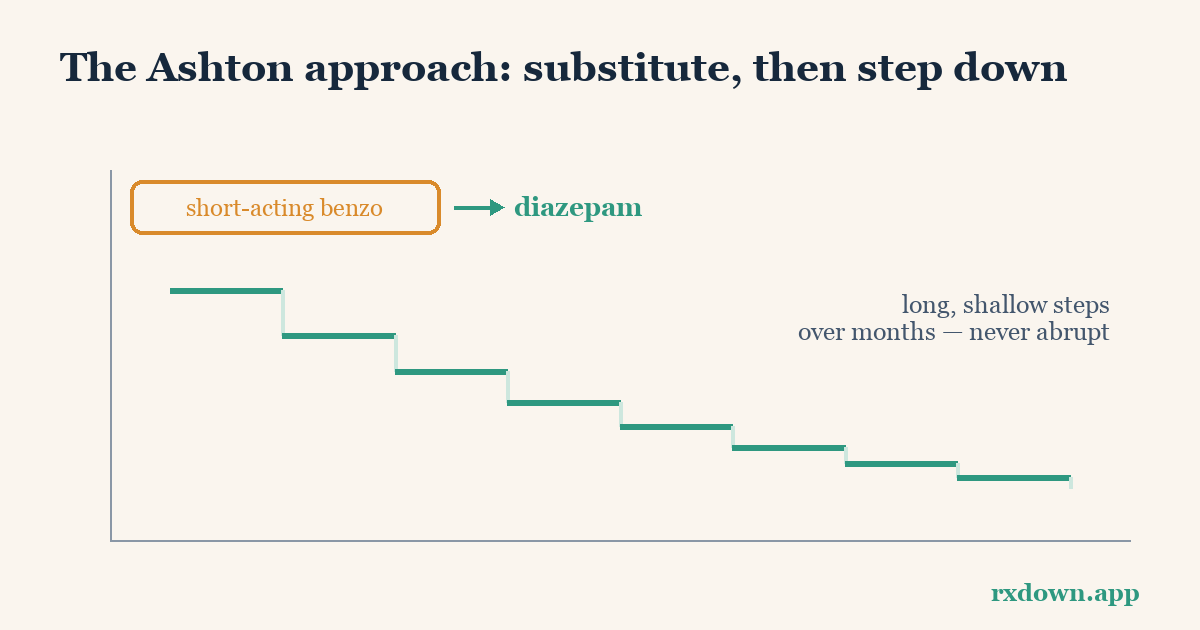
TL;DR: The Ashton Manual, written by Professor Heather Ashton and hosted free at benzo.org.uk, remains the most widely used patient guide for coming off benzodiazepines. Its core method is a slow, symptom-led dose reduction, often after switching to long-acting diazepam so drug levels fall smoothly. Benzodiazepines are one of the few medication classes where stopping suddenly can be medically dangerous—abrupt withdrawal after physical dependence can cause seizures—so any change should be gradual and supervised by your prescriber. The 2025 ASAM benzodiazepine tapering guideline is the modern clinical complement, recommending initial dose reductions of about 5–10% every 2–4 weeks, individualized to each person.
This is education, not medical advice. Benzodiazepine dose changes should always be planned and supervised by the prescriber who knows your history. Do not stop or reduce abruptly on your own. This article describes published approaches and dose ranges; it does not tell you what to take.
Who was Heather Ashton, and why does her manual matter?
Chrystal Heather Ashton (1929–2019) was a British clinical psychopharmacologist and professor at the University of Newcastle. From 1982 to 1994 she ran a dedicated benzodiazepine withdrawal clinic at the Royal Victoria Infirmary in Newcastle, working with hundreds of long-term users over those twelve years and closely following what actually helped them stop.
That clinical experience became Benzodiazepines: How They Work and How to Withdraw—first published in 1999, revised in 2002, and universally known as the Ashton Manual. It has been translated into 11 languages and is hosted free of charge at benzo.org.uk.
The manual matters for two reasons. First, it was one of the earliest documents to insist that benzodiazepine withdrawal should be paced by the patient, not imposed on a fixed clinic timetable. Second, in the absence of official guidance for many years, it filled a genuine gap—clinicians and patients alike used its withdrawal schedules because little else existed. It is a patient-derived, clinically informed resource rather than a formal evidence-graded guideline, and it is best read alongside modern guidance like the 2025 ASAM guideline and NICE.
What are the core principles of the Ashton Manual approach?
Three principles run through the whole manual:
- Gradual dose reduction. Cuts are small and spaced out so blood and tissue levels of the drug fall steadily. A steady decline gives the brain’s GABA system time to readjust, which keeps symptoms milder.
- Switching to a long-half-life agent (diazepam substitution). People on short-acting benzodiazepines are often switched, in stages, to diazepam because its long half-life smooths out the peaks and troughs that make tapering harder.
- A symptom-led pace. The person coming off the drug helps set the speed. If a reduction provokes strong symptoms, the plan pauses or slows; it does not push ahead on schedule. Ashton described this as handing control to the patient.
These same three ideas reappear, in more formal language, in NICE guidance and the 2025 ASAM guideline—evidence that Ashton’s clinical instincts have held up.
Why switch to diazepam before tapering?
Short-acting benzodiazepines clear the body quickly, so the drug level rises and falls sharply between doses. That produces “interdose” symptoms and makes very small reductions hard to feel out. Diazepam behaves differently: it has a long elimination half-life—roughly 20–48 hours, extended to around 100 hours by its active metabolite—so its level stays comparatively flat across the day. It is also available in low tablet strengths (such as 2 mg), and can be split, which lets you make the tiny reductions that matter at the end of a taper.
The switch itself is done gradually—one portion of the daily dose is converted at a time, using approximate equivalent doses, rather than swapping everything at once. The 2025 ASAM guideline notes the same logic, allowing that “tapering with very long-acting agents” is a reasonable strategy in the right circumstances. For the pharmacology behind why small proportional cuts get harder near the bottom, see our hyperbolic tapering guide and receptor occupancy explained.
How much of one benzodiazepine equals another?
Any switch to diazepam depends on rough equivalence figures. The table below lists the widely cited Ashton Manual approximations, with elimination half-lives from the ASAM pharmacokinetic reference for context. These values are approximate and vary between sources—different references and calculators give slightly different numbers, and individual factors (age, liver function, tolerance) shift them further. They are a starting point for a clinician, not a precise conversion.
| Benzodiazepine (brand) | Approx. dose equal to 10 mg diazepam | Elimination half-life | Duration class |
|---|---|---|---|
| Diazepam (Valium) | 10 mg (reference) | ~20–100 h (with active metabolite) | Long-acting |
| Alprazolam (Xanax) | 0.5 mg | ~6–12 h | Short/intermediate |
| Lorazepam (Ativan) | 1 mg | ~10–20 h | Intermediate |
| Clonazepam (Klonopin) | 0.5 mg | ~20–80 h | Long-acting |
| Temazepam (Restoril) | 20 mg | ~8–15 h | Short-acting |
The pattern is clear: alprazolam is the most potent per milligram of the group, which is one reason it is often singled out as difficult to come off. Because equivalence estimates differ, the ASAM guideline and NICE both stress that any conversion is individualized and should be handled by the prescriber.
How long does a benzodiazepine taper take?
Months, not weeks. This is the single point where the Ashton approach most often diverges from a hurried prescription.
- NICE guidance (NG215, 2022) states that withdrawal “may take 3–12 months or longer,” using reductions of roughly 5–10% every 1–2 weeks (or about an eighth of the dose per fortnight), slowing further at lower doses and titrating to symptoms.
- The 2025 ASAM guideline recommends generally starting with 5–10% dose reductions, spaced every 2–4 weeks, then adjusting the pace to what the individual tolerates. It also notes some people manage a faster taper (around 25% every 2–4 weeks) while others need to go much more slowly.
- The Ashton Manual’s own schedules frequently span many months and are explicitly presented as templates to be adapted, not rigid prescriptions.
The reason for the long horizon is biological, not a matter of willpower. Reductions that look small in milligrams can be large in terms of receptor effect near the end of a taper—the basis of hyperbolic tapering—so the last stretch usually has to be the slowest.
Why is stopping benzodiazepines suddenly dangerous?
This is the one class where stopping suddenly can be medically dangerous, and it deserves a plain statement: do not stop benzodiazepines abruptly after regular use. Along with alcohol and barbiturates, benzodiazepines act on the GABA system, and sudden removal after physical dependence leaves the brain in a state of dangerous overexcitation.
The Ashton Manual warns that abrupt or over-rapid withdrawal, especially from high doses, “can give rise to severe symptoms” including convulsions, psychotic reactions, acute anxiety states, “and even death.” The 2025 ASAM guideline puts it in clinical terms: clinicians “should avoid abruptly discontinuing” benzodiazepines in patients who are likely to be physically dependent. Seizure risk is highest with high-dose, long-term use and with short-acting agents, because they leave the body fastest and produce the sharpest withdrawal rebound.
The reassuring counterpoint is that dependence is not the same as addiction. The ASAM guideline estimates that only about 1.5% of people treated with benzodiazepines develop a benzodiazepine use disorder—physical dependence and withdrawal can occur even in someone taking the drug exactly as prescribed. That is precisely why a planned, supervised taper matters: it manages a predictable physiological process safely. If you have reduced too fast and symptoms are escalating, see hold and reinstate and contact your prescriber.
How is benzodiazepine withdrawal different from antidepressant withdrawal?
The two overlap in feel but differ sharply in danger. Antidepressant withdrawal is common and can be severe—a 2019 systematic review (Davies & Read, Addictive Behaviors, vol. 97) found that 56% of people who come off antidepressants experience withdrawal effects. But antidepressant discontinuation, however unpleasant (dizziness, brain zaps, mood swings), is not typically associated with seizures.
Benzodiazepine withdrawal is different in kind: it carries a genuine seizure and delirium risk. That is the core distinction. Both benefit from slow, hyperbolic tapering, but benzodiazepines are the class where the speed of stopping can be a medical emergency, not just a comfort issue.
| Antidepressants (SSRIs/SNRIs) | Benzodiazepines | |
|---|---|---|
| Withdrawal common? | Yes (~56% in Davies & Read, 2019) | Yes, after regular use |
| Seizure risk on abrupt stop? | Not typically | Yes—can be life-threatening |
| Recommended taper | Gradual, hyperbolic | Gradual, hyperbolic, supervised |
| Long, slow tail needed? | Often | Often |
For the antidepressant side in detail, see the antidepressant withdrawal timeline.
What is interdose withdrawal, and why does it happen?
Interdose withdrawal is the mini-withdrawal that surfaces between doses of a short-acting benzodiazepine, before the next dose is due. Because drugs like alprazolam and lorazepam clear quickly, the blood level can drop far enough during the day to provoke rebound anxiety, restlessness, or clock-watching for the next tablet—symptoms that can be mistaken for the original anxiety returning.
The Maudsley Deprescribing Guidelines (Horowitz & Taylor, 2024) describe two ways to manage it. One is to split the daily dose into two to four smaller doses to keep the level steadier and reduce interdose dips. The other is the Ashton strategy: switch to long-acting diazepam so the trough never gets deep enough to trigger symptoms in the first place. Recognizing interdose withdrawal for what it is—a pharmacokinetic dip, not relapse—can change the whole plan; see discontinuation vs relapse.
How does the 2025 ASAM guideline update the Ashton approach?
The Ashton Manual is a patient-experience-derived guide from the 1990s. The 2025 Joint Clinical Practice Guideline on Benzodiazepine Tapering (Brunner et al., Journal of General Internal Medicine) is its modern, evidence-graded complement, developed by the American Society of Addiction Medicine with ten professional societies spanning family medicine, internal medicine, psychiatry, neurology, geriatrics, addiction medicine, obstetrics and gynecology, psychiatric pharmacy, and medical toxicology.
Where the two align:
- Gradual, individualized tapering is the default; abrupt discontinuation is to be avoided in physically dependent patients.
- Symptom-led pacing—adjusting the rate to how the person tolerates each reduction—is explicit in both.
What the ASAM guideline adds:
- A concrete starting rate: generally 5–10% reductions, spaced every 2–4 weeks.
- A recommendation that clinicians reassess the risks and benefits of ongoing benzodiazepine use at least every 3 months.
- Support for adjuncts such as CBT and CBT for insomnia during a taper, and shared decision-making throughout.
Together with NICE NG215 and the Maudsley guidelines, these give clinicians a current, citable framework that echoes—rather than replaces—Ashton’s original insight that slow and patient-led wins.
What symptoms should I expect, and how long do they last?
Common benzodiazepine withdrawal symptoms include sleep disturbance, heightened anxiety and irritability, hand tremor, sweating, poor concentration, nausea, palpitations, headache, muscle pain and stiffness, and perceptual changes such as heightened sensitivity to light and sound. At high doses, more serious events—seizures and psychotic reactions—become possible, which is why supervision matters.
Most acute symptoms ease over the weeks after each reduction, but a minority of people experience protracted symptoms lasting months or, occasionally, longer—a pattern the 2025 ASAM guideline explicitly acknowledges. Recovery often comes in windows and waves: good spells interrupted by flare-ups, gradually trending toward stability. Sleep is frequently the last thing to settle; see sleep during withdrawal. If your benzodiazepine was prescribed for insomnia, the related class of sleeping pills has its own considerations in z-drugs dependence reduction.
Keeping a simple daily record—dose, symptoms, sleep, mood—turns a confusing experience into data you and your prescriber can act on. RxDown is a private withdrawal diary built for exactly this: it logs each step of a taper, charts symptoms over time, includes a taper calculator for planning reductions, and can generate a doctor report to bring to appointments. It supports the conversation with your clinician; it does not replace it. For help starting that conversation, see talking to your doctor about deprescribing, and browse common questions in our FAQ.
Sources
- Ashton CH, Benzodiazepines: How They Work and How to Withdraw (The Ashton Manual) (2002)
- Brunner E et al., Joint Clinical Practice Guideline on Benzodiazepine Tapering, Journal of General Internal Medicine (2025)
- American Society of Addiction Medicine, Benzodiazepine Tapering Clinical Practice Guideline (2025)
- NICE, Medicines associated with dependence or withdrawal symptoms (NG215) (2022)
- Horowitz M & Taylor D, The Maudsley Deprescribing Guidelines (Wiley-Blackwell, 2024)
- Davies J & Read J, A systematic review into the incidence, severity and duration of antidepressant withdrawal effects, Addictive Behaviors (2019)
- Chrystal Heather Ashton, obituary, The Lancet (2019)
- ASAM, Pharmacokinetic Properties of Benzodiazepines (2025)
Frequently asked questions
Is it dangerous to stop benzodiazepines suddenly?
Yes. Benzodiazepines are one of the few drug classes—alongside alcohol—where stopping abruptly after physical dependence can trigger seizures, delirium, and, rarely, death. Both the Ashton Manual and the 2025 ASAM guideline advise against abrupt discontinuation and recommend a gradual, medically supervised taper instead.
Why does the Ashton Manual recommend switching to diazepam?
Diazepam has a very long half-life, so its blood level falls smoothly between doses rather than producing the sharp peaks and troughs of short-acting drugs like alprazolam. It also comes in small tablet strengths that allow tiny reductions late in a taper. The switch is normally made gradually, one portion of the daily dose at a time.
How long does a benzodiazepine taper take?
Months, not weeks. The Ashton Manual and NICE both describe tapers that commonly run 3–12 months or longer, paced to how the person feels. There is no fixed schedule—the pace usually slows further as the dose gets low.
Tracking your dose, sleep, and symptoms makes every conversation in this article easier. RxDown is a free diary built for exactly that. Get RxDown · Free taper calculator