 RxDown
Holding and Reinstating a Taper: When Withdrawal Flares
⚕️ This article is education, not medical advice. Every claim is sourced below. Never stop or change medication without your prescriber — some medications are dangerous to stop abruptly.
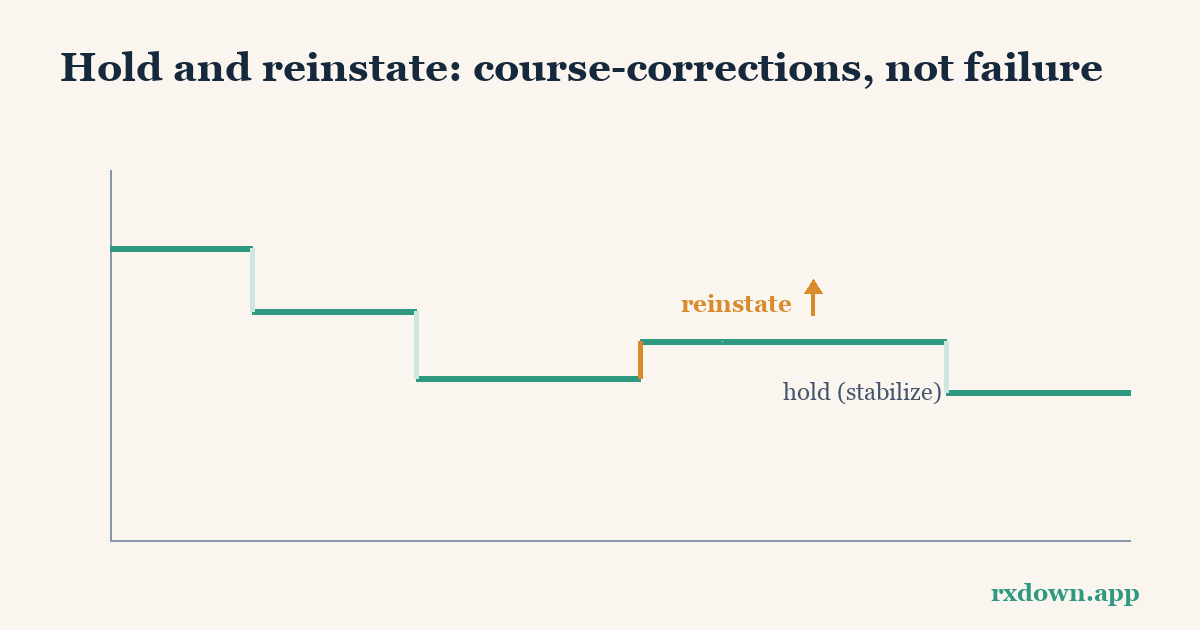
TL;DR: Holding means staying at your current dose until withdrawal symptoms settle before you reduce again; reinstatement means going back up—usually to your last tolerated dose, or to a small partial dose. Both are standard, planned tools in modern deprescribing, not signs that your taper failed. For acute withdrawal, reinstatement often eases symptoms within about a week; clinical practice favors doing it promptly, and after long gaps the response is less predictable. If symptoms flare, the usual advice is to stabilize first, then restart the taper more slowly with smaller steps.
This article is education, not medical advice. Every change to a psychiatric or sleep medication should be planned and supervised by the prescriber who knows your history. Do not stop a medication abruptly and do not change your dose on your own—abrupt changes are the single most common trigger for severe withdrawal. The dose figures below describe published approaches for recognition; they are not instructions for you.
What does “holding” mean in a taper?
Holding means keeping your dose the same for a while instead of taking the next planned reduction. You “pause the descent,” give your nervous system time to re-adapt to the current level, and wait until you feel stable again before you continue.
It helps to picture a taper as a staircase rather than a slide. Each step down is a small stress that the brain adjusts to over days or weeks. A hold is simply standing on one step longer than the schedule suggested—because the last step was harder than expected, or because life stress, illness, or poor sleep has stacked on top of it. Holding is built into the leading deprescribing frameworks. The Maudsley Deprescribing Guidelines (Horowitz & Taylor, 2024) frame tapering as symptom-led, adjusting the pace to what the person can tolerate rather than forcing a fixed timetable.
Holding is different from stopping. You are not abandoning the taper; you are choosing a stable dose as a temporary base camp. Withdrawal is common enough that pauses are expected: a 2019 systematic review (Davies & Read, Addictive Behaviors, vol. 97, pp. 111–121) found that around 56% of people who came off antidepressants experienced withdrawal effects, and of those, about 46% described them as severe.
When is holding the right move?
Holding is generally the right first response when withdrawal symptoms rise after a reduction but are not overwhelming—the kind you can ride out with support while your system re-stabilizes. Rather than pushing to the next step “on schedule,” you stay put until the symptoms fade.
Published guidance points the same way. The Royal College of Psychiatrists’ patient resource Stopping Antidepressants advises reducing slowly and, if withdrawal symptoms become difficult, halting the reduction (or increasing the dose) until symptoms settle. NICE guideline NG222 (2022) similarly recommends tapering in stages while monitoring for both withdrawal symptoms and any return of the original condition, and slowing down if withdrawal is hard to tolerate.
Signs that a hold is worth discussing with your prescriber include: symptoms that clearly started or worsened within days of your last cut; a flare that is uncomfortable but stable; or a “wave” arriving during an otherwise good stretch (see windows and waves). Holding gives you information, too—if symptoms ease while you hold, that supports a withdrawal explanation rather than relapse, a distinction covered in discontinuation vs. relapse.
How long does a hold usually take?
Holds are symptom-led, not calendar-led, so the honest answer is: as long as it takes to feel stable, which is often measured in weeks rather than days. Framer’s 2021 account in Therapeutic Advances in Psychopharmacology—drawn from an online community that has supported thousands of people tapering—suggests that if withdrawal symptoms show no improvement after roughly a week, that is a signal to act rather than keep suffering, and that a taper should only resume once the person “has clearly stabilized.”
There is no single validated number here; durations are drawn from clinical experience and patient-community observation, not randomized trials. As a rough orientation only:
| Situation | Typical hold length (observed, not guaranteed) | What you’re waiting for |
|---|---|---|
| Mild flare after a step down | Days to ~2 weeks | Symptoms fade, energy and sleep return |
| Moderate flare, stable | ~2–4 weeks or more | A clear stretch of feeling like yourself again |
| Repeated flares at each step | Weeks between steps, indefinitely | A reliably calm baseline before any further cut |
The practical rule most frameworks converge on: don’t take the next reduction while you still feel destabilized. Stacking a new cut on top of unresolved symptoms is what tends to turn a manageable flare into a severe one.
What is reinstatement, and how far do you go back up?
Reinstatement means increasing the dose again after symptoms have become too severe to simply hold through. In everyday clinical practice, this usually means returning to the last dose at which you felt well—your last tolerated dose. Both the RCPsych guidance and NICE NG222 describe increasing the dose until withdrawal symptoms resolve, then resuming the taper more gradually.
Reinstatement is a recognized, legitimate step, not a reset to zero. The point is to relieve genuine withdrawal quickly and protect your nervous system, then continue when you are stable. A 2022 review in BJPsych Advances (Horowitz & Taylor, vol. 28, pp. 297–311) reported that in discontinuation studies, withdrawal symptoms resolved within about a week of reinstating the antidepressant—much faster than a true depressive relapse tends to lift—which is one reason the speed of response can help distinguish the two.
The evidence base matters here. Rapid relief from reinstatement in acute withdrawal is supported by discontinuation studies and long clinical experience. For protracted withdrawal lasting many months, the picture is weaker: a 2025 systematic review of post-acute withdrawal syndrome (Rennwald et al., Epidemiology and Psychiatric Sciences) found the overall evidence sparse and of low certainty, with reported durations ranging widely (from about 1.5 to 166 months across studies) and no reliable evidence that reinstatement resolves long-standing symptoms. In other words: reinstatement is a reasonable, commonly used tool, but it is not a guaranteed fix in every case.
Why are small, partial reinstatements often preferred?
A key insight from deprescribing practice is that you may not need to go all the way back up. Because of how these drugs bind to their targets—the hyperbolic, saturating relationship explained in hyperbolic tapering—even a small dose can occupy a large share of receptors and take the edge off withdrawal. Horowitz & Taylor’s 2019 Lancet Psychiatry paper built tapering schedules around this idea, targeting roughly a 10% reduction in receptor occupancy per step rather than a 10% reduction in milligrams.
Framer (2021) describes this directly for reinstatement: rather than jumping straight back to a full dose, an initial small “probe”—she gives the example of about 1 mg of citalopram after stopping a 20 mg dose—often eases withdrawal, and she reports that a very low dose can be surprisingly effective even in long-standing cases. Two reasons drive the preference for going up by the smallest amount that works:
- Overshooting has its own cost. A large jump can bring back side effects and means more medication to taper off again later.
- Avoiding “kindling.” Framer warns that erratic, large swings in blood level—especially from skipping doses—can drive escalating sensitivity to future dose changes. Her blunt rule: never skip doses to taper.
This “smallest effective increase” approach reflects clinician and patient-community experience rather than large randomized trials, so it should be framed honestly as reasoned practice, not settled proof. Your prescriber will decide what and how much, based on your specific medication and history.
Does reinstatement work better if you do it soon?
This is a genuinely debated point, so it is worth labeling the evidence carefully. The consistent theme across guidance and community observation is that reinstatement is most reliable when done promptly, soon after symptoms appear—and becomes less predictable after a long gap off the medication.
The clinical logic: reinstatement replaces something the brain has been adapting to. The longer the gap, the more the nervous system may have already remodeled, so putting the drug back may not map cleanly onto the earlier state. RCPsych and NICE guidance both frame reinstatement as a prompt response to emerging withdrawal, and the 2022 BJPsych Advances review’s finding—symptoms resolving within about a week—describes reinstatement used relatively early.
Here is the honest evidence level:
- Well-supported: prompt reinstatement typically relieves acute withdrawal, often within days to a week.
- Clinical practice + patient-community observation (not RCT-proven): the belief that “sooner is better” and that reinstatement after long gaps is less dependable. This is drawn from prescriber experience and communities such as those Framer describes, not from head-to-head trials.
- Weak / uncertain: whether reinstatement helps established protracted withdrawal at all—the 2025 PAWS review found no reliable evidence either way.
None of this means a delayed attempt is pointless; it means the outcome is harder to predict, so it should be a considered decision with your prescriber rather than a solo experiment.
Hold vs. reinstate: a quick comparison
Both keep you on a symptom-led path; the difference is direction.
| Hold | Reinstate | |
|---|---|---|
| What you do | Stay at the current dose | Increase the dose (fully or partially) |
| When | Symptoms are up but tolerable | Symptoms are severe or not settling |
| Goal | Let the current step stabilize | Relieve withdrawal, then continue |
| Typical timeframe | Days to several weeks | Relief often within ~1 week for acute withdrawal |
| Evidence strength | Widely recommended; symptom-led | Strong for acute; sparse for protracted |
How do you decide with your prescriber?
Reinstatement and long holds are shared decisions, and they go better when you arrive with data rather than a general “I feel bad.” The most useful thing you can bring is a symptom timeline: when each dose change happened, what symptoms appeared, when they started and peaked, and how they track against the reductions.
Helpful things to have ready:
- Dates and doses for recent changes, so the pattern lines up against symptom onset.
- A symptom log with severity ratings—this helps separate withdrawal (usually starts within days of a cut, often eases on holding) from relapse (typically slower, weeks later, mirroring your original illness).
- What you’ve already tried—whether holding helped, and for how long.
For a fuller script on raising this productively, see talking to your doctor about deprescribing. Bringing a clear record shifts the conversation from persuasion to problem-solving, and it makes a slower, individualized plan—the kind NICE and RCPsych both endorse—easier for a prescriber to say yes to.
This is where a diary helps. RxDown is built for exactly this: log doses, symptoms, and sleep day by day, mark holds and reinstatements, and export a doctor-ready report so your prescriber can see the timeline at a glance. Its taper calculator can also model gentler, hyperbolic step sizes for the conversation.
How do you restart the taper after stabilizing?
Once you have stabilized—whether by holding or reinstating—the guidance is consistent: restart the taper more slowly and with smaller steps than before. A flare is information. It tells you the previous pace or step size was too much for you right now, so the sensible response is to shrink the steps, not repeat them.
Framer (2021) frames it plainly: resume “a more gradual taper” only once the person has clearly stabilized. Practical adjustments that appear across the deprescribing literature include:
- Smaller percentage reductions (for example, reducing by a smaller fraction of the current dose each time rather than a fixed number of milligrams).
- Longer intervals between steps, so each reduction fully settles before the next.
- Hyperbolic sizing at the low end, where receptor occupancy changes fastest and cuts feel disproportionately large—the tail of the taper often needs the smallest steps of all. See hyperbolic tapering and, for what recovery can look like over time, the antidepressant withdrawal timeline.
There is no prize for finishing fast. The aim is to reach the finish comfortably, and a slower restart is usually the shortest route there.
Holding is course-correction, not failure
It is worth naming the feeling directly, because it is nearly universal: many people experience holding or reinstating as personal failure—“I should be past this,” “I’ve gone backwards,” “I’ll never get off.” Those thoughts are understandable, but they misread what is happening.
A hold or a reinstatement is a course-correction, the same way a hiker who hits bad weather waits at a lower altitude instead of pushing to the summit. The destination hasn’t changed; the route has. The frameworks that most respect patients’ experience—the Maudsley Deprescribing Guidelines, RCPsych’s patient guidance, and Framer’s community-based account—all treat these as normal, expected parts of a well-run taper. Guilt tends to push people toward the two riskiest choices: powering through severe symptoms, or quitting abruptly out of frustration. Reframing the flare as feedback keeps you on the safe middle path.
If you take one thing from this guide: needing to hold or go back up doesn’t mean you can’t come off your medication. It usually means your body is asking for a gentler pace—and a gentler pace, agreed with your prescriber, is exactly what makes finishing possible. For more common questions, see the FAQ.
Sources
- Framer A., What I have learnt from helping thousands of people taper off antidepressants and other psychotropic medications, Therapeutic Advances in Psychopharmacology (2021)
- Horowitz M. A. & Taylor D., Tapering of SSRI treatment to mitigate withdrawal symptoms, Lancet Psychiatry (2019)
- Horowitz M. A. & Taylor D., Distinguishing relapse from antidepressant withdrawal: clinical practice and antidepressant discontinuation studies, BJPsych Advances (2022)
- Horowitz M. & Taylor D., The Maudsley Deprescribing Guidelines: Antidepressants, Benzodiazepines, Gabapentinoids and Z-drugs, Wiley-Blackwell (2024)
- Royal College of Psychiatrists, Stopping antidepressants (patient information)
- NICE, Depression in adults: treatment and management (NG222) (2022)
- Davies J. & Read J., A systematic review into the incidence, severity and duration of antidepressant withdrawal effects: Are guidelines evidence-based?, Addictive Behaviors (2019)
- Rennwald A. et al., Post-acute withdrawal syndrome (PAWS) after stopping antidepressants: a systematic review with meta-narrative synthesis, Epidemiology and Psychiatric Sciences (2025)
Frequently asked questions
Is holding or reinstating my medication a sign my taper failed?
No. In modern deprescribing practice, holding at a dose and going back up are planned tools for managing a withdrawal flare, not evidence of failure. Most people who need to hold or reinstate still finish their taper successfully by moving more slowly. The goal is a comfortable, symptom-led pace, not a fixed calendar.
How long should I hold before restarting the taper?
Holds are symptom-led rather than fixed. Clinicians usually suggest staying at the current dose until symptoms have clearly settled and you feel stable, which often takes several weeks. The Maudsley Deprescribing Guidelines and clinician-researcher Adele Framer both describe waiting for stabilization before resuming, then using smaller steps. Your prescriber decides timing with you.
Will reinstating my old dose make withdrawal symptoms go away?
For acute withdrawal, reinstatement often helps relatively quickly. A 2022 review in BJPsych Advances (Horowitz & Taylor) notes that in discontinuation studies, withdrawal symptoms resolved within about a week of reinstating the drug. For protracted withdrawal lasting months, the evidence is sparse and reinstatement is less predictable. Discuss the approach with your prescriber.
Tracking your dose, sleep, and symptoms makes every conversation in this article easier. RxDown is a free diary built for exactly that. Get RxDown · Free taper calculator