 RxDown
What Are Brain Zaps in Antidepressant Withdrawal?
⚕️ This article is education, not medical advice. Every claim is sourced below. Never stop or change medication without your prescriber — some medications are dangerous to stop abruptly.
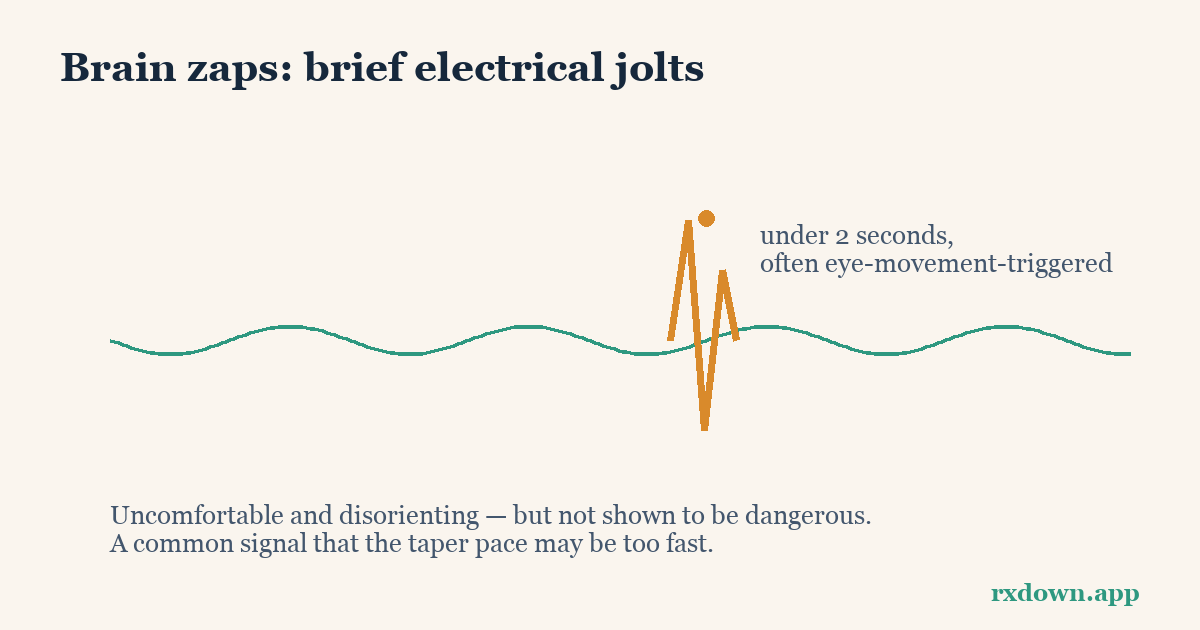
TL;DR: Brain zaps are brief, electric-shock or jolt-like sensations in the head that many people feel while reducing or stopping an antidepressant. They are frequently set off by moving the eyes or turning the head, are strongly linked to short half-life SSRIs and SNRIs like paroxetine and venlafaxine, and are not dangerous. The most reliable way to reduce them, according to published clinical guidance, is to taper more slowly or briefly return to the last dose that felt comfortable — a brain zap is usually a signal that the taper pace outran your nervous system, not that anything is broken.
This article is education, not medical advice. Antidepressants should be reduced or stopped only with the supervision of the prescriber who knows your history, and never by suddenly stopping. Nothing below is an instruction to change your own dose; it describes approaches that have been published so you can have a better-informed conversation with your clinician.
What are brain zaps?
“Brain zaps” is the patient-coined name for a symptom clinicians call an electrical or paresthesia-like phenomenon of antidepressant discontinuation. People describe them as a sudden jolt, buzz, flash, or “shiver” inside the head — as if a small current has passed through the brain. An episode is usually momentary, lasting a fraction of a second, and can arrive alone or in clusters over minutes or hours.
The sensation is often accompanied by other brief features: a wave of dizziness, a flicker in vision, a whooshing or ringing sound, or a split-second feeling of disorientation. In the first formal study of the symptom, Papp and Onton (Prim Care Companion CNS Disord, 2018) noted a handful of reports describing momentary, dissociation-like lapses in awareness alongside the zap, though for most people the experience is a startling but self-contained jolt.
Because the symptom is so hard to describe and rarely shows up on any test, people often worry they are imagining it or that something serious is wrong. They are not imagining it. Brain zaps are a recognized, documented part of the withdrawal picture — one entry in the broader antidepressant withdrawal timeline that can also include dizziness, flu-like feelings, insomnia, and mood changes.
Why does moving your eyes trigger a brain zap?
One of the most distinctive things about brain zaps is that they are often triggered by a specific movement — most commonly a lateral (side-to-side) flick of the eyes, or turning the head. Many people first notice this when glancing quickly to the side, scrolling, or looking around a room.
This eye-movement trigger was the standout, unexpected finding of the Papp and Onton research. In their 2018 analysis of 595 posts from a mental-health website, lateral eye movement was the single most frequently described trigger. Their larger 2022 follow-up (Prim Care Companion CNS Disord), which examined 3,141 questionnaire responses, made the link even clearer: of the 1,669 respondents who named a trigger, more than 1,000 pointed to eye or head movement — and they did so spontaneously, in open-ended answers, without being prompted with the idea.
That a physical movement so reliably provokes the sensation is one of the strongest clues that brain zaps have a genuine neurological basis rather than being purely psychological. What that basis actually is, however, remains unknown.
What does the research actually say?
The evidence base for brain zaps specifically is small and observational, and it is honest to say so. The two anchor studies are both from Papp and Onton, published in the Primary Care Companion for CNS Disorders in 2018 and 2022. Both draw on self-reported data from online communities rather than controlled trials, so they describe real patterns in what people experience but cannot establish cause, mechanism, or true frequency.
Key findings that have held up across both studies:
- Brain zaps cluster around abrupt discontinuation or dose reductions; gradual tapering reduced but did not always eliminate them.
- They are disproportionately reported with short half-life antidepressants — venlafaxine accounted for about 23% of the drug mentions in the 2018 sample, with paroxetine also overrepresented relative to how often it is prescribed, and sertraline appearing frequently as well.
- The time from last dose to first zap tends to track a drug’s half-life: symptoms start almost immediately with short half-life drugs and are delayed with long half-life drugs like fluoxetine.
- A minority reported significant disruption to daily life, with rare cases describing symptoms persisting for months or years.
Set against the wider withdrawal literature, the picture is one of genuine but contested frequency. A widely cited 2019 systematic review (Davies & Read, Addictive Behaviors) reported that around 56% of people coming off antidepressants experience withdrawal effects and that nearly half of those (46%) rate them as severe — though critics noted this drew heavily on online-survey samples that may skew high. A more conservative 2024 meta-analysis of 79 studies and 21,002 patients (Henssler et al., Lancet Psychiatry) estimated that, after subtracting placebo and expectation effects, roughly 15% (about one in six or seven) have discontinuation symptoms attributable to the drug, and about 3% have severe symptoms. Brain zaps sit somewhere inside that range as one specific symptom among many.
Which medications most often cause brain zaps?
The consistent theme across the research is half-life: the faster a drug clears from your body, the more sharply blood levels swing between doses and after a reduction, and the more likely withdrawal symptoms — including brain zaps — become. The 2024 Lancet Psychiatry meta-analysis independently flagged venlafaxine, desvenlafaxine, imipramine, and paroxetine among the drugs most associated with severe discontinuation symptoms, matching the short half-life pattern.
The table below lists approximate half-lives (which vary between individuals) alongside the general withdrawal risk pattern seen in the literature. Generic names are given first, with common brands for recognition.
| Medication | Class | Approx. half-life | Reported zap / withdrawal risk |
|---|---|---|---|
| Paroxetine (Paxil) | SSRI | ~21 hours | High |
| Venlafaxine (Effexor) | SNRI | ~5 hours (parent drug) | High |
| Desvenlafaxine (Pristiq) | SNRI | ~11 hours | High |
| Duloxetine (Cymbalta) | SNRI | ~12 hours | Moderate–high |
| Sertraline (Zoloft) | SSRI | ~26 hours | Moderate |
| Escitalopram (Lexapro) | SSRI | ~30 hours | Moderate |
| Fluoxetine (Prozac) | SSRI | days (active metabolite ~1–2 weeks) | Low / delayed onset |
Fluoxetine is the outlier: its very long half-life means it tapers itself off gradually even after the last dose, which is exactly why it appears less often in brain-zap reports and why clinicians sometimes use it deliberately (more on that below).
What causes brain zaps? Honest limits of the science
Here is the honest answer: there is no established mechanism. Brain zaps have never been directly measured in a laboratory, and no study has pinned down what physically happens during one. What follows are hypotheses, clearly labeled as such.
- Serotonergic effects on sensory processing. Because zaps track serotonergic drug withdrawal, the leading idea is that a sudden drop in serotonin signaling briefly destabilizes how the brain processes sensory and motor information — which could explain why a movement as ordinary as an eye flick can set one off. This is a plausible hypothesis, not a proven pathway.
- Neuronal excitability changes. Some researchers have speculated about transient shifts in cortical or brainstem excitability during withdrawal, sometimes drawing loose analogies to other electrical phenomena. These remain speculative.
- A neurological, not psychological, event. The reliable physical trigger (eye and head movement) argues strongly that something real and neurological is happening, even though the details are unknown.
Papp and Onton themselves described brain zaps as “barely examined and poorly understood,” and called for more research on both prevention and treatment. Anyone who tells you they know exactly what causes a brain zap is going beyond the current evidence. To understand why lowering a dose matters more than the raw milligram number, it also helps to read about receptor occupancy, which shapes how the brain “feels” each reduction.
Are brain zaps dangerous?
For almost everyone, no. Across the literature there is no evidence that brain zaps cause brain damage, seizures, or any lasting neurological injury. They are unpleasant and can be frightening precisely because they feel electrical and uncontrollable, but they are a self-limiting feature of the nervous system adjusting to a lower drug level.
What they should not be is ignored. A brain zap is best read as a signal — feedback that a dose reduction was bigger or faster than your brain was ready for. In that sense they are useful information for pacing a taper, in the same way that windows of feeling well and waves of returning symptoms map the windows and waves rhythm of recovery. If zaps are frequent, intense, or interfering with driving, work, or safety, that is a reason to slow down and talk to your prescriber, not to push through.
A separate, important question is telling withdrawal apart from a return of the original condition. Brain zaps are a distinctive discontinuation symptom rather than a symptom of depression or anxiety, which makes them one of the clearer clues in the harder puzzle of discontinuation versus relapse.
How long do brain zaps last?
The timeline has two layers: how long a single zap lasts (a fraction of a second) and how long the tendency to have them persists after a dose change.
For the second layer, most people find that zaps peak in the first days after a reduction or the last dose, then fade over roughly one to several weeks as the body settles. In the Papp and Onton data, among the reports that mentioned duration, about three-quarters had resolved within a year and roughly a third within a month. A minority, however, described a much longer course — occasionally many months — which was more common after short half-life drugs and after abrupt stops. Patient-support communities such as Surviving Antidepressants document these longer, protracted courses too; those are patient-reported accounts rather than controlled data, but they are consistent enough to take seriously.
The practical takeaway: if brain zaps are lingering or getting worse rather than easing, that usually points to a taper that is moving faster than your nervous system can absorb.
What helps brain zaps? Approaches and their evidence level
There is no medication proven to switch brain zaps off. The published approaches all work indirectly, by giving the brain a gentler change to adapt to. The table summarizes them with an honest read on evidence strength.
| Approach | What it involves | Evidence level |
|---|---|---|
| Slow / hyperbolic taper | Reduce in progressively smaller steps as the dose gets lower | Expert clinical view; the pacing method now recommended by NICE, from Horowitz & Taylor (2019) |
| Hold the current dose | Pause further reductions until symptoms settle before continuing | Standard clinical practice (Maudsley) |
| Reinstate the last tolerated dose | Briefly return, under supervision, to the dose at which you last felt well, then taper more slowly | Clinical practice / Maudsley guidance |
| Switch to fluoxetine (“fluoxetine bridge”) | Move from a short half-life drug onto long half-life fluoxetine, then taper that | Clinical literature; described in Maudsley — done only under supervision |
| Time / watchful waiting | Allow mild zaps to fade on their own | Observational and patient-reported |
| Omega-3 / other supplements | Sometimes tried by patients | Anecdotal only; no controlled evidence |
The idea behind hyperbolic tapering comes from Horowitz and Taylor’s 2019 Lancet Psychiatry paper, which argued that because the relationship between dose and serotonin-transporter occupancy is curved rather than straight, reductions should be sized to produce roughly equal, small steps in effect — about a 10% reduction in receptor occupancy per step — meaning ever-smaller milligram cuts as you approach zero. Their guidance, expanded in the 2024 Maudsley Deprescribing Guidelines, is explicit that if withdrawal symptoms like brain zaps become unbearable, the right response is to return to the previous dose and then reduce more gradually — not to power through.
The fluoxetine bridge deserves a plain explanation because people hear about it often. Because fluoxetine has such a long half-life, some clinicians switch a patient from a short half-life drug (like venlafaxine or paroxetine) onto fluoxetine and then taper the fluoxetine, borrowing its slow self-clearance as a built-in gentle descent. The Maudsley authors note this can help when the core problem is short half-life withdrawal, but also that the switch is trickier than textbooks suggest and must be supervised. It is a published option to discuss with a prescriber, not a self-help move.
If you want to sketch what smaller, evenly-spaced steps might look like for your situation before that conversation, our taper calculator can help you visualize the shape of a slower reduction. For a deeper walk-through of pausing and stepping back, see the hold and reinstate guide.
When should you talk to your prescriber?
Book a conversation if brain zaps are frequent, intense, lasting longer than a few weeks, worsening rather than easing, or affecting your ability to drive, work, or function safely. Also raise them if you are unsure whether what you are feeling is withdrawal or a return of your original symptoms — that distinction changes what to do next, and it is a clinician’s call, not something to settle alone.
It can be hard to be taken seriously about withdrawal, and Papp and Onton specifically noted that patients who felt dismissed were left frustrated. If you need help framing the discussion, our guide on talking to your doctor about deprescribing offers practical language, and our FAQ answers common questions about the process.
Keeping a simple daily record — which dose you are on, when you changed it, and how strong the zaps are — turns a vague “it’s been bad” into a clear pattern your prescriber can act on. This is where a tool like RxDown can help: it lets you log symptoms and dose changes over time and generates a shareable doctor report, alongside a taper calculator for planning gradual reductions, so the timing between a dose drop and a spike in symptoms is visible at a glance.
Brain zaps are common, uncomfortable, and almost never dangerous. Treated as a signal rather than a failure, they usually point to the same simple answer: go slower, and adjust the pace with the person prescribing your medication.
Sources
- Papp & Onton, Brain Zaps: An Underappreciated Symptom of Antidepressant Discontinuation, Prim Care Companion CNS Disord (2018)
- Papp & Onton, Triggers and Characteristics of Brain Zaps According to the Findings of an Internet Questionnaire, Prim Care Companion CNS Disord (2022)
- Horowitz & Taylor, Tapering of SSRI treatment to mitigate withdrawal symptoms, Lancet Psychiatry (2019)
- Horowitz & Taylor, The Maudsley Deprescribing Guidelines, Wiley-Blackwell (2024)
- Davies & Read, A systematic review into the incidence, severity and duration of antidepressant withdrawal effects, Addictive Behaviors (2019)
- Henssler et al., Incidence of antidepressant discontinuation symptoms: a systematic review and meta-analysis, Lancet Psychiatry (2024)
- Surviving Antidepressants (peer-support community), Brain zaps and jolts discussion (patient-reported)
Frequently asked questions
Are brain zaps dangerous or a sign of brain damage?
No. Brain zaps are a well-documented symptom of antidepressant discontinuation, not a sign of injury or seizure. They are uncomfortable and can be alarming, but there is no evidence they cause lasting harm. They are best understood as a signal that the nervous system is adjusting to a falling drug level, often because a dose reduction was larger or faster than your brain could keep pace with.
How long do brain zaps last after stopping an antidepressant?
For most people they fade within a few weeks, with the worst intensity in the first days after a dose drop. In one analysis of reports, roughly three-quarters resolved within a year and about a third within a month. A minority describe zaps persisting for months or longer, more often after short half-life drugs like paroxetine or venlafaxine.
What is the fastest way to stop brain zaps?
The most reliable published approach is to slow down: hold your current dose until symptoms settle, or, with your prescriber, briefly return to the last dose at which you felt well and then taper more gradually. Brain zaps usually respond to the taper pace rather than to any specific pill. Do not make dose changes on your own.
Tracking your dose, sleep, and symptoms makes every conversation in this article easier. RxDown is a free diary built for exactly that. Get RxDown · Free taper calculator