 RxDown
Z-Drugs (Ambien, Lunesta): Dependence and Safe Reduction
⚕️ This article is education, not medical advice. Every claim is sourced below. Never stop or change medication without your prescriber — some medications are dangerous to stop abruptly.
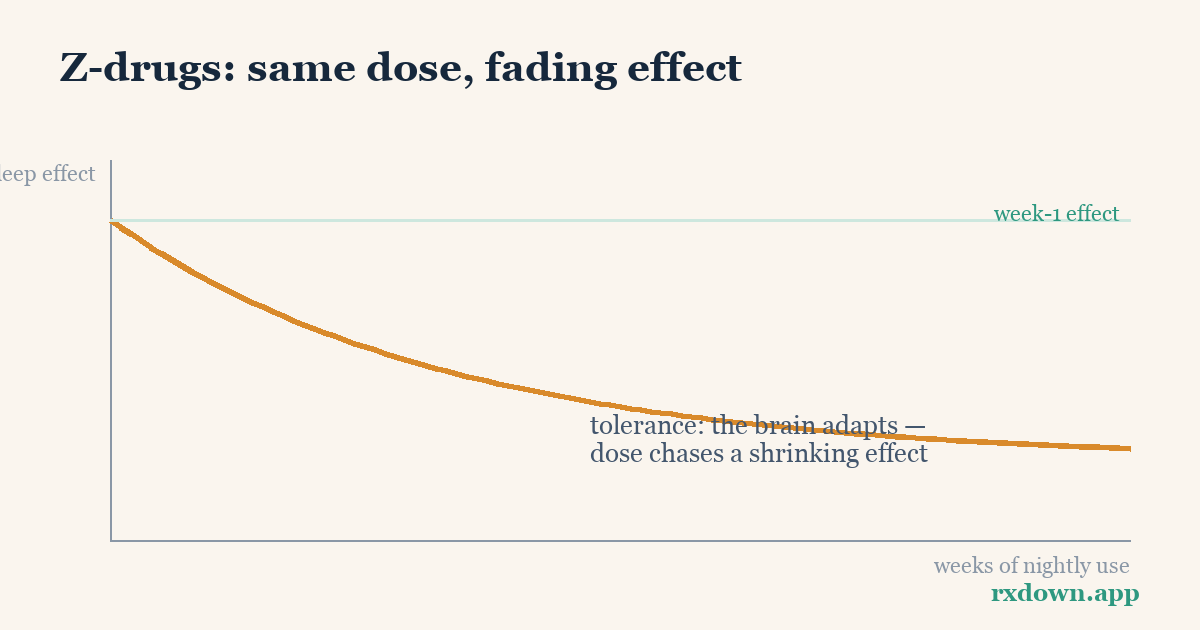
TL;DR: Z-drugs (zolpidem/Ambien, zopiclone and eszopiclone/Lunesta, zaleplon/Sonata) were marketed as a cleaner alternative to benzodiazepines, but they act on the same GABA-A receptor system and can cause tolerance, dependence, withdrawal, and rebound insomnia. They are intended for short-term use, yet studies show a large share of users continue for months or years. The safest way off them is a gradual, prescriber-supervised reduction — with diazepam substitution reserved for difficult cases per the Ashton approach — while switching the underlying treatment to cognitive behavioral therapy for insomnia (CBT-I), the guideline-recommended first-line option. This article is education, not medical advice; never stop a sleep medication abruptly, and make any changes with your prescriber.
What are Z-drugs, and how do they actually work?
“Z-drugs” is the informal name for a group of non-benzodiazepine hypnotics whose generic names happen to start with Z: zolpidem (Ambien, Ambien CR, Edluar, Intermezzo, Zolpimist), zopiclone (Imovane, Zimovane) and its active isomer eszopiclone (Lunesta), and zaleplon (Sonata). They were introduced in the late 1980s and 1990s and heavily promoted as structurally different from benzodiazepines — and chemically, they are. Zolpidem is an imidazopyridine; zaleplon a pyrazolopyrimidine; zopiclone a cyclopyrrolone.
The marketing message was that being chemically different meant being safer. Pharmacologically, that claim is only partly true. Z-drugs are positive allosteric modulators of the GABA-A receptor — the same inhibitory neurotransmitter system that benzodiazepines act on. They bind at or very near the benzodiazepine site and enhance the effect of GABA, the brain’s main “slow down” signal. The main difference is selectivity: zolpidem and zaleplon bind preferentially to GABA-A receptors containing the α1 subunit (associated with sedation), while zopiclone and eszopiclone act more broadly. This selectivity is why Z-drugs are marketed mainly for sleep rather than as daytime anxiety drugs — but it does not remove the shared risks of tolerance, dependence, and withdrawal. As the Ashton Manual puts it, zopiclone and zolpidem “although not benzodiazepines, act in the same way and have the same adverse effects including dependence and withdrawal reactions.”
The practical takeaway: think of Z-drugs as pharmacological cousins of benzodiazepines, not as a fundamentally different class. If you are also managing a benzodiazepine, the Ashton-method benzodiazepine tapering guide covers the shared framework in more depth.
Are Z-drugs addictive? What the evidence says about tolerance and dependence
This is where the evidence needs to be read honestly, because different study designs point in somewhat different directions.
The early, influential view came from Hajak and colleagues (Addiction, 2003), who reviewed the world literature of case reports and concluded that zolpidem and zopiclone were “relatively safe,” with dependence appearing mainly in people who had a prior history of substance abuse or psychiatric illness. That review, however, was based on published case reports — a design that can only describe patterns, not measure how often dependence occurs in the general population.
Later pharmacovigilance data painted a less reassuring picture. Schifano and colleagues (International Journal of Neuropsychopharmacology, 2019) analyzed the European Medicines Agency’s EudraVigilance database and found tens of thousands of adverse-reaction reports linked to Z-drug misuse, abuse, dependence, and withdrawal — thousands of them classified as substance-use disorder. Their work was among the first to give systematic, large-scale signals that Z-drug dependence is not merely anecdotal.
So the fair summary is:
- Tolerance (needing more for the same effect) and physical dependence (withdrawal on stopping) can both develop with regular use, and are more likely at higher doses and longer durations.
- The population-level dependence risk may be somewhat lower than for classic benzodiazepines, but it is real, not negligible.
- Risk is concentrated in people with a history of substance use or other psychiatric conditions — but ordinary long-term therapeutic users can still experience dependence and difficult discontinuation.
Note the evidence strength: much of what we know about severe Z-drug dependence comes from case reports and spontaneous adverse-event databases (which capture harms but not denominators), while the safety reassurances often came from manufacturer-funded short trials. Neither design is the last word. Patient-community reports of protracted, difficult withdrawal exist too, and should be treated as real experiences to investigate rather than as measured incidence rates.
How common is long-term Z-drug use beyond the label?
Z-drugs are approved and intended for short-term treatment of insomnia — typically framed as days to a few weeks. In practice, long-term use is common.
A retrospective cohort by Shayegani and colleagues (PLoS One, 2018) found that among Iraq and Afghanistan veterans prescribed zolpidem, 77.3% had long-term exposure, with an average of 189 days’ supply — far beyond the short-term label. Population studies in older adults have similarly found that the majority of people who start a Z-drug end up using it for well beyond four weeks. The point is not that every long-term user is harmed, but that “short-term only” is frequently not what happens once a prescription starts — which makes a planned exit strategy important from the beginning.
If you have been on a Z-drug for months or years, that does not mean something has gone wrong with you. It means you are in the common situation these medications tend to create, and a structured reduction plan is the appropriate response.
What is rebound insomnia, and how long does it last?
Rebound insomnia is a temporary worsening of sleep to below your normal baseline after stopping a sleep medication — a few nights that feel worse than your insomnia did before you ever started. It happens because the brain has adapted to the drug’s presence, and removing it abruptly leaves the sleep-regulating system briefly over-aroused.
Key features supported by the discontinuation literature:
- Rebound tends to appear within 1–4 nights of stopping, timed to the drug’s half-life (zaleplon and zolpidem are very short-acting; zopiclone and eszopiclone last a little longer).
- In people who used the drug short-term, rebound often peaks early and resolves within about a week.
- Longer-term or higher-dose users may experience a more prolonged and uncomfortable adjustment.
- Crucially, gradual reduction largely prevents rebound — tapered discontinuation behaves much more like placebo than abrupt stopping does.
This is the central reason clinicians taper rather than stop cold: it converts a sharp, frightening rebound into a gentler adjustment. Distinguishing rebound (temporary, settles) from a return of your original insomnia (persistent) matters — our guide on telling withdrawal apart from relapse and the sleep-during-withdrawal guide go deeper on managing the sleep-specific piece.
How are Z-drugs reduced safely?
There is no single universal schedule, and the details belong to you and your prescriber. But the published approaches share a common shape.
1. Gradual dose reduction (the usual first approach). For most people, the standard method is to reduce the dose in steps, allowing time at each step for the nervous system to re-adapt before the next reduction. Reductions are often proportional (a percentage of the current dose) rather than fixed milligram cuts, so that the steps get smaller as the dose gets lower — the same logic behind hyperbolic tapering. Because Z-drug tablets come in limited strengths, prescribers may use alternate-night dosing, split tablets, or a liquid/compounded formulation to make small final steps possible. Slower is generally better tolerated than faster; there is no prize for speed.
2. Diazepam substitution (the Ashton approach, for difficult cases). For people who struggle to taper directly — often because the very short half-life of zolpidem or zaleplon produces sharp inter-dose withdrawal — the Ashton Manual describes substituting to an equivalent dose of diazepam, a long-half-life benzodiazepine, and then tapering the diazepam slowly. The long half-life smooths out the peaks and troughs that make short-acting drugs hard to come off. Ashton treats the short-acting Z-drugs like short-acting benzodiazepines for this purpose. This is a specialist strategy, not a default, and the substitution itself should be done cautiously and under supervision.
Ashton’s published approximate equivalences (all relative to 10 mg diazepam) are shown below. Read the caveats carefully — these are clinical estimates, not precise conversions.
| Z-drug | Approx. dose equivalent to diazepam 10 mg | Half-life |
|---|---|---|
| Zopiclone (Imovane/Zimovane) | 15 mg | ~5–6 hours |
| Zolpidem (Ambien/Stilnox) | 20 mg | ~2 hours |
| Zaleplon (Sonata) | 20 mg | ~1–2 hours |
| Eszopiclone (Lunesta) | Not in Ashton’s original table (S-isomer of zopiclone) — estimate individually | ~6 hours |
Important caveats on the table above:
- These equivalences are approximate and based on clinical experience; the Ashton Manual explicitly warns that “dose equivalents vary between authors” and between individuals.
- Eszopiclone (Lunesta) is the active enantiomer of zopiclone and does not appear in Ashton’s original table; any equivalence for it must be estimated by the prescriber.
- Equivalences describe substitution math, not a recommended dose. This guide does not tell you what to take — that is a decision for you and your prescriber. You can explore proportional step patterns with the taper calculator, but treat its output as a conversation starter for that appointment, not a prescription.
What is the FDA boxed warning on complex sleep behaviors?
On April 30, 2019, the U.S. FDA required its most prominent safety label — a Boxed Warning — for eszopiclone (Lunesta), zaleplon (Sonata), and zolpidem (Ambien and related brands), because of rare but serious injuries from complex sleep behaviors: sleepwalking, sleep-driving, and doing other activities (cooking, making calls, even leaving the house) while not fully awake and with no memory of it afterward.
The FDA stated that over the preceding 26 years it had identified 66 cases of complex sleep behaviors with these medicines that resulted in serious injuries or death, including falls, burns, self-injury, and fatal motor-vehicle collisions. Alongside the Boxed Warning, the FDA added a contraindication: these drugs should not be used at all in anyone who has previously experienced an episode of complex sleep behavior after taking them. These events can occur after a single dose, at recommended doses, and with or without alcohol. If you have ever woken to evidence of doing something asleep that you don’t remember, tell your prescriber promptly — this is one of the clearest medical reasons to reconsider a Z-drug.
What is the evidence-based replacement? CBT-I
Reducing a Z-drug works best when something evidence-based replaces it, so you are moving toward better sleep, not just removing a crutch. That replacement is cognitive behavioral therapy for insomnia (CBT-I).
CBT-I is the guideline-endorsed first-line treatment for chronic insomnia. The American College of Physicians (Annals of Internal Medicine, 2016) recommended that all adults with chronic insomnia receive CBT-I as the initial intervention, with medication considered only as a shared decision when CBT-I alone is insufficient. The American Academy of Sleep Medicine (2017) likewise gives only weak recommendations to zolpidem and eszopiclone, downgraded partly because most of the drug trials were industry-funded and small.
CBT-I isn’t just “sleep hygiene.” It combines stimulus control, sleep restriction (temporarily consolidating time in bed), cognitive work on sleep-related worry, and relaxation. It matches sleep medication for short-term improvement and keeps working longer: a 2025 systematic review and network meta-analysis found that starting with CBT-I produced a long-term insomnia remission rate of about 41% versus roughly 28% for starting with medication, and long-term follow-up of CBT-I trials shows remission holding up years later — with no dependence, no rebound, and no complex sleep behaviors. CBT-I is available through therapists, digital programs, and some primary-care pathways; ask your prescriber what’s accessible where you live.
When is short-term Z-drug use legitimately fine?
None of this means Z-drugs are “bad drugs” or that you were wrong to take one. Used as intended, they have a legitimate place: a short course for acute, situational insomnia — a bereavement, a hospitalization, severe jet lag, a temporary crisis — where a few nights of reliable sleep genuinely helps and the plan from the start is to stop within days to a couple of weeks. The problems this guide describes come mostly from open-ended, indefinite use, not from careful short courses.
The reasonable position, echoing the guidelines, is: use the lowest effective dose for the shortest necessary time, decide the exit plan when you decide to start, and if use has already stretched into months, treat that as a cue to plan a gradual reduction and shift to CBT-I — not as a failure. If your sleep medication is a newer orexin-receptor antagonist rather than a Z-drug, the DORA sleep-medication discontinuation guide covers that different class.
A note on tracking your reduction
Coming off a Z-drug is largely about pattern recognition over weeks: is a bad night rebound that’s already fading, or a signal to hold the current dose a little longer? A simple daily record of dose, sleep, and how you felt makes those patterns visible and turns a vague “it’s rough” into something you and your prescriber can act on. RxDown is a private withdrawal diary built for exactly this — log dose and sleep each day, and generate a clean doctor report to bring to appointments, so the reduction is a shared, data-informed decision rather than a guess. It’s a tracking tool, not a source of medical advice.
The bottom line
Z-drugs are pharmacological relatives of benzodiazepines, not a risk-free alternative. They can cause tolerance, dependence, rebound insomnia, and — per the FDA’s 2019 Boxed Warning — rare but serious complex sleep behaviors. Long-term use beyond the short-term label is common. The safest way off them is a slow, individualized, prescriber-supervised reduction (with diazepam substitution reserved for difficult cases), paired with CBT-I as the durable, evidence-based replacement. Do not stop abruptly, and make every change with your prescriber. For more, see the frequently asked questions.
Sources
- U.S. FDA, Boxed Warning for Certain Prescription Insomnia Medicines (2019)
- Ashton CH, Benzodiazepines: How They Work and How to Withdraw (The Ashton Manual, 2002/rev. 2011)
- Qaseem A et al., Management of Chronic Insomnia Disorder in Adults, Annals of Internal Medicine (2016)
- Sateia MJ et al., Clinical Practice Guideline for the Pharmacologic Treatment of Chronic Insomnia in Adults, Journal of Clinical Sleep Medicine (2017)
- Hajak G et al., Abuse and dependence potential for the non-benzodiazepine hypnotics zolpidem and zopiclone, Addiction (2003)
- Schifano F et al., An Insight into Z-Drug Abuse and Dependence, International Journal of Neuropsychopharmacology (2019)
- Shayegani R et al., Patterns of zolpidem use among Iraq and Afghanistan veterans, PLoS One (2018)
- Initial treatment choices for long-term remission of chronic insomnia disorder in adults: a systematic review and network meta-analysis (2025)
Frequently asked questions
Are Z-drugs addictive like benzodiazepines?
Z-drugs (zolpidem, zopiclone, eszopiclone, zaleplon) act on the same GABA-A receptor system as benzodiazepines and can produce tolerance, physical dependence, and withdrawal. Early reviews suggested a lower dependence risk than benzodiazepines, but later pharmacovigilance data documented thousands of abuse and dependence reports. Risk is higher in people with a history of substance use or psychiatric conditions.
How long does rebound insomnia last after stopping a Z-drug?
Rebound insomnia is a short-lived worsening of sleep below your normal baseline after stopping. In short-term users it often peaks within the first few nights and settles within one to two weeks. Gradual dose reduction rather than abrupt stopping substantially reduces the rebound, which is why prescribers usually taper.
What is the best evidence-based alternative to Z-drugs for insomnia?
Cognitive behavioral therapy for insomnia (CBT-I) is recommended as first-line treatment by both the American College of Physicians (2016) and the American Academy of Sleep Medicine. It works as well as sleep medication in the short term, keeps working longer, and carries no dependence risk.
Tracking your dose, sleep, and symptoms makes every conversation in this article easier. RxDown is a free diary built for exactly that. Get RxDown · Free taper calculator