 RxDown
How to Talk to Your Doctor About Coming Off Medication
⚕️ This article is education, not medical advice. Every claim is sourced below. Never stop or change medication without your prescriber — some medications are dangerous to stop abruptly.
TL;DR: The conversation about coming off medication is easier when you treat it as a plan you build with your prescriber, not a favor you ask for. Come prepared with three things: your reasons, a dated timeline of your dose and symptoms, and a specific request (for example, a slow, flexible taper with the option to pause). Use concrete, respectful scripts to raise deprescribing, ask about hyperbolic tapering and liquid formulations, and negotiate a hold if symptoms flare. If you meet a flat “no,” ask for the clinical reasoning and point to guideline-based approaches — but never stop abruptly or self-taper higher-risk medicines like benzodiazepines against medical advice.
This article is education, not medical advice. Reducing or stopping psychiatric or sleep medication should be planned and supervised by the prescriber who knows your history. Do not stop abruptly. Everything below describes published approaches and how to discuss them — it is not a dosing instruction for your situation.
Why is the deprescribing conversation often so hard?
Two things stack against you before you even sit down. The first is time. A 2017 systematic review of 67 countries (Irving et al., BMJ Open) found primary care consultation length ranged from 48 seconds in Bangladesh to 22.5 minutes in Sweden, and that countries representing about half the world’s population spend five minutes or less with their doctor. It is genuinely hard to open a nuanced, months-long conversation in a slot built for one acute problem.
The second is history. For years, official guidance described antidepressant withdrawal as “mild” and “self-limiting” — typically resolving within a week or two. That framing shaped how a generation of clinicians was trained, so many were taught that stopping was easy and that lingering symptoms were more likely a relapse. The evidence didn’t match. A 2019 systematic review (Davies & Read, Addictive Behaviors) found that 56% of people who came off antidepressants experienced withdrawal effects, and that 46% of those described them as severe.
The position shifted quickly after that. In May 2019 the Royal College of Psychiatrists issued a position statement calling for greater recognition that withdrawal can be “severe and long-lasting” for some people, and urged NICE to update its advice. NICE subsequently amended its guidance, and its current depression guideline (NG222, 2022) acknowledges substantial variation between people, with symptoms that can last months or longer and be more severe for some. Understanding this recent shift matters, because your prescriber may or may not have caught up with it — and you can bring the updated framing into the room.
How do I prepare for the appointment?
Preparation is the single biggest lever you control. Walk in with three clear things.
Your reasons. Be able to say, in one or two sentences, why now. Side effects, feeling well for a sustained period, wanting to try life without the medication, planning a pregnancy, cost — all are legitimate. A concrete reason turns a vague wish into a clinical starting point.
Your history. Have the facts ready: what you take, the current dose, roughly when you started and why, any previous attempts to stop and what happened. Past withdrawal experiences are especially important — if a fast taper went badly before, that is clinical evidence for going slower this time.
Your data. This is what separates a productive appointment from a frustrating one, and it deserves its own section below.
It also helps to name the format. Ask for a follow-up appointment at the outset so the taper is treated as an ongoing, adjustable process. And write your key points on a single page — in a five-minute slot, notes keep you from forgetting the one thing you most needed to say.
What data actually changes the conversation?
The difference between “I think the last drop made me dizzy for a while” and a dated line that reads “dizziness and brain zaps started 4 days after the reduction on 12 May, peaked at day 6, eased by day 18” is the difference between a hunch and a signal your prescriber can act on. Vague recall invites a vague response; a dated dose-and-symptom timeline invites a plan.
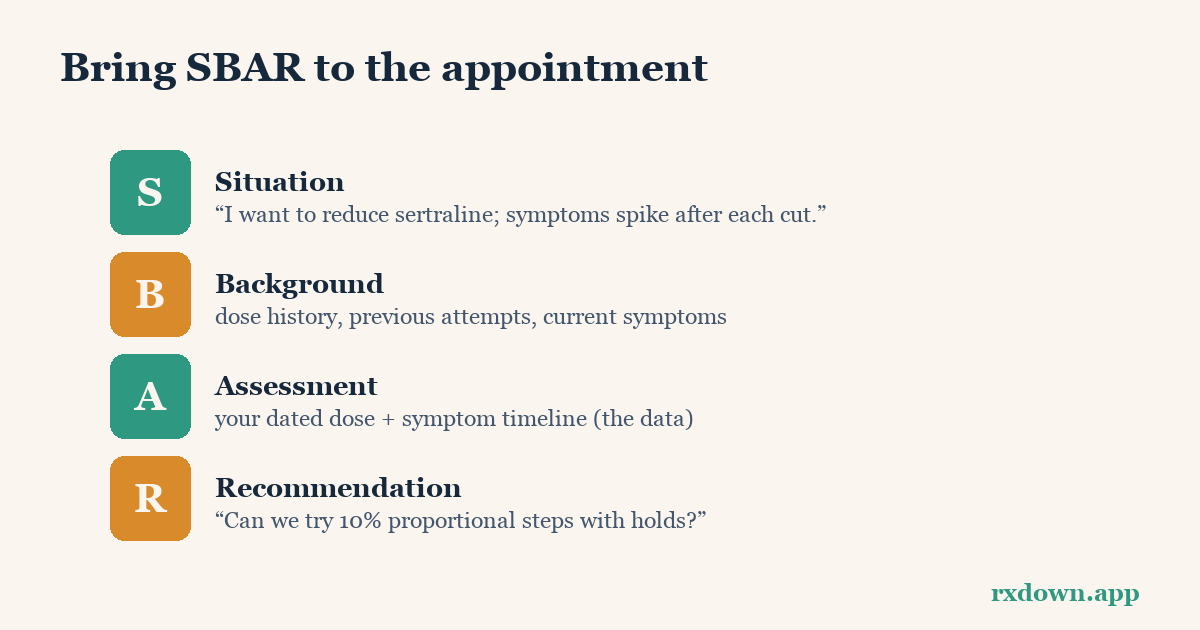
Clinicians already have a shorthand for exactly this kind of structured handover: SBAR — Situation, Background, Assessment, Recommendation. It was adapted for healthcare (popularized by the Institute for Healthcare Improvement) to make critical communication concise and complete. You can borrow the same structure to organize what you say, which quietly signals that you’re a partner in the decision.
| SBAR element | What it covers | A line you could say |
|---|---|---|
| Situation | Why you’re here, in one sentence | ”I’d like to plan coming off my medication.” |
| Background | How long, current dose, why started, past attempts | ”I started about three years ago for anxiety; last time I tapered over two weeks and had weeks of dizziness.” |
| Assessment | Your read on where you are now | ”My mood has been stable for a year; my main worry is withdrawal, not relapse.” |
| Recommendation | What you’re specifically asking for | ”I’d like a slow, flexible taper with the option to hold if symptoms flare.” |
A dated timeline also protects against one of the most common pitfalls: mistaking withdrawal for relapse. When your prescriber can see that symptoms appeared days after a dose change and followed a rise-and-fall pattern, it’s far easier to distinguish the two — a topic worth reading more about in discontinuation vs relapse.
This is exactly the gap RxDown is built to close: it lets you keep a private, local-first diary of dose changes and daily symptoms, then generate a clinician-ready Doctor Report — a dated timeline you can hand over or print — and it includes a free taper calculator for sketching a schedule to discuss. Bring the report; let it do the remembering for you.
How do I raise deprescribing with my doctor?
Lead with a plan, not a demand, and make it collaborative. A workable opener:
“I’ve been on this medication for a while and I’m doing well. I’d like to talk about whether now is a good time to start reducing it — and if so, how we’d do that safely, together.”
That phrasing does three jobs: it states your goal, it signals you understand this needs care, and the word together frames it as shared work. If time is short, say the headline first — “I want to plan coming off my medication” — before the appointment drifts elsewhere.
How do I ask about hyperbolic tapering and liquid formulations?
The science here is worth naming out loud, because it directly informs how a taper is designed. In a widely cited 2019 Lancet Psychiatry paper, Horowitz and Taylor argued that SSRIs should be tapered “hyperbolically” — by amounts that produce even, proportional reductions in receptor (serotonin transporter) occupancy. Because the relationship between dose and receptor occupancy isn’t linear, that translates into progressively smaller dose decrements as you approach zero, rather than fixed cuts. NICE’s current guidance (NG222) endorses proportional tapering and the use of liquid formulations to enable very small final doses. A concrete script:
“I’ve read about tapering by smaller and smaller amounts near the end — sometimes called hyperbolic tapering. Is that an approach you’d be comfortable planning with me? And to make small reductions at the low-dose end, could a liquid formulation or smaller tablet strengths be an option?”
You can point your prescriber to the underlying idea in hyperbolic tapering and receptor occupancy explained. Note the framing: you’re asking whether an evidence-based method fits your case, not telling them what to prescribe.
How do I negotiate a hold if symptoms flare?
Tapering is rarely a straight line, and the ability to pause is one of the most useful things to agree on in advance. Holding at the current dose until symptoms settle — rather than pushing through or automatically reinstating a higher dose — is a recognized, flexible strategy. Agreeing on it early removes the panic from a bad week:
“If I hit a rough patch after a reduction, I’d rather not push through or jump back up straight away. Could we build in the option to hold at that dose for a few weeks and reassess before the next step?”
If symptoms are already significant, the same principle applies to going back to the last tolerated dose. Both are covered in more depth in hold and reinstate. The point to land with your prescriber is that a slower, adjustable schedule is a feature, not a failure.
What if my doctor pushes back?
Pushback is common, and most of it is manageable without conflict. The most useful move is to ask for the reasoning rather than argue:
“Can you help me understand the reasoning behind stopping over two weeks? I’ve seen more recent guidance suggesting a slower, flexible schedule for people who’ve been on a medication a long time — could we look at that together?”
If you’re met with the old “withdrawal is mild and brief” line, you can gently note that this framing has been formally revised: the Royal College of Psychiatrists’ 2019 position statement recognized that withdrawal can be severe and long-lasting for some people, and NICE updated its guidance accordingly. Naming specific, respectable sources — NICE NG222 and the Maudsley Deprescribing Guidelines (Horowitz & Taylor, 2024), which give step-by-step tapering schedules — moves the conversation from your opinion versus theirs to a shared reading of the evidence.
If you still can’t reach a workable plan, asking for a second opinion is reasonable and not rude:
“I really value your care, and I’d also like a second opinion from someone who does a lot of tapering. Would you be open to a referral, or to reviewing a plan together?”
Second opinions are especially worth seeking if a prescriber insists on abrupt discontinuation, dismisses documented withdrawal as relapse without discussion, or won’t consider liquid or small-dose options where they’re clinically appropriate.
What are the red lines I should never cross?
Being an informed, assertive patient is not the same as going it alone. A few hard limits:
- Never stop abruptly. Sudden discontinuation is the single most reliable way to trigger severe withdrawal, and for some medicines it carries real medical risk.
- Never self-taper higher-risk classes against medical advice. This applies especially to benzodiazepines (and, closely related, z-drugs), where withdrawal can include serious complications such as seizures. These require a supervised, gradual plan — the established framework is the Ashton approach, covered in benzodiazepine tapering (Ashton). Do not improvise here.
- Don’t hide a taper you’ve started. If you’ve already reduced on your own, tell your prescriber — they can only help with the full picture.
Advocating for a slower, gentler taper is squarely within your rights. Bypassing medical supervision on high-risk medicines is a different thing, and it’s dangerous.
How does shared decision-making change the frame?
The frame that ties all of this together has an official name: shared decision-making. NICE’s dedicated guideline on it (NG197, published in 2021) defines it as a collaborative process in which you and your healthcare professional work together to reach a joint decision about your care — weighing the options, benefits, risks, and, crucially, what matters to you. It explicitly puts your preferences and values into the clinical equation.
That’s the mindset shift. You are not petitioning a gatekeeper; you are one of two experts in the room — your prescriber is the expert on the pharmacology, and you are the expert on your body, your history, and your goals. When you arrive with clear reasons, a dated timeline, and a specific request, you make it easy for a good clinician to do exactly what the guideline asks: decide with you. The Royal College of Psychiatrists’ patient resource on stopping antidepressants makes the same point from the clinical side — that stopping should be a planned, supported, gradual process.
If you’d like more background before your appointment, our antidepressant withdrawal timeline and the FAQ cover what to expect and how the pieces fit together.
Sources
- NICE, Shared decision making (NG197) (2021)
- Royal College of Psychiatrists, Position statement: RCPsych calls on NICE to update antidepressant withdrawal advice (2019)
- Royal College of Psychiatrists, Stopping antidepressants (patient information)
- NICE, Depression in adults: treatment and management (NG222) (2022)
- Horowitz MA, Taylor D, Tapering of SSRI treatment to mitigate withdrawal symptoms, Lancet Psychiatry (2019)
- Horowitz MA, Taylor D, The Maudsley Deprescribing Guidelines (Wiley-Blackwell, 2024)
- Davies J, Read J, A systematic review into the incidence, severity and duration of antidepressant withdrawal effects, Addictive Behaviors (2019)
- Institute for Healthcare Improvement, SBAR Tool: Situation-Background-Assessment-Recommendation
- Irving G, et al., International variations in primary care physician consultation time, BMJ Open (2017)
Frequently asked questions
How do I bring up stopping my medication with my doctor?
Say it directly and early, framed as a plan rather than a demand: 'I'd like to talk about whether now is a good time to start reducing my medication, and how we'd do it safely together.' Bring a short written summary so you don't lose the thread in a rushed appointment. Ask for a follow-up date so the taper is treated as an ongoing process, not a one-off decision.
What should I do if my doctor refuses to help me taper?
Ask, respectfully, for the clinical reasoning behind their view, and request a guideline-based approach — the NICE guidelines and the Maudsley Deprescribing Guidelines both describe gradual, flexible tapering. If you still can't agree, it is reasonable to ask for a second opinion or a referral. Do not stop abruptly or attempt a do-it-yourself taper of higher-risk medicines such as benzodiazepines on your own.
What information should I bring to a deprescribing appointment?
A dated record of your dose and symptoms over time is far more persuasive than trying to recall it on the spot. Clinicians respond well to structured summaries such as SBAR (Situation, Background, Assessment, Recommendation). A one-page timeline showing what you take, how long you've taken it, past attempts to stop, and your current symptoms lets your prescriber make a decision with you rather than guess.
Tracking your dose, sleep, and symptoms makes every conversation in this article easier. RxDown is a free diary built for exactly that. Get RxDown · Free taper calculator