 RxDown
Stopping DORA Sleep Meds: Quviviq, Dayvigo, Belsomra
⚕️ This article is education, not medical advice. Every claim is sourced below. Never stop or change medication without your prescriber — some medications are dangerous to stop abruptly.
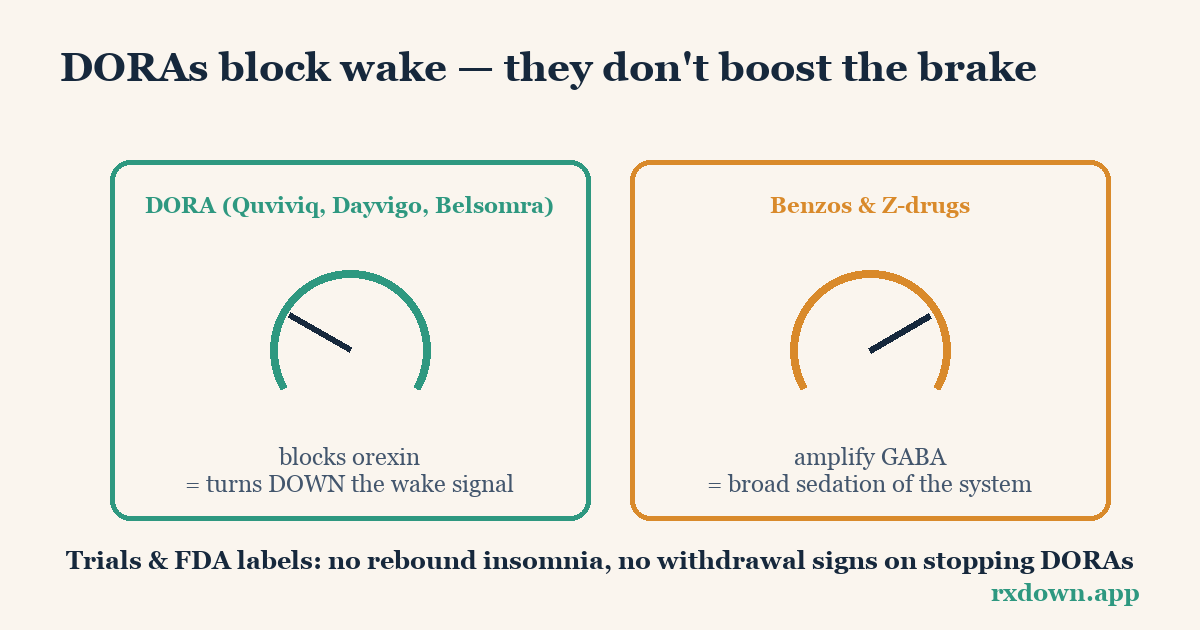
TL;DR: Dual orexin receptor antagonists (DORAs) — daridorexant (Quviviq), lemborexant (Dayvigo), and suvorexant (Belsomra) — treat insomnia by blocking the brain’s wake-promoting orexin signal, not by boosting GABA the way benzodiazepines and Z-drugs do. In their phase 3 trials and FDA labels, abruptly stopping a DORA did not produce rebound insomnia or measurable withdrawal — a genuine pharmacological difference from older hypnotics. They are still Schedule IV controlled substances, but that reflects abuse-potential studies rather than physical dependence. Even so, stopping should be planned with your prescriber, because the underlying insomnia usually still needs treatment.
This article is patient education, not medical advice. It describes published findings and prescribing-label language; it does not tell you what to take or when to stop. Any change to a sleep medication should be decided and supervised by the prescriber who knows your history — especially if you are also taking a benzodiazepine or Z-drug, where abrupt stopping can be genuinely dangerous. Do not change a dose on your own.
What is orexin, and how do DORAs work differently from older sleep drugs?
Orexin (also called hypocretin) is a wake-promoting neuropeptide made by a small cluster of neurons in the lateral hypothalamus. There are two forms, orexin-A and orexin-B, and they act on two receptors, OX1R and OX2R. When orexin neurons fire, they switch on the brain’s arousal systems — the noradrenergic locus coeruleus, the histamine-releasing tuberomammillary nucleus, and others — which keeps you awake and alert. The clearest proof of how central this system is: people who lose orexin neurons develop narcolepsy type 1, a disorder of runaway sleepiness.
A dual orexin receptor antagonist blocks both OX1R and OX2R. Instead of forcing the brain into sedation, it turns down the wake signal so that natural sleep can take over. A 2025 review of the orexin system (Żełabowski et al., International Journal of Molecular Sciences) describes DORAs as agents that “function by selectively dampening orexin-driven arousal, thereby facilitating sleep onset and maintenance without disrupting natural sleep architecture.”
Benzodiazepines and Z-drugs (zolpidem, zopiclone, eszopiclone) work by the opposite logic. They are positive allosteric modulators of the GABA-A receptor — they amplify the brain’s main inhibitory neurotransmitter across widespread circuits. That broad inhibition produces sedation, but also muscle relaxation, anti-anxiety effects, and amnesia, and it reshapes sleep architecture (for example, suppressing REM sleep). This difference in mechanism — narrowing one wake pathway versus broadly suppressing the whole system — is the reason the two classes behave so differently when you stop them. If you want the mechanism in more depth, see how receptor occupancy works.
Which sleep medications are DORAs?
There are three FDA-approved DORAs, all controlled substances, all prescribed for insomnia in adults:
| Generic (brand) | FDA approval | Typical role |
|---|---|---|
| Suvorexant (Belsomra) | 2014 | First-in-class DORA |
| Lemborexant (Dayvigo) | 2019 | Sleep onset and maintenance |
| Daridorexant (Quviviq) | 2022 | Shorter half-life, daytime-function data |
Suvorexant was the first orexin antagonist approved anywhere, in August 2014. Lemborexant followed in December 2019, and daridorexant — designed with a relatively short half-life to limit next-day carryover — was approved in January 2022. All three are dual antagonists (they block both orexin receptors); no single-receptor orexin antagonist is currently approved for insomnia in the US.
Do DORAs cause rebound insomnia or withdrawal when you stop?
This is where DORAs stand out, and the evidence comes straight from the pivotal trials and the FDA labels — not from marketing.
Daridorexant (Quviviq). The phase 3 program (Mignot et al., Lancet Neurology, 2022) ran two large randomized, double-blind, placebo-controlled trials, each ending with a 7-day single-blind placebo run-out specifically designed to catch rebound and withdrawal after treatment stopped. The trials found that daridorexant improved sleep and, at the 50 mg dose, daytime functioning, and reported no rebound insomnia and no withdrawal symptoms on discontinuation. The Quviviq label goes further: across a program in which 1,232 people were treated for up to 12 months, “there were no reports indicative of abuse liability,” and chronic administration “did not produce withdrawal signs or symptoms upon drug discontinuation.”
Lemborexant (Dayvigo). The Dayvigo label states that the drug “was not associated with rebound insomnia following treatment discontinuation.” Withdrawal was measured formally with the Tyrer Benzodiazepine Withdrawal Symptom Questionnaire after stopping the 5 mg or 10 mg dose, and there was “no evidence of withdrawal effects” at either dose — which the label reads as evidence that lemborexant does not produce physical dependence.
Suvorexant (Belsomra). The Belsomra label reports that in three-month clinical studies, “no rebound insomnia … was observed with discontinuation of suvorexant at doses of 15 to 40 mg,” and “no withdrawal effects were observed” at those doses.
The important honest caveat: “no rebound insomnia” is an average across trial populations over a defined study period. It is strong, consistent, drug-label-level evidence, but it does not promise that every individual will feel nothing when they stop. It also does not mean your insomnia is cured — more on that distinction below.
Why are DORAs still Schedule IV controlled substances?
If the trials show no physical dependence and no withdrawal, why are DORAs regulated like sleeping pills that do cause dependence? Because US drug scheduling weighs abuse potential — how much a drug is “liked” and sought after recreationally — which is a different question from physical dependence.
In human abuse-liability studies, DORAs produced subjective effects similar to zolpidem. The Belsomra label describes a study in 36 recreational polydrug users where suvorexant (40, 80, and 150 mg) produced “drug-liking” ratings similar to zolpidem (15, 30 mg). Because daridorexant and lemborexant share the same mechanism, regulators placed all three in Schedule IV — the same tier as benzodiazepines and Z-drugs (see the 2022 Federal Register notice on daridorexant scheduling).
But the real-world picture looks milder than the lab studies predicted. A 2023 analysis of lemborexant’s abuse potential (Moline et al., Psychopharmacology) concluded that “the totality of evidence suggests that [lemborexant] may be less likely to be abused and associated with overdose in the real-world setting compared with GABA-ergic drugs approved for insomnia.” Internet-forum and adverse-event surveillance of the DORA class has shown limited recreational interest. So: Schedule IV status is about theoretical abuse liability, not about a body that becomes physically hooked and crashes when the drug stops.
DORAs vs. Z-drugs vs. benzodiazepines: how do they compare?
| Feature | DORAs (daridorexant, lemborexant, suvorexant) | Z-drugs (zolpidem, zopiclone, eszopiclone) | Benzodiazepines (temazepam, etc.) |
|---|---|---|---|
| Core mechanism | Block orexin/hypocretin wake signal (OX1R + OX2R antagonist) | Enhance GABA-A (positive allosteric modulator) | Enhance GABA-A (broader: sedation, anxiolysis, muscle relaxation) |
| Physical dependence | Not observed in trials/labels | Can occur, especially with prolonged use | Well documented |
| Rebound insomnia on stopping | Not observed in phase 3 trials/labels | Common, especially after abrupt stop | Common |
| Pharmacologic taper generally needed? | No, per labels | Often advised | Yes — a gradual taper is essential |
| US controlled-substance status | Schedule IV | Schedule IV | Schedule IV |
The takeaway from the table: all three classes are Schedule IV, but only the GABA-A drugs carry a well-documented physical-dependence and rebound risk that makes a structured taper important. For the older drugs, coming off is its own project — see reducing Z-drug dependence and benzodiazepine tapering (the Ashton approach).
Can you stop a DORA cold turkey?
Pharmacologically, the labels say a DORA does not require a taper — daridorexant, lemborexant, and suvorexant can be discontinued without gradual dose reduction, because rebound insomnia and withdrawal were not observed. That genuinely sets them apart from benzodiazepines and Z-drugs.
But “no taper required” is not the same as “just stop and you’re done.” Several honest caveats apply:
- Your underlying insomnia is still there. The medication was managing a symptom; stopping it removes the management, not the cause. Sleep problems can return — that is relapse of insomnia, not drug withdrawal (again, an important distinction covered below).
- Long-term, real-world discontinuation data are limited. The reassuring findings come mostly from controlled trials lasting up to 12 months with defined run-out periods. Broad, long-term, real-world stopping data — across people on multiple medications, with comorbidities — are still thin. Absence of evidence for a problem is not the same as long-term proof.
- Individuals vary. Trial averages don’t capture everyone. Some people report a rough few nights after stopping any sleep aid, partly from anxiety about sleeping unaided.
- Class effects belong to the “on-drug” period, not withdrawal. DORAs carry warnings for next-day somnolence (the most common adverse effect), impaired next-morning driving at higher doses, and rare complex sleep behaviors such as sleep-driving. These are reasons prescribers monitor DORA use — but they are effects of taking the drug, not of stopping it.
- Don’t generalize to other medications. If you’re on a DORA plus a benzodiazepine, Z-drug, antidepressant, or other CNS medication, the “no taper needed” logic applies only to the DORA. Abruptly stopping the others can be harmful.
Is it rebound insomnia, or is my insomnia coming back?
This distinction matters more with DORAs than with almost any other sleep drug, because the trials tell us rebound is unlikely — so if sleep worsens after stopping, the more probable explanation is your original insomnia reasserting itself.
- Rebound insomnia is a short-lived worsening beyond your baseline, driven by the nervous system readjusting to the drug’s absence. It’s the classic pattern with benzodiazepines and Z-drugs.
- Return of underlying insomnia (relapse) is your baseline sleep problem coming back because it was never resolved — the drug was masking it.
Confusing the two leads people to conclude they “can’t stop,” when what they actually need is treatment for the insomnia itself. Tracking your sleep objectively across the transition is the practical way to tell them apart — a genuine spike-then-settle over a few nights looks different from a steady return to your pre-medication pattern. We cover this more in discontinuation vs. relapse and sleep during withdrawal.
What’s the safest way to stop a DORA?
Even without a pharmacological taper requirement, a few steps make stopping smoother and safer.
1. Decide it with your prescriber. Confirm which of your medications the “no taper” evidence actually applies to, review your reasons for stopping, and agree on a plan and a check-in point. This is also the moment to raise anything else you’re taking. A good framework for that conversation is in talking to your doctor about deprescribing.
2. Treat the insomnia, not just the prescription. Both major guidelines put behavioral therapy first. The American College of Physicians (Qaseem et al., Annals of Internal Medicine, 2016) recommends that “all adult patients receive cognitive behavioral therapy for insomnia (CBT-I) as the initial treatment.” The American Academy of Sleep Medicine’s 2021 behavioral guideline (Edinger et al., Journal of Clinical Sleep Medicine) gives multicomponent CBT-I its only STRONG recommendation. CBT-I addresses the cause, and its gains tend to last after treatment ends — which is exactly what you want when coming off a sleep medication.
3. Track sleep objectively during the transition. Because rebound is unlikely with DORAs, a nightly record helps you see whether any change is a brief adjustment or a return of the original problem — and gives your prescriber real data instead of impressions. Note bedtime, estimated sleep, night awakenings, and how you feel the next day.
This is where a diary earns its place. RxDown lets you log sleep and symptoms night by night during a medication change and turns the record into a shareable doctor report, so the conversation with your prescriber runs on your actual pattern rather than memory. If you’re coordinating a stop across more than one medication, its taper calculator can help you and your prescriber map out the drugs that do need a gradual reduction.
The bottom line: DORAs are the rare sleep medications where the trial and label evidence genuinely supports stopping without a taper and without expecting rebound or withdrawal. That’s reassuring and real. What it doesn’t do is treat the insomnia underneath — so the most useful move on the way off a DORA is to make sure the sleep problem itself has a plan, ideally CBT-I, and to keep the decision inside your prescriber’s care.
Sources
- Mignot E, et al. Safety and efficacy of daridorexant in patients with insomnia disorder: results from two phase 3 trials. Lancet Neurology (2022);21:125–139.
- QUVIVIQ (daridorexant) Prescribing Information. FDA (2022).
- BELSOMRA (suvorexant) Prescribing Information. Merck / FDA.
- DAYVIGO (lemborexant) Prescribing Information. Eisai / FDA.
- Moline M, et al. The abuse potential of lemborexant, a dual orexin receptor antagonist. Psychopharmacology (2023);240:699–711.
- Qaseem A, et al. Management of Chronic Insomnia Disorder in Adults: A Clinical Practice Guideline From the American College of Physicians. Annals of Internal Medicine (2016);165:125–133.
- Edinger JD, et al. Behavioral and psychological treatments for chronic insomnia disorder in adults: an AASM clinical practice guideline. Journal of Clinical Sleep Medicine (2021);17:255–262.
- Żełabowski K, et al. Targeting the Orexin System in the Pharmacological Management of Insomnia and Other Diseases. Int J Mol Sci (2025);26:8700.
- Schedules of Controlled Substances: Placement of Daridorexant in Schedule IV. Federal Register (2022).
Frequently asked questions
Do you get withdrawal or rebound insomnia when you stop a DORA?
In the phase 3 trials and the FDA labels for daridorexant (Quviviq), lemborexant (Dayvigo), and suvorexant (Belsomra), abrupt discontinuation — even after up to 12 months of use — did not produce rebound insomnia or measurable withdrawal signs. That is a real difference from benzodiazepines and Z-drugs. It does not guarantee that any individual won't notice their original insomnia return, which is a separate issue from withdrawal.
If DORAs aren't physically addictive, why are they controlled substances?
All three DORAs are Schedule IV in the United States. That scheduling reflects human abuse-potential studies in which recreational drug users rated 'drug-liking' similar to zolpidem, not evidence of physical dependence or withdrawal. Post-marketing surveillance has since suggested that real-world abuse of DORAs is uncommon.
Do you need to taper off a DORA slowly?
The prescribing information for all three DORAs indicates they can be stopped without a pharmacologic taper because withdrawal and rebound insomnia were not observed. Even so, the decision to stop should be made with your prescriber, and the underlying insomnia usually still needs a treatment plan — CBT-I is the guideline-recommended first-line option.
Tracking your dose, sleep, and symptoms makes every conversation in this article easier. RxDown is a free diary built for exactly that. Get RxDown · Free taper calculator