 RxDown
Evidence reviewed through:
⚕️ This article is education, not medical advice. Every claim is sourced below. Never stop or change medication without your prescriber — some medications are dangerous to stop abruptly.
Sleep Restriction and Sleep Compression in CBT-I: Safety, Adaptations, and Clinical Oversight
Key answer
Sleep restriction therapy is better understood as sleep-window therapy: it limits time in bed to consolidate sleep, then expands the window as sleep becomes more efficient. It is one of the most active CBT-I components, but it can temporarily increase sleepiness. Sleep compression reaches a similar goal more gradually and may be chosen when abrupt narrowing would create unacceptable risk or poor adherence. [1–4]
Neither method should be copied from a generic formula. The starting window, minimum time in bed, rate of change, driving precautions, and monitoring need adaptation for age, bipolar disorder, seizure disorders, untreated sleep apnea, pregnancy, chronic pain, shift work, falls, caregiving, and medication changes.
At a glance
| Question | Evidence-based answer |
|---|---|
| Is sleep restriction the same as sleep deprivation? | No, but it can create short-term partial sleep loss and increased sleepiness. |
| Is a fixed 5-hour window appropriate for everyone? | No. Minimum windows and progression rules vary by protocol and patient risk. |
| What is sleep compression? | A gradual reduction in time in bed rather than a large initial narrowing. |
| Who needs extra oversight? | People with bipolar disorder, seizures, dangerous sleepiness, untreated sleep apnea, fall risk, pregnancy, complex medical illness, or unstable medication withdrawal. |
| Should severe deterioration be “pushed through”? | No. Reassess and adapt; urgent symptoms require care. |
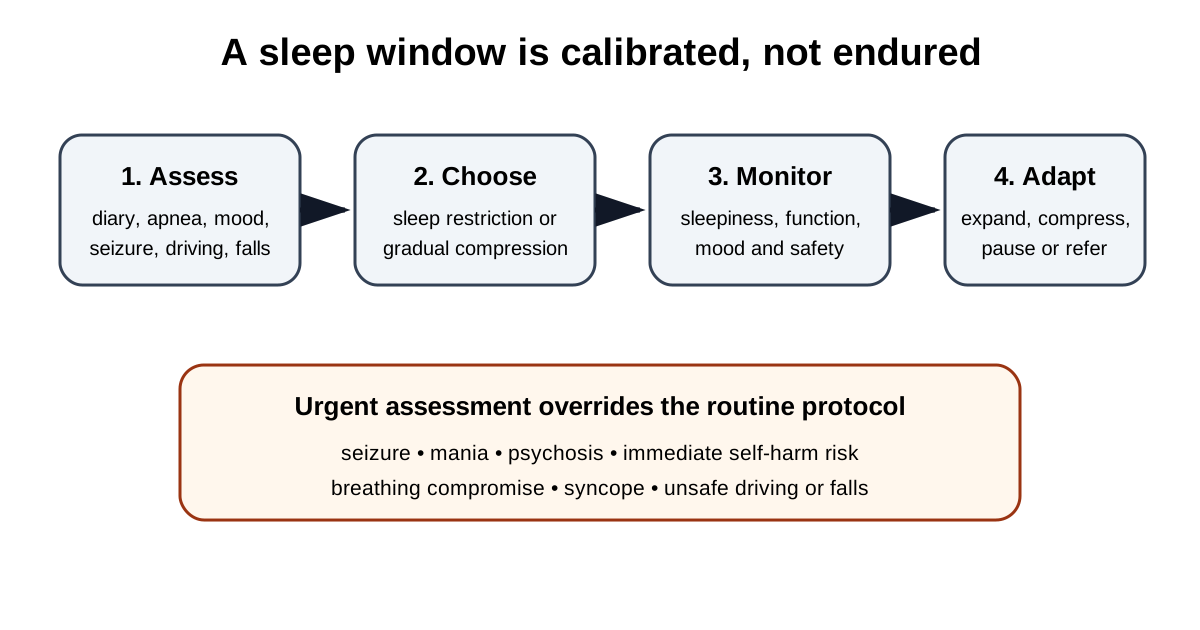
How sleep-window therapy works
People with insomnia often extend time in bed to compensate for poor sleep. The extra opportunity can increase awake time in bed, weaken the bed–sleep association, and make sleep more fragmented. A structured window aligns time in bed more closely with observed sleep, while a consistent rise time strengthens circadian timing. As sleep consolidates, the window is expanded.
The target is not a permanently short night. The target is more reliable sleep and better daytime function with adequate sleep opportunity.
Sleep restriction versus sleep compression
| Feature | Sleep-window restriction | Sleep compression |
|---|---|---|
| Initial change | Larger, protocol-defined narrowing | Smaller, staged narrowing |
| Potential advantage | Faster sleep consolidation | May be easier to tolerate in frailty, pain, fall risk, or high anxiety |
| Potential downside | More early sleepiness and adherence difficulty | Slower response and still requires monitoring |
| Evidence base | Core CBT-I component with substantial adult evidence | Used as an adaptation; direct comparative evidence is smaller |
The names do not define a universally safe protocol. Some brief programs use different minimum windows and adjustment thresholds. A website should explain principles without publishing a personalized calculator that omits risk screening.
Conditions that change the plan
Bipolar disorder
Reduced need for sleep, rising energy, faster speech, impulsivity, or unusual confidence can signal hypomania or mania rather than ordinary CBT-I fatigue. Small studies suggest adapted behavioral treatment can be feasible, but regularizing sleep and monitoring mood may take priority over aggressive window narrowing. [5]
Seizure disorders
Sleep loss can lower seizure threshold for some people. A neurologist should determine whether sleep-window therapy is appropriate, and medication changes must not be coordinated by an app.
Obstructive sleep apnea and dangerous sleepiness
CBT-I can be used with treated sleep apnea, but untreated breathing events and severe sleepiness need assessment. Driving or operating machinery while sleepy is unsafe regardless of the diary score.
Older adults, falls, and frailty
Nighttime walking, orthostatic symptoms, sedatives, vision, mobility, and caregiving duties matter. Sleep compression, nap modification, environmental changes, and closer follow-up may be safer than a rigid protocol.
Medication withdrawal
Withdrawal, rebound insomnia, and a CBT-I sleep window can all alter sleep simultaneously. Avoid stacking rapid medication reductions with aggressive behavioral changes when the resulting sleep loss cannot be interpreted or managed safely.
Monitoring that matters
Track sleep opportunity, estimated sleep, sleep efficiency, daytime sleepiness, unplanned dozing, near-miss accidents, mood elevation, seizures, falls, headaches, pain flares, and medication timing. Wearables can add trend information but should not set the sleep window automatically.
When to stop and seek assessment
Urgent or prompt assessment is warranted for a seizure, delirium, hallucinations, emerging mania, immediate self-harm risk, breathing compromise, repeated near-miss driving events, syncope, or inability to function safely. A routine adjustment should not be used to explain away those events.
Questions for a CBT-I clinician
- Why is this starting window appropriate for my actual sleep and safety risks?
- What minimum window and adjustment rule does this protocol use?
- Would sleep compression be safer than a larger initial restriction?
- How will bipolar, seizure, apnea, fall, pregnancy, pain, or medication-withdrawal risks be monitored?
- Which symptoms mean pause, modify, or seek urgent care?
Frequently asked questions
Does more restriction work better?
No. Excessive restriction can increase risk without improving treatment. The window is a calibrated therapeutic tool, not a dose–response contest.
Can an app calculate my window?
A validated program may calculate suggestions after screening and monitoring, but high-risk conditions require human oversight. RxDown should record sleep and function, not prescribe a sleep window.
Are naps always forbidden?
No universal rule fits shift workers, pregnancy, frailty, illness, or dangerous sleepiness. Nap timing and duration can be adapted.
What if I feel worse during the first week?
Mild temporary sleepiness can occur. Severe or escalating impairment, mood elevation, seizures, falls, or unsafe driving changes the plan.
References
- Edinger JD, et al. AASM clinical practice guideline for behavioral and psychological insomnia treatments. 2021. Evidence type: Clinical practice guideline. Use: CBT-I and component recommendations.
- Edinger JD, et al. AASM systematic review and GRADE assessment. 2021. Evidence type: Systematic review. Use: Benefits, harms, and component evidence.
- Riemann D, et al. European Insomnia Guideline 2023. Evidence type: Guideline. Use: Sleep restriction and stimulus control as active CBT-I ingredients and first-line treatment.
- Kyle SD, et al. Sleep restriction therapy for insomnia is associated with reduced objective total sleep time, increased daytime somnolence, and impaired vigilance. 2014. Evidence type: Experimental treatment study. Use: Early impairment and need for safety advice.
- Kaplan KA, Harvey AG. Behavioral treatment of insomnia in bipolar disorder. 2013. Evidence type: Small clinical series. Use: Adaptation and mood monitoring; not definitive safety proof.

Bring real data to your doctor
Generate a clinician-ready Doctor Report in SBAR format with trend charts, plus clean CSV and PDF exports. Walk into your next appointment with evidence, not guesswork.
RxDown is a data tracking and journaling tool for adults (18+). It does not provide medical advice, diagnosis, or treatment. Never stop taking medication or change your dose based solely on information from this app or website — medication reduction should always be supervised by a qualified healthcare professional.