 RxDown
Evidence reviewed through:
⚕️ This article is education, not medical advice. Every claim is sourced below. Never stop or change medication without your prescriber — some medications are dangerous to stop abruptly.
CBT-I for Adolescents: Evidence, Family Support, and Digital Programs
Key answer
A 2024 meta-analysis of eight randomized trials involving 599 adolescents found that CBT-I improved insomnia severity, sleep-onset latency, total sleep time, and sleep efficiency on average. Digital and school-based formats can help access, but programs vary, adherence is uneven, and adolescent circadian timing, school demands, family routines, mood, and safety must be addressed. [1–5]
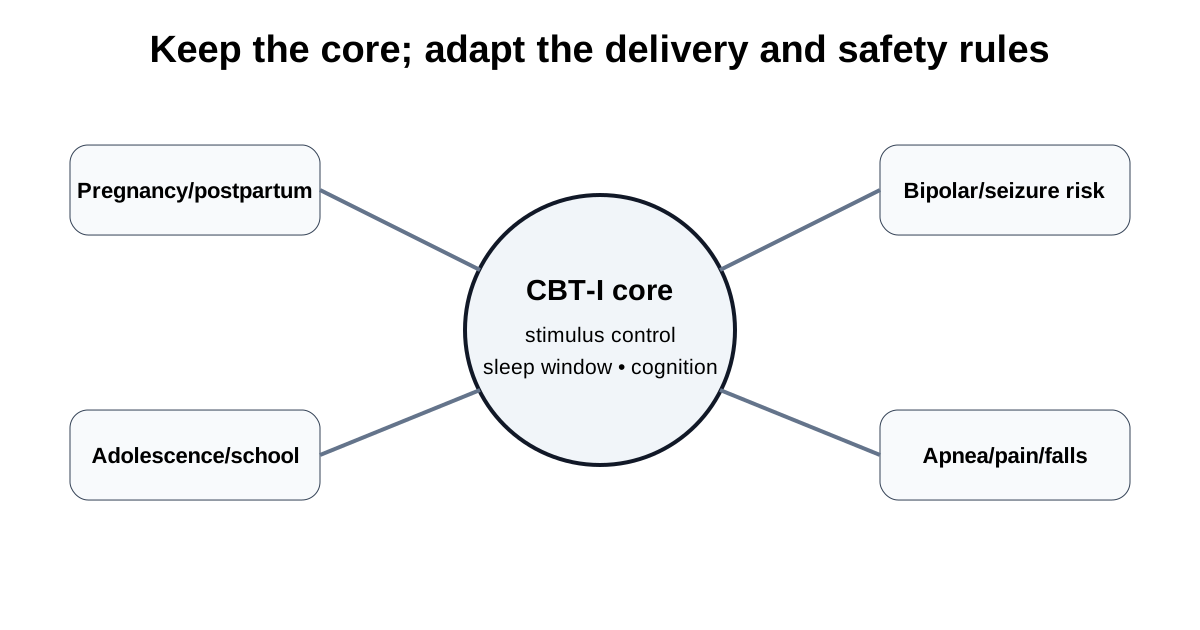
Adolescent CBT-I is not simply adult CBT-I with younger wording. It may include later biological sleep timing, morning light, limits on compensatory weekend sleep, parent or caregiver collaboration, homework load, device use, and a sleep window that protects adequate developmental sleep opportunity.
At a glance
| Topic | Adolescent-specific issue |
|---|---|
| Circadian timing | Puberty commonly shifts sleep later; an early school start can create chronic sleep restriction. |
| Sleep window | Must avoid compounding insufficient sleep, unsafe driving, mood instability, or seizures. |
| Family role | Caregivers can support schedules and reduce conflict without policing every minute. |
| Digital CBT-I | Scalable and promising, but engagement, privacy, crisis escalation, and program quality vary. |
| Mental health | Treat insomnia directly while separately assessing depression, anxiety, ADHD, bipolar disorder, trauma, and self-harm risk. |
| Medication | Starting CBT-I does not itself justify stopping an antidepressant, stimulant, melatonin, or sleep medicine. |
What the evidence shows
The 2024 randomized-trial meta-analysis reported statistically significant improvements across major insomnia outcomes, but only eight trials were available. A 2025 school-based review found subjective improvements in sleep duration, sleep onset, and sleep quality, while objective measures were less consistent. A larger 2025 digital-intervention review found that digital CBT-I reduced insomnia severity, with wide variation in program design and support. [1–3]
These averages do not identify the best delivery format for every adolescent. Trials often recruit motivated participants and may exclude severe psychiatric or medical conditions.
Circadian delay versus insomnia
An adolescent who cannot fall asleep at 10 p.m. but sleeps well from 1 a.m. to 9 a.m. may have a circadian timing problem, insufficient alignment with school, insomnia, or a combination. Treatment may need light timing, schedule changes, and assessment for delayed sleep–wake phase disorder rather than progressively earlier bedtime alone.
Spending more time in bed does not always solve insufficient sleep, but narrowing a sleep window in an already sleep-deprived student can be harmful. The diary must separate sleep opportunity from inability to sleep.
Family support without conflict
Helpful caregiver actions include protecting a consistent wake time, reducing late-night household disruption, supporting morning light and breakfast, negotiating device charging outside the bedroom when acceptable, and coordinating school accommodations. Punitive monitoring can increase arousal and concealment.
Family involvement should respect adolescent privacy and local consent rules. A digital program must state how crisis information, data, and parent access are handled.
Digital programs: what to check
Look for a defined CBT-I protocol, age-appropriate minimum sleep opportunity, circadian assessment, mood and suicide screening, human escalation, privacy information, and evidence from the actual program rather than from CBT-I generally. Gamification or an AI chatbot does not establish clinical effectiveness.
A wearable can support timing trends but cannot diagnose insomnia, sleep apnea, depression, or medication withdrawal.
Medication and comorbidity
Stimulant timing, antidepressants, sedating antihistamines, melatonin, caffeine, nicotine, cannabis, and energy drinks can all affect sleep. Medication decisions require the prescribing clinician. Abruptly stopping a dependence-forming medicine or antidepressant can cause withdrawal and should not be embedded in a sleep app.
Treat insomnia while separately treating depression, anxiety, ADHD, trauma, chronic pain, or bipolar disorder. Better sleep can improve some symptoms without proving the comorbidity has resolved.
Safety and urgent assessment
Prompt or urgent care is needed for immediate self-harm risk, psychosis, mania or rapidly decreasing need for sleep, seizure, severe intoxication or withdrawal, breathing pauses with dangerous sleepiness, or repeated drowsy-driving events. In many countries, a teenager who is too sleepy to drive should not drive.
Frequently asked questions
Does every teenager need eight hours?
Sleep need varies, but adolescents generally require more sleep opportunity than many adults. A therapeutic window should not be built from an arbitrary adult minimum.
Can CBT-I help depression?
Sleep improvement can reduce depressive symptoms, and one large youth trial found a lower incidence of major depression after app-based CBT-I in a selected group. This does not make CBT-I a replacement for depression treatment. [4]
Is melatonin part of CBT-I?
No. Melatonin is a separate intervention. Timing, product quality, indication, and local regulation require clinical discussion.
Should parents take away all devices?
A collaborative plan is usually more sustainable than a blanket punishment. Content, timing, light, social pressure, and the function of device use all matter.
References
- Efficacy of CBT-I in adolescents: systematic review and meta-analysis of randomized trials. 2024. Evidence type: Meta-analysis of 8 RCTs, 599 participants. Use: Average insomnia and sleep outcomes.
- CBT-I in school settings: systematic review and meta-analysis. 2025. Evidence type: Systematic review. Use: Subjective benefits and inconsistent objective outcomes.
- Active components in digital sleep interventions among adolescents: systematic review and meta-analysis. 2025. Evidence type: Systematic review of 18 RCTs. Use: Digital CBT-I efficacy, heterogeneity, and delivery limits.
- Chen SJ, et al. App-based CBT-I for prevention of major depressive disorder in youth. 2025. Evidence type: Randomized clinical trial. Use: Prevention signal in youth with insomnia and subclinical depression; not general population proof.
- Transdiagnostic sleep and circadian intervention in youth: long-term follow-up. 2024. Evidence type: Long-term randomized-trial follow-up. Use: Early gains did not produce detectable eight-year group differences, illustrating limits of extrapolation.

Bring real data to your doctor
Generate a clinician-ready Doctor Report in SBAR format with trend charts, plus clean CSV and PDF exports. Walk into your next appointment with evidence, not guesswork.
RxDown is a data tracking and journaling tool for adults (18+). It does not provide medical advice, diagnosis, or treatment. Never stop taking medication or change your dose based solely on information from this app or website — medication reduction should always be supervised by a qualified healthcare professional.