 RxDown
Evidence reviewed through:
⚕️ This article is education, not medical advice. Every claim is sourced below. Never stop or change medication without your prescriber — some medications are dangerous to stop abruptly.
Interdose Withdrawal: Why Symptoms Can Appear Before the Next Dose
Key answer
What “interdose withdrawal” means, which patterns support it, what can mimic it, and why changing dose frequency without a plan can create new risks. The central safety principle is: Symptoms that emerge as exposure falls between scheduled doses in a physically dependent person. [1–2]
A safe interpretation starts with the exact medication or intervention, the reason it is being used, the formulation, treatment duration, other medicines, current symptoms, and the risks of both continuing and changing treatment. The article therefore explains decision factors and safety boundaries rather than prescribing a fixed schedule.
At a glance
| Question or decision | Evidence-based answer |
|---|---|
| Definition | Symptoms that emerge as exposure falls between scheduled doses in a physically dependent person. |
| More plausible with | Shorter half-life, rapid absorption and clearance, widely spaced dosing, missed doses, or metabolic interactions. |
| Common mimics | Panic, anticipatory anxiety, tolerance, caffeine, alcohol, pain cycles, and inconsistent adherence. |
| What not to do | Add extra doses or change timing repeatedly without prescriber oversight. |
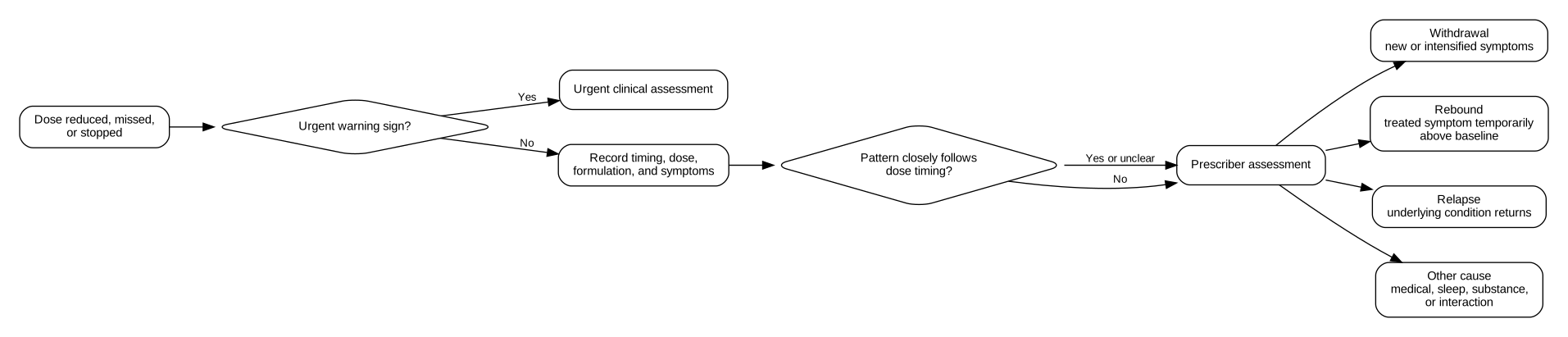
Evidence basis and uncertainty
This article prioritizes regulator-hosted product information, current clinical guidance, systematic reviews, randomized trials, and carefully labeled observational or mechanistic evidence. The references below are used according to their design and limitations [1–2]. Absence of a detected signal is not rewritten as absence of risk, and a population average is not presented as an individual prediction.
| Reference | Evidence type | How it is used in this article |
|---|---|---|
| 1 | Multisociety clinical practice guideline | Recommends individualized, generally gradual reductions, monitoring, and avoidance of abrupt discontinuation in physically dependent patients. |
| 2 | Guideline | Individualized planning, slow stepwise reduction, monitoring, and differentiation of withdrawal from relapse. |
Working definitions
| Term | Meaning in this article |
|---|---|
| Withdrawal symptoms | New or intensified symptoms after a dose reduction, missed dose, formulation change, or stop when physiologic adaptation is a plausible contributor. |
| Rebound | Temporary return of a treated symptom above its pretreatment baseline. |
| Relapse or recurrence | Return of the underlying treated condition. |
| Physical dependence | Physiologic adaptation; it is not the same as addiction or a substance use disorder. |
The pattern matters more than the label
A reproducible rise in symptoms before a scheduled dose and relief after dosing may support a concentration-related effect. The pattern should be recorded over multiple days because expectations and daily routines can create a similar clock-linked experience.
Why shorter-acting medicines are discussed more often
Faster clearance creates larger troughs between doses. However, half-life is an average, and active metabolites, dose formulation, organ function, and enzyme interactions matter. Even long-acting medicines can produce symptoms when doses are missed or absorption changes.
What can mimic interdose withdrawal
Panic attacks, rebound anxiety, stimulant or caffeine timing, alcohol withdrawal, pain flares, hypoglycemia, thyroid disease, sleep loss, and conditioned fear around dosing can all produce symptoms before the next dose.
Why dose-frequency changes need supervision
Dividing a total daily dose may smooth exposure for some people but can alter sedation, adherence, driving, nighttime breathing, and the later taper plan. Increasing the total dose to eliminate troughs can deepen dependence and is not a neutral fix.
What to record
Record exact dose times, formulation, meal timing, caffeine, nicotine, alcohol, symptoms, pulse only if safely measured, and what happens after the dose. Include days without symptoms to avoid selective recall.
When urgent medical assessment may be needed
    Seek urgent local medical assessment when any of the following applies. This list is intentionally conservative and is not a diagnostic checklist:

- Seizure, delirium, hallucinations, or severe confusion-
Extra doses are being taken unpredictably
-
Concurrent opioid or alcohol use with sedation or breathing difficulty
-
Symptoms include chest pain, fainting, or another plausible medical emergency
Emergency pathways and telephone numbers vary by country. A tracking application or educational article cannot rule out an emergency.
Questions to take to the prescriber
- What is the current indication and treatment goal?
- Which alternative explanations for the symptoms need assessment?
- What is the exact medication, formulation, timing, and most recent change?
- Which outcome should be monitored before another change is considered?
- What are the urgent warning signs and the fastest route back to the clinical team?
Frequently asked questions
Does relief after a dose prove interdose withdrawal?
It supports the hypothesis but can also reflect expectancy or treatment of the underlying anxiety. Clinical review is needed.
Should I take the medication more often?
Do not change frequency or total dose without the prescriber. The risks and later taper implications must be considered.
Can extended-release formulations prevent it?
Sometimes they smooth absorption, but product behavior and elimination vary and conversion can create new problems.
Is interdose withdrawal addiction?
No. It can occur from physical dependence without compulsive use or other features of addiction.
Regional and formulation note
Guidelines, labels, formulations, and care pathways vary by country. Verify the exact product label, manufacturer, strength, release system, and local clinical pathway before use. A tablet or capsule instruction that is correct for one product may be wrong for another.
References
-
ASAM and partner societies. Joint Clinical Practice Guideline on Benzodiazepine Tapering. 2025. Evidence type: Multisociety clinical practice guideline. Use in this article: Recommends individualized, generally gradual reductions, monitoring, and avoidance of abrupt discontinuation in physically dependent patients.
-
NICE. Medicines associated with dependence or withdrawal symptoms: safe prescribing and withdrawal management for adults (NG215). Evidence type: Guideline. Use in this article: Individualized planning, slow stepwise reduction, monitoring, and differentiation of withdrawal from relapse.

Bring real data to your doctor
Generate a clinician-ready Doctor Report in SBAR format with trend charts, plus clean CSV and PDF exports. Walk into your next appointment with evidence, not guesswork.
RxDown is a data tracking and journaling tool for adults (18+). It does not provide medical advice, diagnosis, or treatment. Never stop taking medication or change your dose based solely on information from this app or website — medication reduction should always be supervised by a qualified healthcare professional.