 RxDown
Evidence reviewed through:
⚕️ This article is education, not medical advice. Every claim is sourced below. Never stop or change medication without your prescriber — some medications are dangerous to stop abruptly.
Alcohol, Opioids, and Other Sedatives During a Benzodiazepine Taper
Key answer
Why alcohol, opioids, gabapentinoids, Z-drugs, and other sedatives change benzodiazepine taper safety—and why abrupt alcohol cessation may itself be dangerous. The central safety principle is: Additive sedation, impaired judgment, falls, and respiratory depression. [1–4]
A safe interpretation starts with the exact medication or intervention, the reason it is being used, the formulation, treatment duration, other medicines, current symptoms, and the risks of both continuing and changing treatment. The article therefore explains decision factors and safety boundaries rather than prescribing a fixed schedule.
At a glance
| Question or decision | Evidence-based answer |
|---|---|
| Main combined risk | Additive sedation, impaired judgment, falls, and respiratory depression. |
| Alcohol complication | Regular heavy alcohol use can create its own dangerous withdrawal risk if stopped abruptly. |
| Opioid complication | Overdose risk rises, and tolerance can change during opioid reduction or interruption. |
| Best practice | Disclose actual use without stigma and coordinate one integrated safety plan. |
Evidence basis and uncertainty
This article prioritizes regulator-hosted product information, current clinical guidance, systematic reviews, randomized trials, and carefully labeled observational or mechanistic evidence. The references below are used according to their design and limitations [1–4]. Absence of a detected signal is not rewritten as absence of risk, and a population average is not presented as an individual prediction.
| Reference | Evidence type | How it is used in this article |
|---|---|---|
| 1 | Multisociety clinical practice guideline | Recommends individualized, generally gradual reductions, monitoring, and avoidance of abrupt discontinuation in physically dependent patients. |
| 2 | Clinical practice guideline | Warns against abrupt discontinuation or rapid dose reduction except for life-threatening circumstances and emphasizes collaborative, patient-centered care. |
| 3 | Regulatory safety communication | Highlights respiratory risk with opioids, other central nervous system depressants, lung disease, and older age. |
| 4 | Regulatory safety communication | Strengthened warnings on dependence, addiction, withdrawal, and safer prescribing. |
Working definitions
| Term | Meaning in this article |
|---|---|
| Withdrawal symptoms | New or intensified symptoms after a dose reduction, missed dose, formulation change, or stop when physiologic adaptation is a plausible contributor. |
| Rebound | Temporary return of a treated symptom above its pretreatment baseline. |
| Relapse or recurrence | Return of the underlying treated condition. |
| Physical dependence | Physiologic adaptation; it is not the same as addiction or a substance use disorder. |
Why “just avoid everything” is not a complete plan
Avoiding alcohol and nonprescribed sedatives is often safer, but a person with physical dependence on alcohol or another sedative may be harmed by abrupt cessation. The clinician needs the real amount, timing, frequency, and prior withdrawal history to plan safely.
Opioids and breathing risk
Benzodiazepines and opioids both depress central nervous system function. Combined use raises overdose risk, especially with sleep apnea, lung disease, older age, high doses, or additional sedatives. Naloxone and overdose education may be appropriate, but naloxone does not reverse benzodiazepine effects.
Gabapentinoids, Z-drugs, antihistamines, and cannabis
Pregabalin, gabapentin, Z-drugs, sedating antihistamines, antipsychotics, muscle relaxants, and cannabis can add sedation or cognitive impairment. “Natural” does not mean interaction-free. The risk depends on product, dose, timing, and the person’s health.
Caffeine and stimulants can also confuse the picture
Increasing caffeine to counter sedation may worsen anxiety, tremor, palpitations, and sleep. Prescription stimulants and decongestants can complicate autonomic symptoms. Record them rather than assuming every symptom comes from the taper.
Create an integrated plan
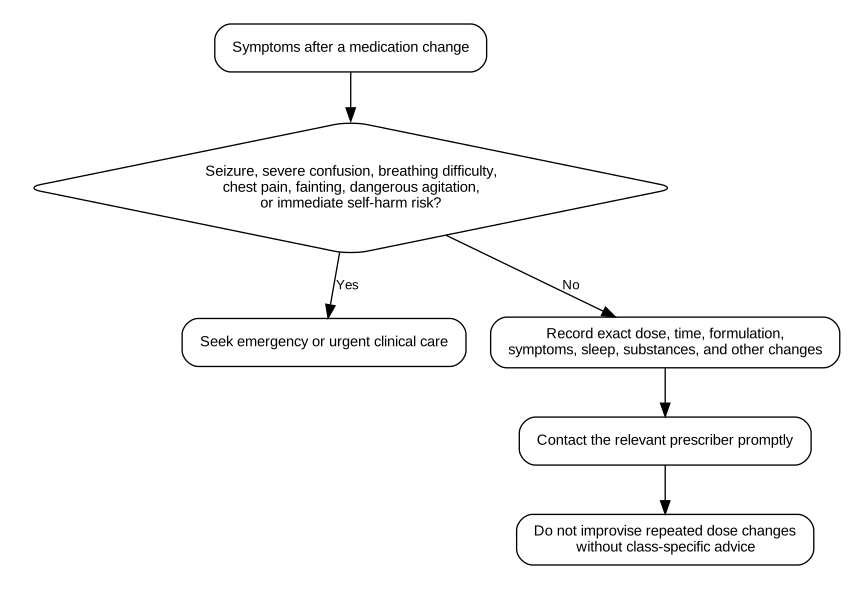
The plan should address overdose risk, alcohol withdrawal risk, seizure history, sleep breathing, driving, naloxone, medication storage, and which substance or medication change comes first. Parallel uncoordinated reductions increase danger and reduce interpretability.
When urgent medical assessment may be needed
    Seek urgent local medical assessment when any of the following applies. This list is intentionally conservative and is not a diagnostic checklist:

- Slow or difficult breathing, blue lips, unresponsiveness, or suspected overdose-
History of alcohol-withdrawal seizure or delirium
-
Several sedatives are being stopped at once without supervision
-
Driving, falls, or dangerous behavior while sedated
Emergency pathways and telephone numbers vary by country. A tracking application or educational article cannot rule out an emergency.
Questions to take to the prescriber
- What is the current indication and treatment goal?
- Which alternative explanations for the symptoms need assessment?
- What is the exact medication, formulation, timing, and most recent change?
- Which outcome should be monitored before another change is considered?
- What are the urgent warning signs and the fastest route back to the clinical team?
Frequently asked questions
Can I drink occasionally during a taper?
Individual risk varies, but alcohol can add sedation, impair sleep, and destabilize symptoms. Discuss actual use with the prescriber rather than relying on a universal allowance.
Should I stop alcohol immediately?
If use is frequent or heavy, abrupt cessation can be dangerous. Seek clinical assessment for withdrawal risk.
Does naloxone make the combination safe?
No. Naloxone can reverse opioid effects temporarily but does not reverse benzodiazepine or alcohol sedation and does not prevent overdose.
Should opioids or benzodiazepines be tapered first?
There is no universal order. Overdose risk, withdrawal risk, pain or anxiety stability, and patient priorities must be balanced.
Regional and formulation note
Guidelines, labels, formulations, and care pathways vary by country. Verify the exact product label, manufacturer, strength, release system, and local clinical pathway before use. A tablet or capsule instruction that is correct for one product may be wrong for another.
References
-
ASAM and partner societies. Joint Clinical Practice Guideline on Benzodiazepine Tapering. 2025. Evidence type: Multisociety clinical practice guideline. Use in this article: Recommends individualized, generally gradual reductions, monitoring, and avoidance of abrupt discontinuation in physically dependent patients.
-
CDC Clinical Practice Guideline for Prescribing Opioids for Pain — United States, 2022. Evidence type: Clinical practice guideline. Use in this article: Warns against abrupt discontinuation or rapid dose reduction except for life-threatening circumstances and emphasizes collaborative, patient-centered care.
-
US FDA. Serious breathing problems with gabapentin and pregabalin in patients with respiratory risk factors. 2019. Evidence type: Regulatory safety communication. Use in this article: Highlights respiratory risk with opioids, other central nervous system depressants, lung disease, and older age.
-
UK MHRA. Improving information supplied with gabapentinoids, benzodiazepines and Z-drugs. 2026. Evidence type: Regulatory safety communication. Use in this article: Strengthened warnings on dependence, addiction, withdrawal, and safer prescribing.

Bring real data to your doctor
Generate a clinician-ready Doctor Report in SBAR format with trend charts, plus clean CSV and PDF exports. Walk into your next appointment with evidence, not guesswork.
RxDown is a data tracking and journaling tool for adults (18+). It does not provide medical advice, diagnosis, or treatment. Never stop taking medication or change your dose based solely on information from this app or website — medication reduction should always be supervised by a qualified healthcare professional.