 RxDown
Evidence reviewed through:
⚕️ This article is education, not medical advice. Every claim is sourced below. Never stop or change medication without your prescriber — some medications are dangerous to stop abruptly.
CBT-I vs Sleep Hygiene: Why Advice Alone Is Not the Same Treatment
Key answer
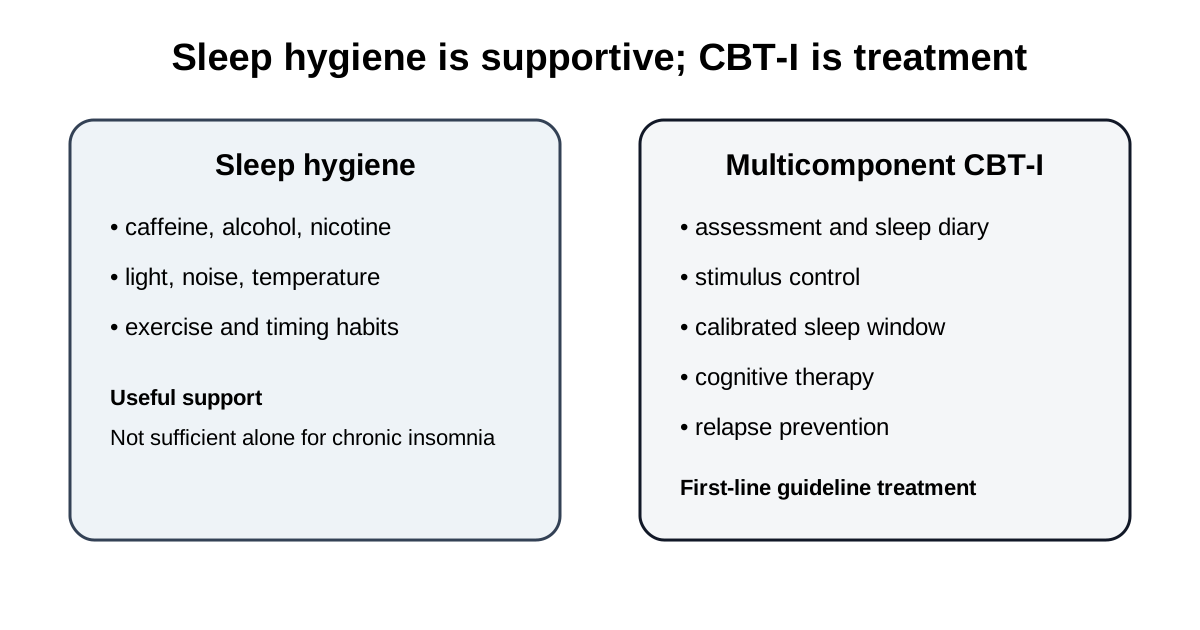
Sleep hygiene is a set of general habits; cognitive behavioral therapy for insomnia (CBT-I) is a structured treatment. Sleep hygiene may support good sleep, but the American Academy of Sleep Medicine recommends against using sleep hygiene as the only treatment for chronic insomnia. Multicomponent CBT-I is strongly recommended because it combines sleep regulation education with stimulus control, a carefully managed sleep window, cognitive therapy, and relapse-prevention skills. [1–4]
This distinction matters during medication reduction. Advice such as “avoid caffeine” or “keep the bedroom dark” cannot be expected to prevent withdrawal, rebound insomnia, or relapse. CBT-I can treat an insomnia process that coexists with those problems, but it does not prescribe medication changes or guarantee symptom-free tapering.
At a glance
| Feature | Sleep hygiene | Multicomponent CBT-I |
|---|---|---|
| Main purpose | Reduce habits or environmental factors that can interfere with sleep | Treat the behavioral and cognitive processes that maintain chronic insomnia |
| Typical content | Caffeine, alcohol, light, exercise, bedroom, noise, temperature | Stimulus control, sleep-window scheduling, cognitive therapy, sleep education, relaxation when indicated, and relapse prevention |
| Personalization | Often generic | Uses a sleep diary, diagnosis, comorbidities, safety risks, and weekly response |
| Evidence as stand-alone chronic-insomnia treatment | Insufficient; AASM suggests not using it alone [1] | Strong guideline recommendation [1–4] |
| Medication decisions | None | None unless a separate prescriber-led plan is coordinated |
| Early experience | Usually low burden | May temporarily increase sleepiness or frustration and therefore needs clear safety rules |
What sleep hygiene can and cannot do
Sleep hygiene can identify correctable contributors: late caffeine, alcohol used as a sleep aid, nicotine, bright light at night, an uncomfortable room, or inconsistent timing. These changes can be worthwhile, particularly when a specific behavior is clearly disrupting sleep.
The limitation is that many people with chronic insomnia already follow reasonable habits. Their difficulty may be maintained by spending excessive time awake in bed, variable rise times, compensatory naps, fear of not sleeping, clock monitoring, or a cycle of effort and arousal. Repeating generic advice can imply blame without treating that cycle.
What CBT-I adds
A full program usually includes several coordinated components:
- Assessment and sleep diary: confirms the pattern and screens for other sleep, medical, psychiatric, circadian, and substance-related problems.
- Stimulus control: rebuilds the association between bed and sleep rather than wakeful struggle.
- Sleep-window scheduling: initially aligns time in bed more closely with observed sleep, then expands it as sleep consolidates.
- Cognitive therapy: addresses catastrophic predictions, rigid rules, and unhelpful monitoring.
- Sleep regulation education: explains sleep drive, circadian timing, and normal variability.
- Relapse prevention: creates a plan for flares without returning to excessive time in bed or unsafe self-medication.
Relaxation may be included, but CBT-I is not simply relaxation, mindfulness, or positive thinking.
Why the distinction matters during withdrawal or tapering
Insomnia after a dose reduction may represent withdrawal, rebound, recurrence of the treated condition, an independent insomnia disorder, or several processes at once. CBT-I targets the insomnia-maintaining process; it does not establish which medication mechanism is responsible.
During an unstable benzodiazepine or hypnotic taper, a clinician may adapt the sleep window, delay more demanding behavioral changes, and coordinate timing with the prescriber. The aim is not to “push through” severe sleep loss. Mania risk, seizure risk, untreated sleep apnea, dangerous daytime sleepiness, falls, or acute psychiatric deterioration changes the plan.
How to recognize a credible CBT-I program
A credible program should state who developed it, what components it contains, how sleep-window recommendations are calculated, how safety is screened, how progress is monitored, and when a human clinician becomes involved. It should not claim that a wearable can diagnose insomnia or that an algorithm can direct a medication taper.
A program that offers only articles about caffeine, screens, and bedroom temperature is sleep education or sleep hygiene—not full CBT-I.
What to track
A useful sleep diary records bedtime, estimated sleep onset, awakenings, final wake time, rise time, naps, medication timing, alcohol or other sedatives, daytime sleepiness, and safety-relevant events. Track function as well as sleep: driving, falls, work errors, mood elevation, panic, and suicidal thoughts matter more than a single nightly score.
Questions to take to the clinical team
- Do I meet criteria for chronic insomnia, or is another sleep or medical disorder more likely?
- Does this program provide multicomponent CBT-I or only sleep education?
- Is sleep-window scheduling appropriate with my bipolar, seizure, apnea, pregnancy, pain, or medication history?
- How will medication changes be coordinated separately?
- What symptoms should stop the program and prompt urgent assessment?
Frequently asked questions
Is sleep hygiene useless?
No. It can remove specific barriers and is commonly included within CBT-I. The problem is presenting it as sufficient stand-alone treatment for chronic insomnia.
Is stimulus control just “use the bed only for sleep”?
That is one part, but implementation must account for mobility, trauma, caregiving, safety, and the practical environment.
Can CBT-I work if I take sleep medication?
Yes, it can be used while medication continues, but any reduction is a separate prescriber-led decision. The evidence does not justify automatically tapering because CBT-I has started.
How quickly should it work?
Many protocols last four to eight sessions, but response varies. Early sleepiness does not prove failure, and severe deterioration is not something to ignore.
References
- Edinger JD, et al. Behavioral and psychological treatments for chronic insomnia disorder in adults: AASM clinical practice guideline. 2021. Evidence type: Clinical practice guideline. Use: Strong recommendation for multicomponent CBT-I and conditional recommendation against sleep hygiene as a stand-alone treatment.
- Edinger JD, et al. AASM systematic review, meta-analysis, and GRADE assessment. 2021. Evidence type: Systematic review supporting the guideline. Use: Component and outcome evidence.
- Riemann D, et al. European Insomnia Guideline 2023. Evidence type: European guideline. Use: CBT-I first line for adults of any age, including comorbidities; in-person or digital delivery.
- Qaseem A, et al. Management of chronic insomnia disorder in adults. 2016. Evidence type: ACP clinical practice guideline. Use: CBT-I as initial treatment and shared decisions before adding medication.

Bring real data to your doctor
Generate a clinician-ready Doctor Report in SBAR format with trend charts, plus clean CSV and PDF exports. Walk into your next appointment with evidence, not guesswork.
RxDown is a data tracking and journaling tool for adults (18+). It does not provide medical advice, diagnosis, or treatment. Never stop taking medication or change your dose based solely on information from this app or website — medication reduction should always be supervised by a qualified healthcare professional.