 RxDown
Evidence reviewed through:
⚕️ This article is education, not medical advice. Every claim is sourced below. Never stop or change medication without your prescriber — some medications are dangerous to stop abruptly.
Akathisia During Medication Reduction: How to Recognize It and When It Is Urgent
Key answer
A safety-focused guide to inner restlessness during medication reduction, how akathisia differs from anxiety, and when severe distress needs urgent assessment. The central safety principle is: Subjective inner restlessness with an urge or need to move, often accompanied by observable pacing, shifting, or inability to sit still. [1]
A safe interpretation starts with the exact medication or intervention, the reason it is being used, the formulation, treatment duration, other medicines, current symptoms, and the risks of both continuing and changing treatment. The article therefore explains decision factors and safety boundaries rather than prescribing a fixed schedule.
At a glance
| Question or decision | Evidence-based answer |
|---|---|
| Core experience | Subjective inner restlessness with an urge or need to move, often accompanied by observable pacing, shifting, or inability to sit still. |
| Common confusion | Anxiety, agitation, restless legs syndrome, mania, stimulant effects, pain, and withdrawal. |
| Medication contexts | Often associated with dopamine-blocking or dopamine-modulating medicines, but may appear after starting, increasing, reducing, or stopping several medication classes. |
| Urgency | Severe akathisia can be intolerable and may coincide with inability to stay safe; urgent assessment is appropriate. |
Evidence basis and uncertainty
This article prioritizes regulator-hosted product information, current clinical guidance, systematic reviews, randomized trials, and carefully labeled observational or mechanistic evidence. The references below are used according to their design and limitations [1]. Absence of a detected signal is not rewritten as absence of risk, and a population average is not presented as an individual prediction.
| Reference | Evidence type | How it is used in this article |
|---|---|---|
| 1 | Guideline | Individualized planning, slow stepwise reduction, monitoring, and differentiation of withdrawal from relapse. |
Working definitions
| Term | Meaning in this article |
|---|---|
| Withdrawal symptoms | New or intensified symptoms after a dose reduction, missed dose, formulation change, or stop when physiologic adaptation is a plausible contributor. |
| Rebound | Temporary return of a treated symptom above its pretreatment baseline. |
| Relapse or recurrence | Return of the underlying treated condition. |
| Physical dependence | Physiologic adaptation; it is not the same as addiction or a substance use disorder. |
What akathisia feels like
Akathisia is more than ordinary worry. People may describe an internal motor pressure, tormenting restlessness, inability to remain seated, a need to pace, or brief relief only while moving. Observable movement can be absent, especially when the person is suppressing it or the symptom is primarily subjective.
Why it can be mistaken for anxiety
Both can include tension, insomnia, and agitation. Anxiety is often organized around fear or worry, while akathisia has a prominent movement urge and bodily restlessness. The distinction is not always clear, and a person can have both. Labeling severe akathisia as “just anxiety” can delay treatment.
Medication timing and differential diagnosis
Akathisia is classically linked to antipsychotics and some anti-nausea medicines, but cases are reported with antidepressants and after medication changes. It can follow initiation, dose increase, drug interaction, reduction, or cessation. Restless legs syndrome is usually worse at rest and in the evening with leg-predominant sensations; mania includes broader mood and behavioral change; withdrawal may produce a wider symptom cluster.
What a clinician may assess
Assessment includes the full medication timeline, recent dose changes, interacting drugs, substance use, sleep, mental state, neurologic examination, and the person’s subjective distress. Structured scales such as the Barnes Akathisia Rating Scale may support documentation, but they do not replace clinical judgment.
Why self-treatment can be risky
Increasing or decreasing the suspected medication, adding sedatives, or using alcohol can worsen the situation or obscure the cause. Treatment depends on the causative medicine, psychiatric stability, blood pressure, respiratory risk, and other conditions. Severe symptoms require a rapid prescriber response.
What the evidence cannot establish
Published evidence includes trials, case reports, and clinical experience, but withdrawal-related akathisia incidence and optimal management are not well quantified. Associations between akathisia and suicidal behavior are concerning but methodologically difficult; the safe response is to assess immediate risk directly rather than infer it from a diagnosis.
When urgent medical assessment may be needed
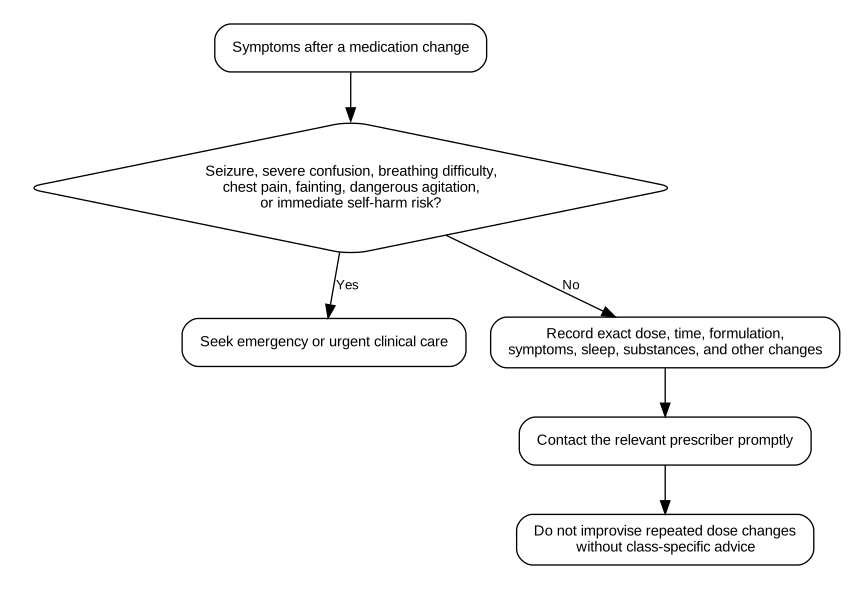
    Seek urgent local medical assessment when any of the following applies. This list is intentionally conservative and is not a diagnostic checklist:

- Immediate self-harm or violence risk-
Inability to remain safe because the restlessness is unbearable
-
New psychosis, mania, severe confusion, or delirium
-
Severe rigidity, high fever, or autonomic instability suggesting another acute syndrome
Emergency pathways and telephone numbers vary by country. A tracking application or educational article cannot rule out an emergency.
Questions to take to the prescriber
- What is the current indication and treatment goal?
- Which alternative explanations for the symptoms need assessment?
- What is the exact medication, formulation, timing, and most recent change?
- Which outcome should be monitored before another change is considered?
- What are the urgent warning signs and the fastest route back to the clinical team?
Frequently asked questions
Can akathisia happen after reducing a medication?
Yes, it has been reported after reduction or cessation, although initiation, dose increases, interactions, and other causes are also possible.
Is pacing required for diagnosis?
No. The subjective inner restlessness can be prominent even when movement is limited or suppressed.
Is akathisia the same as restless legs syndrome?
No. They can overlap, but restless legs is usually leg-focused, worse at rest and evening, and linked to characteristic sensations. Clinical assessment is needed.
What should I tell the clinician?
Describe the internal sensation, urge to move, visible movements, sleep, exact medication timing, and whether you feel able to keep yourself safe.
Regional and formulation note
Guidelines, labels, formulations, and care pathways vary by country. Verify the exact product label, manufacturer, strength, release system, and local clinical pathway before use. A tablet or capsule instruction that is correct for one product may be wrong for another.
References
- NICE. Medicines associated with dependence or withdrawal symptoms: safe prescribing and withdrawal management for adults (NG215). Evidence type: Guideline. Use in this article: Individualized planning, slow stepwise reduction, monitoring, and differentiation of withdrawal from relapse.

Bring real data to your doctor
Generate a clinician-ready Doctor Report in SBAR format with trend charts, plus clean CSV and PDF exports. Walk into your next appointment with evidence, not guesswork.
RxDown is a data tracking and journaling tool for adults (18+). It does not provide medical advice, diagnosis, or treatment. Never stop taking medication or change your dose based solely on information from this app or website — medication reduction should always be supervised by a qualified healthcare professional.