 RxDown
Evidence reviewed through:
⚕️ This article is education, not medical advice. Every claim is sourced below. Never stop or change medication without your prescriber — some medications are dangerous to stop abruptly.
Tapering in Older Adults With Multiple Medications
Key answer
A geriatric framework for reducing medications while protecting function, cognition, falls, disease control, and the person’s goals. The central safety principle is: Function, cognition, falls, symptom control, treatment burden, and quality of life. [1–3]
A safe interpretation starts with the exact medication or intervention, the reason it is being used, the formulation, treatment duration, other medicines, current symptoms, and the risks of both continuing and changing treatment. The article therefore explains decision factors and safety boundaries rather than prescribing a fixed schedule.
At a glance
| Question or decision | Evidence-based answer |
|---|---|
| Primary outcomes | Function, cognition, falls, symptom control, treatment burden, and quality of life. |
| Common hazards | Sedative and anticholinergic burden, orthostatic hypotension, renal dosing, duplicate therapy, and interaction cascades. |
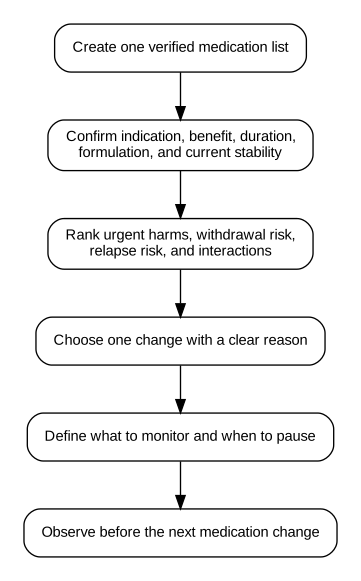
| Process | Medication reconciliation, goal review, one prioritized change, monitoring, and caregiver support where appropriate. |
| What not to do | Stop several long-term medicines at once solely because they appear on a potentially inappropriate medication list. |
Evidence basis and uncertainty
This article prioritizes regulator-hosted product information, current clinical guidance, systematic reviews, randomized trials, and carefully labeled observational or mechanistic evidence. The references below are used according to their design and limitations [1–3]. Absence of a detected signal is not rewritten as absence of risk, and a population average is not presented as an individual prediction.
| Reference | Evidence type | How it is used in this article |
|---|---|---|
| 1 | Consensus criteria | Highlights risks from benzodiazepines, Z-drugs, anticholinergic burden, interactions, and polypharmacy in adults 65 and older. |
| 2 | Guideline | Individualized planning, slow stepwise reduction, monitoring, and differentiation of withdrawal from relapse. |
| 3 | Systematic review | Interventions can reduce anticholinergic burden, but evidence on patient-important outcomes remains limited. |
Working definitions
| Term | Meaning in this article |
|---|---|
| Withdrawal symptoms | New or intensified symptoms after a dose reduction, missed dose, formulation change, or stop when physiologic adaptation is a plausible contributor. |
| Rebound | Temporary return of a treated symptom above its pretreatment baseline. |
| Relapse or recurrence | Return of the underlying treated condition. |
| Physical dependence | Physiologic adaptation; it is not the same as addiction or a substance use disorder. |
Start with actual use and goals
Older adults often take prescriptions from several specialists plus over-the-counter medicines and supplements. Reconcile what is actually taken, including as-needed doses. Ask which outcomes matter most: alertness, pain, mobility, sleep, staying at home, preventing hospitalization, or reducing pill burden.
Account for changing physiology
Kidney and liver function, body composition, albumin, blood pressure regulation, swallowing, cognition, and sensitivity to sedatives change with age and illness. A previously stable regimen may become risky after hospitalization, dehydration, weight loss, or a new medication.
Identify prescribing cascades
A medicine may have been added to treat another medicine’s adverse effect—for example, a sedative causing falls followed by another drug for dizziness. Removing the wrong link first can worsen the cascade. Map indication and chronology.
Use one prioritized experiment
When feasible, choose one change with a measurable target and observation period. Monitor function, cognition, falls, pain, sleep, mood, blood pressure or glucose where relevant, and withdrawal or disease recurrence. Caregivers may provide important observations but should not override the person’s preferences and capacity.
Coordinate transitions of care
Hospital discharge, rehabilitation, and care-home transitions are high-risk times for accidental continuation, omission, or duplication. The updated list should state which medicine changed, why, who follows it, and what would trigger reinstatement or another review.
When urgent medical assessment may be needed
    Seek urgent local medical assessment when any of the following applies. This list is intentionally conservative and is not a diagnostic checklist:

- Acute delirium, repeated falls, suspected toxicity, or major orthostatic symptoms-
Several prescribers give conflicting instructions
-
Essential seizure, cardiac, endocrine, transplant, or psychiatric treatment is omitted
-
The person cannot understand or safely execute a complex regimen without support
Emergency pathways and telephone numbers vary by country. A tracking application or educational article cannot rule out an emergency.
Questions to take to the prescriber
- What is the current indication and treatment goal?
- Which alternative explanations for the symptoms need assessment?
- What is the exact medication, formulation, timing, and most recent change?
- Which outcome should be monitored before another change is considered?
- What are the urgent warning signs and the fastest route back to the clinical team?
Frequently asked questions
Does polypharmacy mean all medicines are inappropriate?
No. Multiple medications may be necessary. The question is whether each has a current indication, benefit, acceptable risk, and workable monitoring plan.
Should the highest-risk medicine always be first?
Urgent harm may take priority, but withdrawal and relapse risk can change the order. Sequence is individualized.
Can a caregiver decide to stop medicines?
Medication decisions should involve the patient and authorized clinicians, with capacity and legal frameworks respected.
How often should the list be reviewed?
At major health changes, care transitions, new symptoms, new prescriptions, and at regular planned intervals.
Regional and formulation note
Guidelines, labels, formulations, and care pathways vary by country. Verify the exact product label, manufacturer, strength, release system, and local clinical pathway before use. A tablet or capsule instruction that is correct for one product may be wrong for another.
References
-
American Geriatrics Society 2023 Updated AGS Beers Criteria for Potentially Inappropriate Medication Use in Older Adults. Evidence type: Consensus criteria. Use in this article: Highlights risks from benzodiazepines, Z-drugs, anticholinergic burden, interactions, and polypharmacy in adults 65 and older.
-
NICE. Medicines associated with dependence or withdrawal symptoms: safe prescribing and withdrawal management for adults (NG215). Evidence type: Guideline. Use in this article: Individualized planning, slow stepwise reduction, monitoring, and differentiation of withdrawal from relapse.
-
Griffiths R, et al. Deprescribing anticholinergic medications in hospitalized older adults: systematic review. 2025. Evidence type: Systematic review. Use in this article: Interventions can reduce anticholinergic burden, but evidence on patient-important outcomes remains limited.

Bring real data to your doctor
Generate a clinician-ready Doctor Report in SBAR format with trend charts, plus clean CSV and PDF exports. Walk into your next appointment with evidence, not guesswork.
RxDown is a data tracking and journaling tool for adults (18+). It does not provide medical advice, diagnosis, or treatment. Never stop taking medication or change your dose based solely on information from this app or website — medication reduction should always be supervised by a qualified healthcare professional.