 RxDown
Evidence reviewed through:
⚕️ This article is education, not medical advice. Every claim is sourced below. Never stop or change medication without your prescriber — some medications are dangerous to stop abruptly.
Alternate-Day Dosing: Why Skipping Days Can Make Withdrawal Harder
Key answer
Why taking a medication every other day can create larger concentration swings, when exceptions exist, and how to ask for more consistent smaller-dose options. The central safety principle is: A full dose followed by a drug-free interval can create repeated peaks and troughs rather than a steady smaller exposure. [1–3]
A safe interpretation starts with the exact medication or intervention, the reason it is being used, the formulation, treatment duration, other medicines, current symptoms, and the risks of both continuing and changing treatment. The article therefore explains decision factors and safety boundaries rather than prescribing a fixed schedule.
At a glance
| Question or decision | Evidence-based answer |
|---|---|
| Main concern | A full dose followed by a drug-free interval can create repeated peaks and troughs rather than a steady smaller exposure. |
| Highest concern | Shorter half-life medicines, medications with active withdrawal risk, and seizure- or cardiovascular-risk drugs. |
| Possible exception | Selected long-half-life medicines or indication-specific plans directed by a prescriber. |
| Better question | Can the same total reduction be delivered as a smaller consistent daily dose with a verified formulation? |
Evidence basis and uncertainty
This article prioritizes regulator-hosted product information, current clinical guidance, systematic reviews, randomized trials, and carefully labeled observational or mechanistic evidence. The references below are used according to their design and limitations [1–3]. Absence of a detected signal is not rewritten as absence of risk, and a population average is not presented as an individual prediction.
| Reference | Evidence type | How it is used in this article |
|---|---|---|
| 1 | Guideline | Individualized planning, slow stepwise reduction, monitoring, and differentiation of withdrawal from relapse. |
| 2 | Professional guidance | Patient-facing guidance on withdrawal, proportional reductions, and formulation considerations. |
| 3 | Systematic review | Found limited evidence on the accuracy and safety of dose-form manipulation; product-specific verification remains essential. |
Working definitions
| Term | Meaning in this article |
|---|---|
| Withdrawal symptoms | New or intensified symptoms after a dose reduction, missed dose, formulation change, or stop when physiologic adaptation is a plausible contributor. |
| Rebound | Temporary return of a treated symptom above its pretreatment baseline. |
| Relapse or recurrence | Return of the underlying treated condition. |
| Physical dependence | Physiologic adaptation; it is not the same as addiction or a substance use disorder. |
Why the same weekly total is not the same exposure
The nervous system experiences concentration over time, not a weekly arithmetic average. Taking a full dose on Monday and none on Tuesday can produce a higher peak and a lower trough than taking a smaller dose each day. The difference is greatest for medicines that clear quickly.
Repeated peaks and troughs can make symptoms follow the calendar: feeling worse on off-days, temporarily better after the next dose, and increasingly uncertain about whether the underlying condition is returning.
Half-life is relevant but not the only factor
A short half-life raises concern, but active metabolites, formulation, absorption, organ function, and dosing frequency also matter. Extended-release delivery can smooth absorption without making elimination long. Conversely, a very long-lived medicine may have less fluctuation, yet alternate-day dosing is still a clinical choice rather than a universal rule.
When clinicians may deliberately use non-daily dosing
There are indication- and medication-specific exceptions, including products explicitly designed for weekly dosing or selected long-half-life strategies. Those exceptions should not be copied to unrelated medications. The prescriber should explain why the interval is appropriate and how delayed symptoms will be monitored.
Questions to ask instead of improvising skipped days
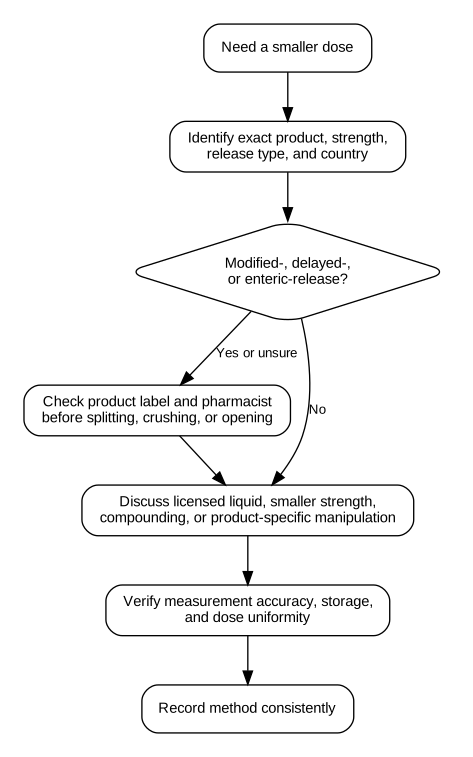
Ask whether a smaller commercial strength, licensed liquid, compounded preparation, verified tablet split, or product-specific capsule method is available. Ask whether changing formulation can be separated from changing dose. A pharmacist can check whether the proposed method preserves release characteristics and measurement accuracy.
How to recognize a peak–trough pattern
Record dose time, symptom onset, sleep, and function every day. A recurring off-day pattern is useful information, but it does not prove withdrawal. Caffeine, alcohol, work schedule, sleep debt, menstrual cycle, pain, and other medications can create similar periodic patterns.
When urgent medical assessment may be needed
    Seek urgent local medical assessment when any of the following applies. This list is intentionally conservative and is not a diagnostic checklist:

- The medication carries seizure, blood-pressure, cardiac, adrenal, or severe withdrawal risk-
Symptoms include seizure, severe confusion, breathing difficulty, chest pain, or fainting
-
The person is alternating modified-release products without product-specific advice
-
Several medications are being changed on different alternating schedules
Emergency pathways and telephone numbers vary by country. A tracking application or educational article cannot rule out an emergency.
Questions to take to the prescriber
- What is the current indication and treatment goal?
- Which alternative explanations for the symptoms need assessment?
- What is the exact medication, formulation, timing, and most recent change?
- Which outcome should be monitored before another change is considered?
- What are the urgent warning signs and the fastest route back to the clinical team?
Frequently asked questions
Is alternate-day dosing always wrong?
No. Some medication- and indication-specific plans use it. The concern is treating it as a generic taper method without considering pharmacokinetics and formulation.
Why did my symptoms improve after the next dose?
That pattern may support a concentration-related effect, but it is not diagnostic and should be discussed with the prescriber.
Does an extended-release tablet make every-other-day dosing stable?
Not necessarily. Extended release changes absorption during that dose; it does not guarantee meaningful exposure through an entire skipped day.
Can I alternate two tablet strengths instead?
That still creates day-to-day variation. Whether the variation is clinically acceptable depends on the medicine and should be verified.
Regional and formulation note
Guidelines, labels, formulations, and care pathways vary by country. Verify the exact product label, manufacturer, strength, release system, and local clinical pathway before use. A tablet or capsule instruction that is correct for one product may be wrong for another.
References
-
NICE. Medicines associated with dependence or withdrawal symptoms: safe prescribing and withdrawal management for adults (NG215). Evidence type: Guideline. Use in this article: Individualized planning, slow stepwise reduction, monitoring, and differentiation of withdrawal from relapse.
-
Royal College of Psychiatrists. Stopping antidepressants. Evidence type: Professional guidance. Use in this article: Patient-facing guidance on withdrawal, proportional reductions, and formulation considerations.
-
O’Brien D, et al. A systematic review of manipulations to pharmaceutical dosage forms used in psychotropic tapering plans. 2025. Evidence type: Systematic review. Use in this article: Found limited evidence on the accuracy and safety of dose-form manipulation; product-specific verification remains essential.

Bring real data to your doctor
Generate a clinician-ready Doctor Report in SBAR format with trend charts, plus clean CSV and PDF exports. Walk into your next appointment with evidence, not guesswork.
RxDown is a data tracking and journaling tool for adults (18+). It does not provide medical advice, diagnosis, or treatment. Never stop taking medication or change your dose based solely on information from this app or website — medication reduction should always be supervised by a qualified healthcare professional.