 RxDown
Evidence reviewed through:
⚕️ This article is education, not medical advice. Every claim is sourced below. Never stop or change medication without your prescriber — some medications are dangerous to stop abruptly.
How to Make Smaller Medication Doses: Liquids, Compounding, Tablet Splitting, and Beads
Key answer
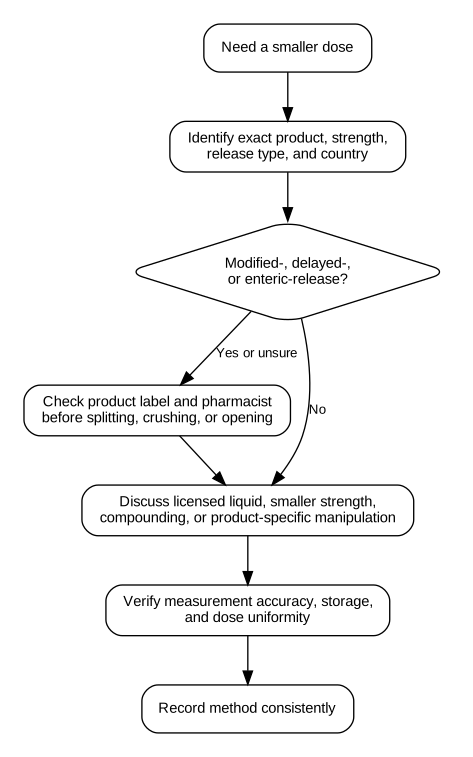
A formulation-first guide to making smaller medication doses without assuming that every tablet can be split or every capsule can be opened. The central safety principle is: Identify the exact product, release type, strength, country, and manufacturer. [1–4]
A safe interpretation starts with the exact medication or intervention, the reason it is being used, the formulation, treatment duration, other medicines, current symptoms, and the risks of both continuing and changing treatment. The article therefore explains decision factors and safety boundaries rather than prescribing a fixed schedule.
At a glance
| Question or decision | Evidence-based answer |
|---|---|
| Safest starting point | Identify the exact product, release type, strength, country, and manufacturer. |
| Licensed liquid | Often preferable when available, but concentration, excipients, measuring device, shaking, and storage must be verified. |
| Compounding | May provide smaller strengths, but stability, uniformity, beyond-use date, and pharmacy quality matter. |
| Tablet splitting | Suitable only for products whose design and labeling support it; halves may still vary. |
| Capsule beads or contents | Product-specific. Counting or weighing has limited validation and may alter delayed-release protection or dose uniformity. |
Evidence basis and uncertainty
This article prioritizes regulator-hosted product information, current clinical guidance, systematic reviews, randomized trials, and carefully labeled observational or mechanistic evidence. The references below are used according to their design and limitations [1–4]. Absence of a detected signal is not rewritten as absence of risk, and a population average is not presented as an individual prediction.
| Reference | Evidence type | How it is used in this article |
|---|---|---|
| 1 | Systematic review | Found limited evidence on the accuracy and safety of dose-form manipulation; product-specific verification remains essential. |
| 2 | Pharmacy review | Rules are product-specific: many modified-release or enteric-coated products must not be crushed, while some scored products may be split only when labeling confirms it. |
| 3 | Guideline | Individualized planning, slow stepwise reduction, monitoring, and differentiation of withdrawal from relapse. |
| 4 | Professional guidance | Patient-facing guidance on withdrawal, proportional reductions, and formulation considerations. |
Working definitions
| Term | Meaning in this article |
|---|---|
| Withdrawal symptoms | New or intensified symptoms after a dose reduction, missed dose, formulation change, or stop when physiologic adaptation is a plausible contributor. |
| Rebound | Temporary return of a treated symptom above its pretreatment baseline. |
| Relapse or recurrence | Return of the underlying treated condition. |
| Physical dependence | Physiologic adaptation; it is not the same as addiction or a substance use disorder. |
Why the dosage form is part of the medicine
A medication is not only its active ingredient. Coatings, matrices, pellets, osmotic systems, capsule shells, and release-controlling layers determine where and how the ingredient is delivered. Two products with the same generic name and total milligrams may have different manipulation rules.
The first step is therefore not choosing a kitchen technique. It is recording the complete product: generic name, manufacturer, imprint, strength, immediate- or modified-release status, and country-specific label.
Licensed liquids
A licensed oral solution or suspension may allow measured doses without damaging a release system. The concentration must be written in both milligrams and milliliters. Suspensions may require shaking; concentrates may require dilution; some products need specific storage or have short in-use periods. Household teaspoons are not accurate measuring devices.
A liquid is not automatically linear in effect, and switching from a tablet to a liquid can introduce a manufacturer, excipient, or absorption change. Document the switch separately from the dose reduction whenever possible.
Pharmacy compounding
A compounding pharmacy may prepare capsules or liquids at strengths that are not commercially available. The prescriber and pharmacist should specify the exact ingredient, dosage form, concentration, vehicle, storage, beyond-use date, and measuring device. Compounded products are not all equivalent, and quality standards differ by jurisdiction.
Tablet splitting
A score line can indicate that a tablet was designed to be divided, but not every score guarantees equal drug content for repeated tiny reductions. Unscored, very small, brittle, enteric-coated, and many modified-release tablets may be unsuitable. A tablet cutter may improve consistency, but visual equality does not prove dose equality.
Opening capsules, counting beads, or weighing contents
Some capsules contain immediate-release powder; others contain delayed-release or extended-release pellets. Some product labels permit sprinkling intact contents on a specified food for swallowing, but that instruction does not necessarily validate removing a fraction for tapering. Pellet number, size, and drug distribution may vary within and between manufacturers.
Weighing powder or beads also requires a validated assumption that weight tracks active drug content. Published reviews find limited evidence for many community manipulation methods. A pharmacist should identify whether a method is chemically and mechanically plausible for the exact product.
How to reduce avoidable measurement error
Use one verified method consistently. Keep the same manufacturer when feasible, use calibrated oral syringes for liquids, write down concentration and calculation, avoid simultaneous formulation and dose changes, and ask the pharmacist what variation is expected. Photographing the label and recording lot or manufacturer changes can help interpret unexpected symptoms.
When urgent medical assessment may be needed
    Seek urgent local medical assessment when any of the following applies. This list is intentionally conservative and is not a diagnostic checklist:

- A product is extended-, controlled-, delayed-, sustained-, or enteric-release and the manipulation rule is unknown-
A dose calculation cannot be independently checked
-
The person has seizure risk or is using a high-risk medicine where dose error could be dangerous
-
New symptoms began after a manufacturer or formulation switch rather than a planned dose change
Emergency pathways and telephone numbers vary by country. A tracking application or educational article cannot rule out an emergency.
Questions to take to the prescriber
- What is the current indication and treatment goal?
- Which alternative explanations for the symptoms need assessment?
- What is the exact medication, formulation, timing, and most recent change?
- Which outcome should be monitored before another change is considered?
- What are the urgent warning signs and the fastest route back to the clinical team?
Frequently asked questions
Can every scored tablet be split?
No. Check the exact product label and pharmacist guidance. A score may support splitting into a limited number of parts, not repeated micro-splitting.
Is bead counting proven accurate?
Not broadly. It may be plausible for selected products, but pellet distribution and release design vary. The evidence base is limited and product-specific.
Is a compounded liquid always better?
No. It can be useful, but stability, concentration, uniformity, excipients, cost, access, and pharmacy quality must be considered.
Can I make a liquid at home?
Only when a pharmacist or validated product-specific instruction confirms the method, vehicle, concentration, stability, and measurement. Improvised recipes can produce inaccurate or unstable doses.
Regional and formulation note
Guidelines, labels, formulations, and care pathways vary by country. Verify the exact product label, manufacturer, strength, release system, and local clinical pathway before use. A tablet or capsule instruction that is correct for one product may be wrong for another.
References
-
O’Brien D, et al. A systematic review of manipulations to pharmaceutical dosage forms used in psychotropic tapering plans. 2025. Evidence type: Systematic review. Use in this article: Found limited evidence on the accuracy and safety of dose-form manipulation; product-specific verification remains essential.
-
Blaszczyk A, et al. Crushed tablet administration for patients with dysphagia and enteral feeding: challenges and considerations. Drugs & Aging. 2023. Evidence type: Pharmacy review. Use in this article: Rules are product-specific: many modified-release or enteric-coated products must not be crushed, while some scored products may be split only when labeling confirms it.
-
NICE. Medicines associated with dependence or withdrawal symptoms: safe prescribing and withdrawal management for adults (NG215). Evidence type: Guideline. Use in this article: Individualized planning, slow stepwise reduction, monitoring, and differentiation of withdrawal from relapse.
-
Royal College of Psychiatrists. Stopping antidepressants. Evidence type: Professional guidance. Use in this article: Patient-facing guidance on withdrawal, proportional reductions, and formulation considerations.

Bring real data to your doctor
Generate a clinician-ready Doctor Report in SBAR format with trend charts, plus clean CSV and PDF exports. Walk into your next appointment with evidence, not guesswork.
RxDown is a data tracking and journaling tool for adults (18+). It does not provide medical advice, diagnosis, or treatment. Never stop taking medication or change your dose based solely on information from this app or website — medication reduction should always be supervised by a qualified healthcare professional.