 RxDown
Evidence reviewed through:
⚕️ This article is education, not medical advice. Every claim is sourced below. Never stop or change medication without your prescriber — some medications are dangerous to stop abruptly.
Insomnia After Cancer Treatment: Why It Persists and How It Is Assessed
Key answer
An evidence-based overview of persistent insomnia during and after cancer treatment, including contributors, validated assessment, sleep-disorder differential diagnosis, and first-line care. The central safety principle is: Insomnia symptoms occurring in the context of cancer, treatment, survivorship, symptoms, and psychosocial factors—not a single biological subtype. [1–4]
A safe interpretation starts with the exact medication or intervention, the reason it is being used, the formulation, treatment duration, other medicines, current symptoms, and the risks of both continuing and changing treatment. The article therefore explains decision factors and safety boundaries rather than prescribing a fixed schedule.
At a glance
| Question or decision | Evidence-based answer |
|---|---|
| What “cancer-related insomnia” means | Insomnia symptoms occurring in the context of cancer, treatment, survivorship, symptoms, and psychosocial factors—not a single biological subtype. |
| Why it can persist | Conditioned arousal, irregular sleep, pain, hot flashes, fatigue, mood symptoms, medications, breathing disorders, circadian disruption, and fear of recurrence can interact. |
| Assessment tools | A clinical interview and sleep diary, often supported by a validated measure such as the Insomnia Severity Index; testing is targeted, not routine for everyone. |
| First-line chronic-insomnia care | Cancer guidelines recommend cognitive behavioral therapy for insomnia (CBT-I), adapted to medical context when needed. |
Evidence basis and uncertainty
This article prioritizes regulator-hosted product information, current clinical guidance, systematic reviews, randomized trials, and carefully labeled observational or mechanistic evidence. The references below are used according to their design and limitations [1–4]. Absence of a detected signal is not rewritten as absence of risk, and a population average is not presented as an individual prediction.
| Reference | Evidence type | How it is used in this article |
|---|---|---|
| 1 | Oncology clinical practice guideline | Recommends screening and first-line CBT-I-based care for chronic insomnia in patients with cancer and cancer survivors. |
| 2 | Systematic review and meta-analysis | Found average improvement but highlighted heterogeneity and the difference between statistical change and patient-level response. |
| 3 | Narrative review | Sleep problems reflect interacting factors such as pre-existing sleep disorders, prior treatment, hot flashes, pain, and endocrine therapy. |
| 4 | Systematic review | Reported heterogeneous sleep outcomes across surgery, chemotherapy, radiotherapy, and endocrine therapy; pooled descriptive means are not direct causal comparisons or individual risk estimates. |
Working definitions
| Term | Meaning in this article |
|---|---|
| Withdrawal symptoms | New or intensified symptoms after a dose reduction, missed dose, formulation change, or stop when physiologic adaptation is a plausible contributor. |
| Rebound | Temporary return of a treated symptom above its pretreatment baseline. |
| Relapse or recurrence | Return of the underlying treated condition. |
| Physical dependence | Physiologic adaptation; it is not the same as addiction or a substance use disorder. |
Insomnia can continue after treatment ends
Cancer treatment may end while sleep disruption continues. Symptoms can be triggered by surgery, chemotherapy, radiotherapy, endocrine therapy, corticosteroids, pain, hot flashes, nocturia, hospital routines, or worry. Over time, spending longer in bed, irregular schedules, napping, monitoring the clock, and fear of not sleeping can maintain insomnia even after the original trigger improves. Persistent insomnia is real and treatable; it is not evidence that the person is coping badly.
A structured assessment prevents oversimplification
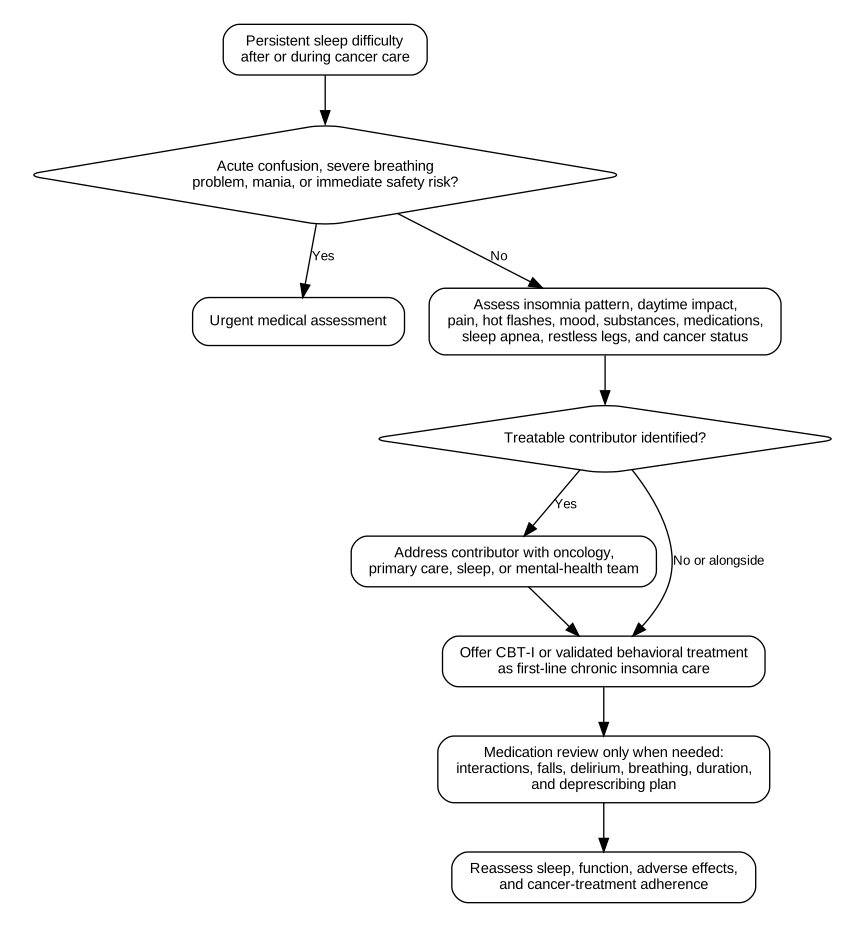
Assessment should define sleep onset, awakenings, early waking, opportunity for sleep, daytime impairment, duration, and weekly pattern. Record treatment phase, cancer symptoms, current medicines, alcohol and caffeine, naps, activity, mood, hot flashes, pain, and caregiving demands. A validated questionnaire can quantify severity and response but does not replace diagnosis.
Other sleep and medical conditions to consider
Obstructive sleep apnea, restless legs syndrome, circadian rhythm disorder, parasomnia, medication adverse effects, thyroid disease, anemia, infection, cardiopulmonary disease, uncontrolled pain, depression, anxiety, and substance effects can coexist. Snoring with witnessed breathing pauses, leg discomfort relieved by movement, extreme sleepiness, or unusual nighttime behavior may change the evaluation.
What treatment usually starts with
ESMO guidance supports CBT-I as first-line treatment for chronic insomnia in patients with cancer and survivors. CBT-I combines several components—typically stimulus control, sleep scheduling or restriction, cognitive work, relaxation, and relapse prevention. Sleep hygiene alone is not equivalent. Delivery may be face-to-face, telehealth, group, brief behavioral, or digital, with adaptation for fatigue, pain, frailty, and treatment schedules.
Where medication fits
A sleep medication may sometimes be considered for short-term distress, acute treatment-related insomnia, or when CBT-I is inaccessible or insufficient. The decision should review falls, delirium, respiratory disease, liver and kidney function, interactions, driving, alcohol, opioid or benzodiazepine use, and the person’s treatment goals. Long-term use requires periodic benefit–risk review; a cancer history does not by itself select a particular hypnotic.
What the evidence cannot promise
Average treatment effects do not mean every survivor responds. Cancer studies vary by cancer type, treatment stage, insomnia definition, control condition, and delivery model. No single prevalence estimate applies to all cancers or all points in survivorship. A persistent symptom deserves reassessment rather than repeated escalation of sedatives without a sleep diagnosis.
When urgent medical assessment may be needed
    Seek urgent local medical assessment when any of the following applies. This list is intentionally conservative and is not a diagnostic checklist:

- New breathing difficulty, chest pain, severe infection symptoms, or uncontrolled pain-
Immediate self-harm risk, mania, psychosis, or severe confusion
-
New focal neurologic symptoms, seizure, or rapidly worsening headache
-
Witnessed prolonged breathing pauses, severe daytime sleepiness with driving risk, or recurrent falls
Emergency pathways and telephone numbers vary by country. A tracking application or educational article cannot rule out an emergency.
Questions to take to the prescriber
- What is the current indication and treatment goal?
- Which alternative explanations for the symptoms need assessment?
- What is the exact medication, formulation, timing, and most recent change?
- Which outcome should be monitored before another change is considered?
- What are the urgent warning signs and the fastest route back to the clinical team?
Frequently asked questions
Is insomnia normal after cancer treatment?
It is common, but persistent sleep difficulty with daytime impairment deserves assessment and treatment.
Does every survivor need a sleep study?
No. Testing is targeted when symptoms suggest sleep apnea, movement disorder, parasomnia, another sleep disorder, or an uncertain diagnosis.
Is sleep hygiene enough?
Usually not for chronic insomnia. It can support care but is not a substitute for multicomponent CBT-I.
Can fear of recurrence affect sleep?
Yes. It can increase arousal and nighttime monitoring and may be addressed within CBT-I or psycho-oncology care.
Regional and formulation note
Guidelines, labels, formulations, and care pathways vary by country. Verify the exact product label, manufacturer, strength, release system, and local clinical pathway before use. A tablet or capsule instruction that is correct for one product may be wrong for another.
References
-
Grassi L, et al. Insomnia in adult patients with cancer: ESMO Clinical Practice Guideline. 2023. Evidence type: Oncology clinical practice guideline. Use in this article: Recommends screening and first-line CBT-I-based care for chronic insomnia in patients with cancer and cancer survivors.
-
Cooper JT, et al. Effects of CBT-I compared with controls among cancer survivors: systematic review and meta-analysis of randomized trials. 2025. Evidence type: Systematic review and meta-analysis. Use in this article: Found average improvement but highlighted heterogeneity and the difference between statistical change and patient-level response.
-
Van Dyk K, et al. Sleep and endocrine therapy in breast cancer. 2021. Evidence type: Narrative review. Use in this article: Sleep problems reflect interacting factors such as pre-existing sleep disorders, prior treatment, hot flashes, pain, and endocrine therapy.
-
Carson EK, et al. The impact of breast cancer treatment on sleep disturbance: a systematic review. Breast Cancer Research and Treatment. 2025. Evidence type: Systematic review. Use in this article: Reported heterogeneous sleep outcomes across surgery, chemotherapy, radiotherapy, and endocrine therapy; pooled descriptive means are not direct causal comparisons or individual risk estimates.

Bring real data to your doctor
Generate a clinician-ready Doctor Report in SBAR format with trend charts, plus clean CSV and PDF exports. Walk into your next appointment with evidence, not guesswork.
RxDown is a data tracking and journaling tool for adults (18+). It does not provide medical advice, diagnosis, or treatment. Never stop taking medication or change your dose based solely on information from this app or website — medication reduction should always be supervised by a qualified healthcare professional.