 RxDown
Evidence reviewed through:
⚕️ This article is education, not medical advice. Every claim is sourced below. Never stop or change medication without your prescriber — some medications are dangerous to stop abruptly.
Cancer-Related Insomnia and Sleep Medications: Interactions, Delirium, Falls, and Tapering Questions
Key answer
A safety-first guide to sleep medications during cancer treatment and survivorship, covering interactions, delirium, falls, respiratory risk, long-term review, and withdrawal or rebound questions. The central safety principle is: Benzodiazepines, Z-drugs, DORAs, sedating antidepressants, antipsychotics, antihistamines, melatonin products, and other agents have different evidence and risks. [1–4]
A safe interpretation starts with the exact medication or intervention, the reason it is being used, the formulation, treatment duration, other medicines, current symptoms, and the risks of both continuing and changing treatment. The article therefore explains decision factors and safety boundaries rather than prescribing a fixed schedule.
At a glance
| Question or decision | Evidence-based answer |
|---|---|
| Medication is not one category | Benzodiazepines, Z-drugs, DORAs, sedating antidepressants, antipsychotics, antihistamines, melatonin products, and other agents have different evidence and risks. |
| Cancer-specific review | Treatment interactions, organ function, delirium, falls, respiratory status, pain medicines, hot flashes, nausea medicines, and treatment schedule. |
| Long-term question | Is there a current benefit, what harm is present, and is chronic insomnia receiving first-line behavioral treatment? |
| Tapering safeguard | Do not abruptly stop a medication that may cause clinically significant withdrawal; identify the exact product and indication first. |
Evidence basis and uncertainty
This article prioritizes regulator-hosted product information, current clinical guidance, systematic reviews, randomized trials, and carefully labeled observational or mechanistic evidence. The references below are used according to their design and limitations [1–4]. Absence of a detected signal is not rewritten as absence of risk, and a population average is not presented as an individual prediction.
| Reference | Evidence type | How it is used in this article |
|---|---|---|
| 1 | Oncology clinical practice guideline | Recommends screening and first-line CBT-I-based care for chronic insomnia in patients with cancer and cancer survivors. |
| 2 | Clinical practice guideline | Strongly recommends multicomponent CBT-I for chronic insomnia; sleep hygiene alone is not equivalent to CBT-I. |
| 3 | Guideline | Individualized planning, slow stepwise reduction, monitoring, and differentiation of withdrawal from relapse. |
| 4 | Consensus criteria | Highlights risks from benzodiazepines, Z-drugs, anticholinergic burden, interactions, and polypharmacy in adults 65 and older. |
Working definitions
| Term | Meaning in this article |
|---|---|
| Withdrawal symptoms | New or intensified symptoms after a dose reduction, missed dose, formulation change, or stop when physiologic adaptation is a plausible contributor. |
| Rebound | Temporary return of a treated symptom above its pretreatment baseline. |
| Relapse or recurrence | Return of the underlying treated condition. |
| Physical dependence | Physiologic adaptation; it is not the same as addiction or a substance use disorder. |
Why “a sleeping pill” is too vague
Sedating medicines act through different receptors and have different half-lives, interactions, dependence risks, and evidence. A benzodiazepine, a Z-drug, a dual orexin receptor antagonist (DORA), a sedating antidepressant, and an antihistamine should not be discussed as substitutes. The generic medication name and exact formulation should remain the canonical terms throughout the record.
Cancer-treatment factors that change risk
Chemotherapy, endocrine therapy, corticosteroids, antiemetics, opioids, gabapentinoids, cannabinoids, alcohol, and other central nervous system depressants can alter sedation or interaction risk. Kidney or liver impairment can increase exposure. Neuropathy, frailty, nocturia, anemia, and orthostatic symptoms increase fall risk. Respiratory disease or sleep apnea may change the safety assessment.
Delirium is not ordinary insomnia
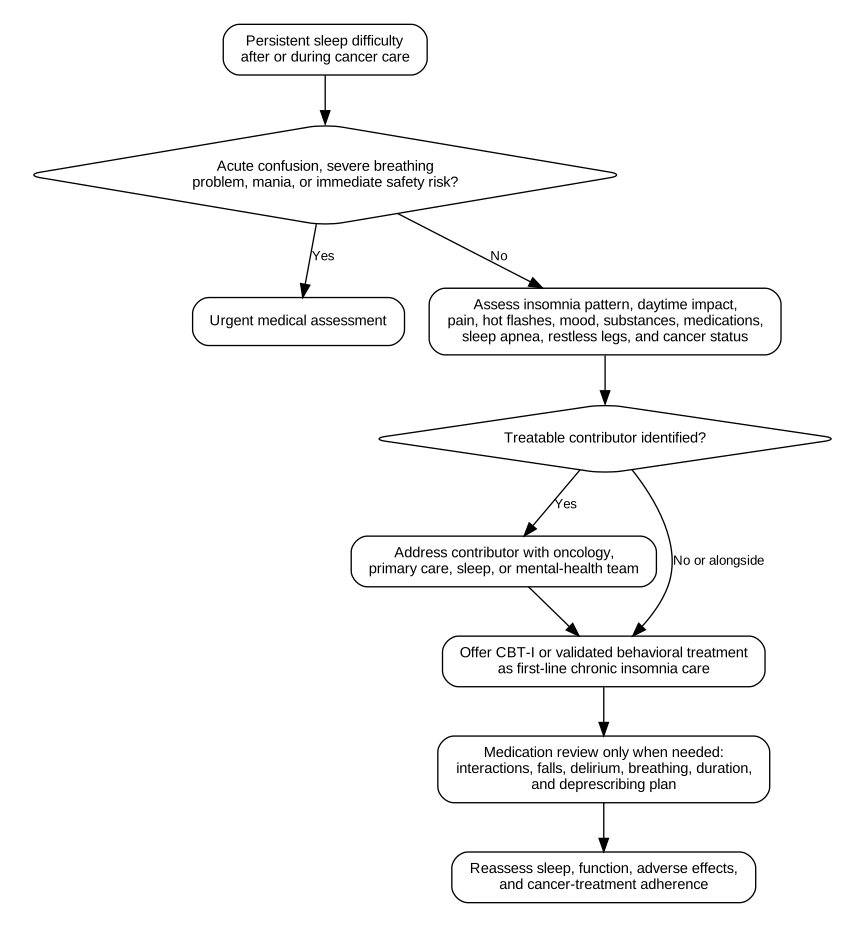
New fluctuating attention, disorientation, hallucinations, altered arousal, or reversed sleep–wake pattern—especially during acute illness or hospitalization—may indicate delirium. Adding another sedative without finding the cause can worsen harm. Infection, metabolic disturbance, medication toxicity, pain, urinary retention, constipation, hypoxia, and brain involvement may require urgent evaluation.
Long-term use and medication review
Review the original reason, current benefit, dose timing, next-day function, falls, cognition, driving, tolerance, missed-dose symptoms, and concurrent sedatives. For chronic insomnia, offer or arrange CBT-I rather than treating medication review as a stand-alone removal exercise. Shared decisions can include continuing, changing, or reducing treatment; the goal is not automatic discontinuation.
Withdrawal, rebound, and recurrence
Withdrawal symptoms are new or intensified symptoms related to physiologic adaptation after a reduction or stop. Rebound insomnia is a temporary return of insomnia above pretreatment baseline. Recurrence is return of the underlying insomnia or another condition. The patterns overlap. Benzodiazepines and some other medicines should not be abruptly stopped after physical dependence; a prescriber should individualize any plan.
What evidence cannot decide remotely
Trials rarely capture every oncology regimen, interaction, frailty level, or long-term combination. A website cannot rank one hypnotic as safest for every survivor or calculate a taper without diagnosis, exposure, formulation, organ function, and co-medications. Pharmacy and oncology review are essential when treatment changes are active.
When urgent medical assessment may be needed
    Seek urgent local medical assessment when any of the following applies. This list is intentionally conservative and is not a diagnostic checklist:

- New confusion, hallucinations, fluctuating alertness, or suspected delirium-
Slow or difficult breathing, overdose, or a high-risk sedative combination
-
Recurrent falls, fainting, severe daytime sleepiness, or unsafe driving
-
Abrupt interruption of a benzodiazepine or another high-risk medication with severe symptoms
Emergency pathways and telephone numbers vary by country. A tracking application or educational article cannot rule out an emergency.
Questions to take to the prescriber
- What is the current indication and treatment goal?
- Which alternative explanations for the symptoms need assessment?
- What is the exact medication, formulation, timing, and most recent change?
- Which outcome should be monitored before another change is considered?
- What are the urgent warning signs and the fastest route back to the clinical team?
Frequently asked questions
Does a cancer survivor need to stop every sleep medication?
No. The current benefit, harm, indication, alternatives, and the person’s goals determine the decision.
Can melatonin interact with cancer treatment?
Products vary and interactions or treatment-specific cautions are possible; the oncology pharmacist should review every supplement.
Is rebound insomnia proof that I still need the medication?
No. It may be temporary, but recurrence and other causes can overlap and require assessment.
What is the safest sleep medication during chemotherapy?
There is no universal answer; regimen, organ function, symptoms, interactions, delirium and fall risk, and goals must be reviewed.
Regional and formulation note
Guidelines, labels, formulations, and care pathways vary by country. Verify the exact product label, manufacturer, strength, release system, and local clinical pathway before use. A tablet or capsule instruction that is correct for one product may be wrong for another.
References
-
Grassi L, et al. Insomnia in adult patients with cancer: ESMO Clinical Practice Guideline. 2023. Evidence type: Oncology clinical practice guideline. Use in this article: Recommends screening and first-line CBT-I-based care for chronic insomnia in patients with cancer and cancer survivors.
-
American Academy of Sleep Medicine. Behavioral and psychological treatments for chronic insomnia disorder in adults. 2021. Evidence type: Clinical practice guideline. Use in this article: Strongly recommends multicomponent CBT-I for chronic insomnia; sleep hygiene alone is not equivalent to CBT-I.
-
NICE. Medicines associated with dependence or withdrawal symptoms: safe prescribing and withdrawal management for adults (NG215). Evidence type: Guideline. Use in this article: Individualized planning, slow stepwise reduction, monitoring, and differentiation of withdrawal from relapse.
-
American Geriatrics Society 2023 Updated AGS Beers Criteria for Potentially Inappropriate Medication Use in Older Adults. Evidence type: Consensus criteria. Use in this article: Highlights risks from benzodiazepines, Z-drugs, anticholinergic burden, interactions, and polypharmacy in adults 65 and older.

Bring real data to your doctor
Generate a clinician-ready Doctor Report in SBAR format with trend charts, plus clean CSV and PDF exports. Walk into your next appointment with evidence, not guesswork.
RxDown is a data tracking and journaling tool for adults (18+). It does not provide medical advice, diagnosis, or treatment. Never stop taking medication or change your dose based solely on information from this app or website — medication reduction should always be supervised by a qualified healthcare professional.