 RxDown
Evidence reviewed through:
⚕️ This article is education, not medical advice. Every claim is sourced below. Never stop or change medication without your prescriber — some medications are dangerous to stop abruptly.
I Stopped My Medication and Feel Unwell—What Information Should I Gather Now?
Key answer
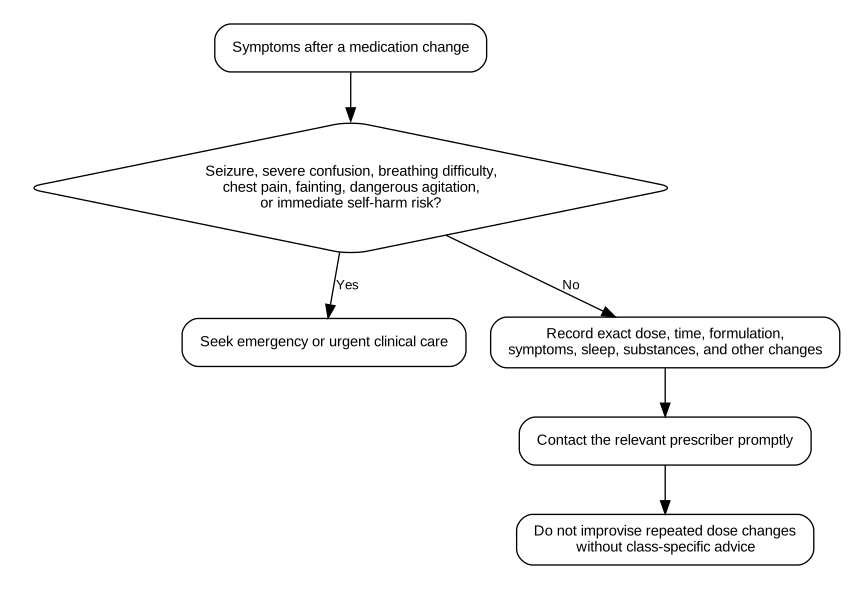
A calm first-response guide for symptoms after stopping a medication: emergency warning signs, the information a clinician needs, and why repeated self-directed dose changes can confuse the picture. The central safety principle is: Is there an emergency warning sign? [1–4]
A safe interpretation starts with the exact medication or intervention, the reason it is being used, the formulation, treatment duration, other medicines, current symptoms, and the risks of both continuing and changing treatment. The article therefore explains decision factors and safety boundaries rather than prescribing a fixed schedule.
At a glance
| Question or decision | Evidence-based answer |
|---|---|
| First question | Is there an emergency warning sign? |
| Most useful information | Exact medication, formulation, dose, timing of the last dose and changes, symptoms, other substances, and the original indication. |
| What not to assume | That every symptom is withdrawal, or that withdrawal cannot be serious. |
| What not to improvise | Repeated stop–start dose changes without class-specific clinical advice. |
Evidence basis and uncertainty
This article prioritizes regulator-hosted product information, current clinical guidance, systematic reviews, randomized trials, and carefully labeled observational or mechanistic evidence. The references below are used according to their design and limitations [1–4]. Absence of a detected signal is not rewritten as absence of risk, and a population average is not presented as an individual prediction.
| Reference | Evidence type | How it is used in this article |
|---|---|---|
| 1 | Guideline | Individualized planning, slow stepwise reduction, monitoring, and differentiation of withdrawal from relapse. |
| 2 | Professional guidance | Patient-facing guidance on withdrawal, proportional reductions, and formulation considerations. |
| 3 | Multisociety clinical practice guideline | Recommends individualized, generally gradual reductions, monitoring, and avoidance of abrupt discontinuation in physically dependent patients. |
| 4 | Clinical practice guideline | Warns against abrupt discontinuation or rapid dose reduction except for life-threatening circumstances and emphasizes collaborative, patient-centered care. |
Working definitions
| Term | Meaning in this article |
|---|---|
| Withdrawal symptoms | New or intensified symptoms after a dose reduction, missed dose, formulation change, or stop when physiologic adaptation is a plausible contributor. |
| Rebound | Temporary return of a treated symptom above its pretreatment baseline. |
| Relapse or recurrence | Return of the underlying treated condition. |
| Physical dependence | Physiologic adaptation; it is not the same as addiction or a substance use disorder. |
Step 1: check for urgent warning signs
Some symptoms after stopping a medication require urgent or emergency assessment rather than online troubleshooting. Examples include seizure, severe confusion or delirium, trouble breathing, chest pain, fainting, severe dehydration, uncontrolled blood pressure symptoms, new psychosis or mania, and immediate risk of self-harm.
The threshold for urgent review is lower after abrupt changes to benzodiazepines, alcohol, opioids, gabapentinoids used for seizures, clonidine, corticosteroids, baclofen, antiseizure medicines, and other medications with class-specific hazards.
Step 2: make a medication timeline
Write the generic name, brand and manufacturer if known, immediate- or modified-release formulation, strength, total daily dose, dosing times, duration of use, date and time of the last dose, and every recent reduction or missed dose. Include prescription, over-the-counter, supplement, nicotine, caffeine, alcohol, cannabis, and other substance changes.
A photograph of the label can prevent errors. “I stopped last week” is less useful than “the final 37.5 mg extended-release dose was taken at 8 p.m. on August 10.”
Step 3: describe symptoms without diagnosing them
Record onset, peak, duration, triggers, whether symptoms change before or after a dose, sleep, appetite, hydration, pulse or blood pressure only if safely and accurately measured, and impact on walking, driving, work, caregiving, or self-care.
Also describe the original condition before treatment. New dizziness, sensory symptoms, vomiting, tremor, or a distinctive timing pattern may support withdrawal; return of a familiar mood, panic, pain, seizure, or insomnia pattern may support relapse or rebound. Both can occur.
Step 4: contact the right clinical service
Contact the prescriber or covering clinician promptly. A pharmacist can clarify formulation and missed-dose instructions but does not replace urgent medical assessment. For medication for opioid use disorder, contact the treatment service quickly because loss of tolerance and recurrence risk matter. For cancer, transplant, endocrine, seizure, or cardiac treatment, contact the relevant specialty team.
Why reinstatement is not a universal answer
Reinstating a prior dose may help some withdrawal states, may be ineffective after time has passed, may cause adverse effects, or may be unsafe for a particular class. The decision depends on the medicine, time since stopping, severity, original indication, previous response, interactions, and urgent risks. This page therefore does not provide a general reinstatement instruction.
When urgent medical assessment may be needed
    Seek urgent local medical assessment when any of the following applies. This list is intentionally conservative and is not a diagnostic checklist:

- Seizure, delirium, hallucinations, or severe confusion-
Slow or difficult breathing, blue lips, or unresponsiveness
-
Chest pain, fainting, severe palpitations, or signs of stroke
-
Immediate self-harm or violence risk, mania, or psychosis
-
Severe vomiting, diarrhea, dehydration, or inability to take essential medicines
Emergency pathways and telephone numbers vary by country. A tracking application or educational article cannot rule out an emergency.
Questions to take to the prescriber
- What is the current indication and treatment goal?
- Which alternative explanations for the symptoms need assessment?
- What is the exact medication, formulation, timing, and most recent change?
- Which outcome should be monitored before another change is considered?
- What are the urgent warning signs and the fastest route back to the clinical team?
Frequently asked questions
Should I take the old dose immediately?
A website cannot answer that safely across medication classes. Contact the prescriber or urgent service with the exact timeline; use the emergency pathway for red flags.
How can I tell withdrawal from relapse?
Timing and symptom quality help, but neither is definitive. The original illness, formulation, half-life, and response over time all matter.
What if I cannot reach my prescriber?
Use the local urgent-care, after-hours, pharmacy, poison-center, emergency, or crisis pathway appropriate to the symptoms and medication.
Should I drive to get help?
Do not drive if dizzy, confused, severely sleep-deprived, sedated, agitated, or otherwise impaired. Use emergency transport or ask another person for help.
Regional and formulation note
Guidelines, labels, formulations, and care pathways vary by country. Verify the exact product label, manufacturer, strength, release system, and local clinical pathway before use. A tablet or capsule instruction that is correct for one product may be wrong for another.
References
-
NICE. Medicines associated with dependence or withdrawal symptoms: safe prescribing and withdrawal management for adults (NG215). Evidence type: Guideline. Use in this article: Individualized planning, slow stepwise reduction, monitoring, and differentiation of withdrawal from relapse.
-
Royal College of Psychiatrists. Stopping antidepressants. Evidence type: Professional guidance. Use in this article: Patient-facing guidance on withdrawal, proportional reductions, and formulation considerations.
-
ASAM and partner societies. Joint Clinical Practice Guideline on Benzodiazepine Tapering. 2025. Evidence type: Multisociety clinical practice guideline. Use in this article: Recommends individualized, generally gradual reductions, monitoring, and avoidance of abrupt discontinuation in physically dependent patients.
-
CDC Clinical Practice Guideline for Prescribing Opioids for Pain — United States, 2022. Evidence type: Clinical practice guideline. Use in this article: Warns against abrupt discontinuation or rapid dose reduction except for life-threatening circumstances and emphasizes collaborative, patient-centered care.

Bring real data to your doctor
Generate a clinician-ready Doctor Report in SBAR format with trend charts, plus clean CSV and PDF exports. Walk into your next appointment with evidence, not guesswork.
RxDown is a data tracking and journaling tool for adults (18+). It does not provide medical advice, diagnosis, or treatment. Never stop taking medication or change your dose based solely on information from this app or website — medication reduction should always be supervised by a qualified healthcare professional.