 RxDown
Evidence reviewed through:
⚕️ This article is education, not medical advice. Every claim is sourced below. Never stop or change medication without your prescriber — some medications are dangerous to stop abruptly.
CBT-I With DORAs: What Is Known, What Has Not Been Tested, and How to Avoid Overclaiming
Key answer
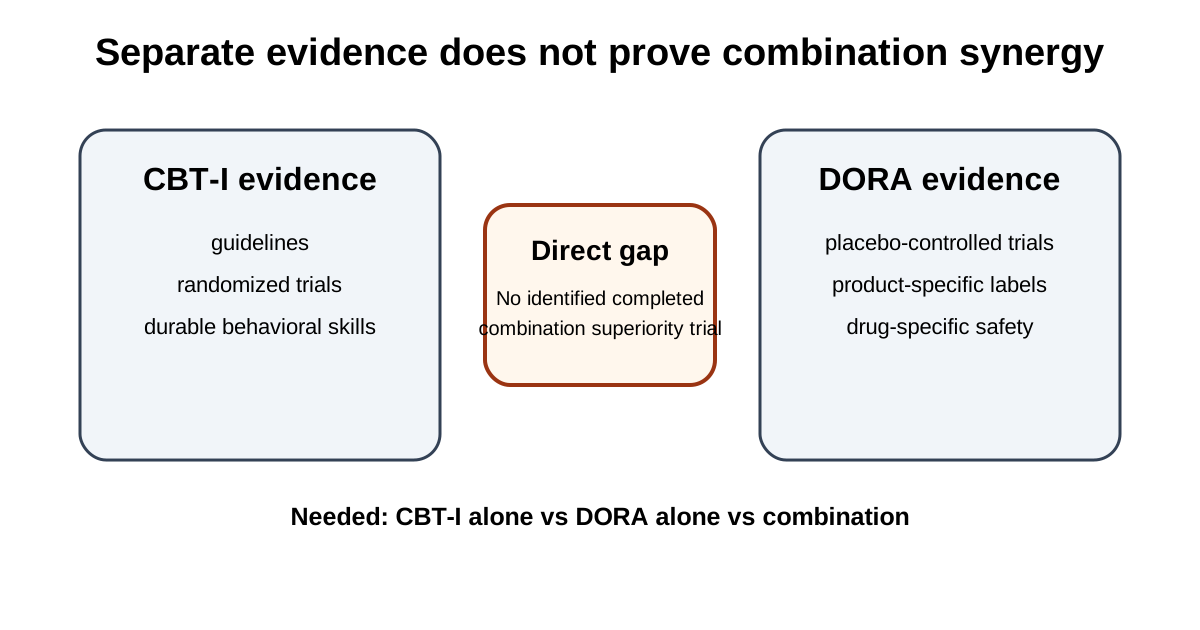
CBT-I and dual orexin receptor antagonists (DORAs) each have evidence for insomnia, but evidence for the combination is not the same as evidence for either treatment alone. In searches of PubMed and ClinicalTrials.gov through 19 August 2026, we did not identify a completed randomized trial designed to compare CBT-I plus suvorexant, lemborexant, or daridorexant with CBT-I alone or a DORA alone in a general chronic-insomnia population.
That absence does not mean the combination is ineffective or unsafe. It means websites should not claim synergy, faster remission, easier DORA discontinuation, or prevention of rebound based on separate monotherapy trials. Combination decisions remain individualized and should be studied directly. [1–7]
At a glance
| Question | Current answer |
|---|---|
| Is CBT-I first-line for chronic insomnia? | Yes in major adult guidelines. [1–3] |
| Do DORAs improve insomnia outcomes versus placebo? | Yes for approved products under the conditions tested in their trials and labels. [4–6] |
| Has CBT-I + a DORA been proven superior to either alone? | No completed direct comparative trial was identified in this review. |
| Can CBT-I be used while a person takes a DORA? | Clinically possible, but evidence and safety must be individualized; no universal sequencing rule follows. |
| Does CBT-I prevent DORA withdrawal or rebound? | Not established. DORA discontinuation data come mainly from drug trials, not CBT-I combination trials. |
| Can evidence from zolpidem or trazodone combinations be transferred? | No. Different mechanisms, designs, and populations prevent direct substitution. |
What is established for CBT-I
AASM, ACP, and European guidelines recommend CBT-I as the initial or first-line treatment for chronic insomnia. The best-supported form is multicomponent treatment rather than sleep hygiene alone. Digital delivery can improve access, although therapist support, adherence, and safety screening affect outcomes. [1–3]
What is established for DORAs
Suvorexant, lemborexant, and daridorexant have placebo-controlled trial programs and regulator-reviewed labeling for insomnia in certain regions. Outcomes, doses, treatment durations, next-day effects, contraindications, and discontinuation assessments differ. A class label should not be treated as proof that every DORA is interchangeable. [4–6]
Clinical trials generally test efficacy against placebo under eligibility criteria that exclude or limit many comorbidities. They do not establish how a DORA should be combined with every behavioral program or how to taper another hypnotic.
What a direct combination trial would need to test
A useful factorial or multi-arm trial would compare at least:
- CBT-I alone;
- DORA alone;
- CBT-I plus the same DORA;
- an appropriate control or usual-care condition.
It should preregister insomnia remission, daytime function, adverse events, adherence, falls or driving outcomes where relevant, durability after medication discontinuation, and whether CBT-I permits a lower medication exposure. It should also report therapist contact, digital support, comorbidities, and the exact DORA regimen.
Without those comparisons, an apparent improvement after combined care cannot identify whether the behavioral treatment, medication, natural course, expectation, or interaction caused the change.
Why older combination evidence cannot simply be copied
Trials combining behavioral therapy with benzodiazepines, Z-drugs, trazodone, or other hypnotics answer mechanism-specific questions. A DORA reduces wake drive through orexin-receptor antagonism; it is not a dose-equivalent substitute for a GABAergic hypnotic. Cross-tapering or substitution introduces withdrawal, rebound, interaction, and timing questions beyond insomnia efficacy.
A 2025 European expert consensus proposed algorithms that include CBT-I and medications, but consensus algorithms and indirect evidence do not replace randomized comparison of the DORA–CBT-I combination. Conflicts of interest and regional labeling should be disclosed. [7]
Appropriate current wording
Supported wording:
CBT-I remains a first-line treatment for chronic insomnia. A DORA may be considered separately when clinically appropriate. Direct evidence defining whether the combination is superior, safer, or helpful for medication discontinuation remains limited.
Unsupported wording:
CBT-I and DORAs work synergistically, prevent withdrawal, and are the best combined treatment.
Research and product implications
RxDown can track insomnia severity, sleep timing, next-day function, DORA exposure, other sedatives, and CBT-I participation. It should not infer synergy from correlated improvement. Product analytics should label treatment start dates and avoid presenting wearable sleep estimates as polysomnography or diagnosis.
Frequently asked questions
Should CBT-I start before a DORA?
There is no universal sequence. Guidelines place CBT-I first-line, but urgency, access, severity, comorbidities, preferences, and prior response can alter care.
Can a DORA make CBT-I easier?
Plausible, but not established by direct comparative evidence. Sedation or improved sleep could help some people and complicate diary interpretation for others.
Can CBT-I make it easier to stop a DORA?
Not proven. Do not generalize from benzodiazepine or Z-drug deprescribing trials.
Was no trial found because the combination is unsafe?
No. Failure to identify a direct trial is an evidence gap, not a safety signal.
References
- Edinger JD, et al. AASM clinical practice guideline for behavioral and psychological insomnia treatments. 2021. Evidence type: Clinical practice guideline. Use: Strong recommendation for multicomponent CBT-I.
- Riemann D, et al. European Insomnia Guideline 2023. Evidence type: Guideline. Use: CBT-I first line, in-person or digital.
- Qaseem A, et al. ACP guideline for chronic insomnia. 2016. Evidence type: Clinical practice guideline. Use: Initial CBT-I and shared decisions about added medication.
- DailyMed. Suvorexant product labeling. Evidence type: Regulator-hosted labeling. Use: Approved regional claims and discontinuation conditions.
- DailyMed. Lemborexant product labeling. Evidence type: Regulator-hosted labeling. Use: Approved regional claims and safety.
- DailyMed. Daridorexant product labeling. Evidence type: Regulator-hosted labeling. Use: Approved regional claims and safety.
- Clinical practice guidelines for switching or deprescribing hypnotic medications for chronic insomnia: European expert consensus. 2025. Evidence type: Expert consensus based on 21 selected papers. Use: Clinical context and limitations; not direct proof of CBT-I–DORA synergy.

Bring real data to your doctor
Generate a clinician-ready Doctor Report in SBAR format with trend charts, plus clean CSV and PDF exports. Walk into your next appointment with evidence, not guesswork.
RxDown is a data tracking and journaling tool for adults (18+). It does not provide medical advice, diagnosis, or treatment. Never stop taking medication or change your dose based solely on information from this app or website — medication reduction should always be supervised by a qualified healthcare professional.