 RxDown
Evidence reviewed through:
⚕️ This article is education, not medical advice. Every claim is sourced below. Never stop or change medication without your prescriber — some medications are dangerous to stop abruptly.
CBT-I for Cancer Survivors: Evidence, Delivery Options, and Who May Need More
Key answer
A research-grounded guide to cognitive behavioral therapy for insomnia in cancer survivors, including components, delivery formats, expected benefits, adaptations, nonresponse, and evidence limitations. The central safety principle is: CBT-I is recommended as first-line treatment for chronic insomnia, including in oncology guidance. [1–3]
A safe interpretation starts with the exact medication or intervention, the reason it is being used, the formulation, treatment duration, other medicines, current symptoms, and the risks of both continuing and changing treatment. The article therefore explains decision factors and safety boundaries rather than prescribing a fixed schedule.
At a glance
| Question or decision | Evidence-based answer |
|---|---|
| First-line status | CBT-I is recommended as first-line treatment for chronic insomnia, including in oncology guidance. |
| Core components | Stimulus control, sleep scheduling or sleep restriction, cognitive strategies, relaxation, and relapse prevention. |
| Delivery formats | Individual, group, telehealth, brief behavioral treatment, and digital programs; support level and suitability vary. |
| Important limitation | Average improvement does not mean universal response, and trial populations may not represent advanced illness or complex comorbidity. |
Evidence basis and uncertainty
This article prioritizes regulator-hosted product information, current clinical guidance, systematic reviews, randomized trials, and carefully labeled observational or mechanistic evidence. The references below are used according to their design and limitations [1–3]. Absence of a detected signal is not rewritten as absence of risk, and a population average is not presented as an individual prediction.
| Reference | Evidence type | How it is used in this article |
|---|---|---|
| 1 | Oncology clinical practice guideline | Recommends screening and first-line CBT-I-based care for chronic insomnia in patients with cancer and cancer survivors. |
| 2 | Systematic review and meta-analysis | Found average improvement but highlighted heterogeneity and the difference between statistical change and patient-level response. |
| 3 | Clinical practice guideline | Strongly recommends multicomponent CBT-I for chronic insomnia; sleep hygiene alone is not equivalent to CBT-I. |
Working definitions
| Term | Meaning in this article |
|---|---|
| Withdrawal symptoms | New or intensified symptoms after a dose reduction, missed dose, formulation change, or stop when physiologic adaptation is a plausible contributor. |
| Rebound | Temporary return of a treated symptom above its pretreatment baseline. |
| Relapse or recurrence | Return of the underlying treated condition. |
| Physical dependence | Physiologic adaptation; it is not the same as addiction or a substance use disorder. |
What CBT-I actually is
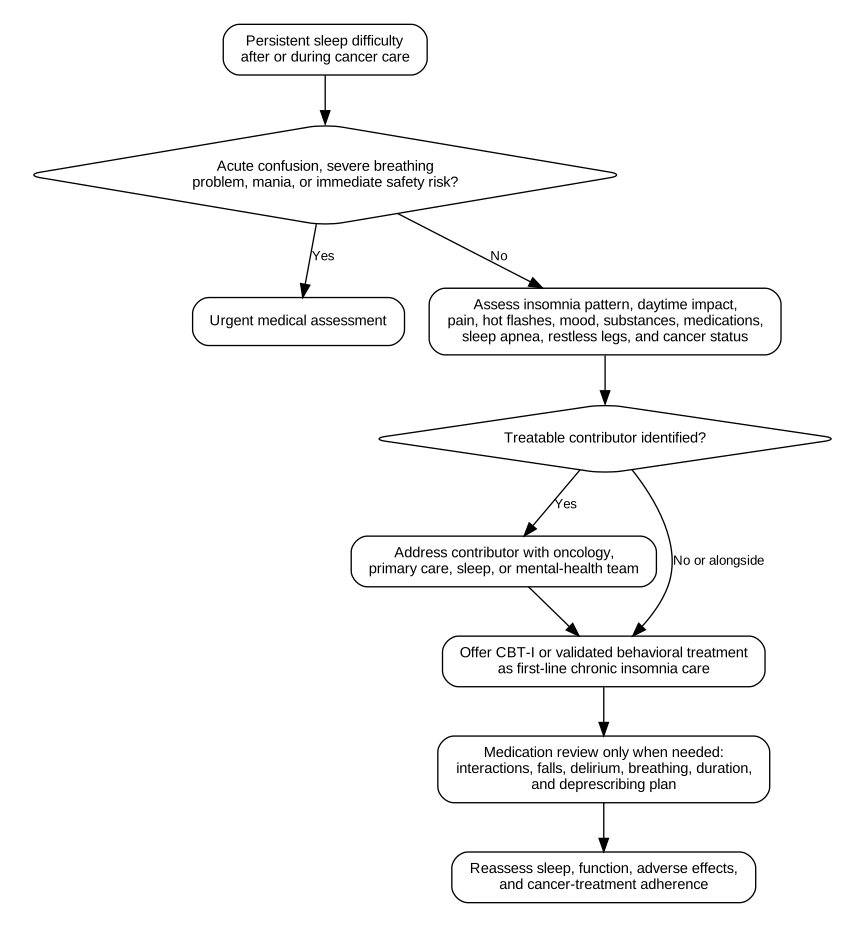
CBT-I is a structured treatment, not a list of sleep-hygiene tips. It targets behaviors and beliefs that perpetuate insomnia. Stimulus control rebuilds the bed–sleep association; sleep scheduling consolidates sleep opportunity; cognitive strategies address catastrophic predictions and monitoring; relaxation reduces arousal; and relapse planning prepares for future treatment, scan, or symptom-related disruptions.
What cancer-survivor trials suggest
Randomized trials and meta-analyses generally show improvement in insomnia severity and sleep continuity compared with control conditions. The size of benefit varies, and statistical improvement is not the same as every participant achieving remission or a patient-important threshold. Heterogeneity reflects cancer type, stage, treatment, baseline insomnia, delivery method, therapist contact, comparator, and follow-up.
How CBT-I may be adapted
Standard principles can be retained while adapting pace and monitoring for fatigue, pain, hot flashes, nocturia, immune compromise, mobility limitations, caregiving, and variable treatment schedules. Sleep-restriction components should be supervised when there is severe sleepiness, fall risk, seizure risk, bipolar disorder, or another condition in which sleep loss may be hazardous. The aim is not to ignore medical symptoms but to treat insomnia alongside them.
Digital, group, and brief options
Digital CBT-I can expand access and may work well for people able to engage independently. Therapist-guided digital programs may offer more support than fully automated ones. Group and telehealth formats can also reduce travel burden. A person with severe depression, suicidality, mania risk, complex sleep disorders, cognitive impairment, or unstable cancer symptoms may need clinician-led care rather than self-guided treatment alone.
What to do when response is incomplete
Check whether the diagnosis is correct, the full protocol was delivered, medical symptoms are controlled, circadian timing is addressed, and another sleep disorder is present. Review medications, alcohol, caffeine, pain, hot flashes, restless legs, breathing symptoms, and mood. Nonresponse is not personal failure and should not automatically lead to escalating sedative combinations.
Evidence limits and honest wording
Use “CBT-I improves insomnia on average and is recommended first-line,” not “CBT-I cures cancer insomnia.” Many studies have modest samples and exclude medically unstable patients. Access, adaptation, adherence, and long-term implementation remain important research and service gaps.
2025–2026 evidence update
The OncoSleep randomized trial reported a large improvement in insomnia severity from a six-module web program with clinician support in 154 cancer survivors. A 2025 meta-analysis across chronic diseases also found moderate-to-large insomnia benefits and high acceptability. These results strengthen access arguments but do not eliminate the need to adapt treatment during unstable cancer symptoms, severe fatigue, falls, cognitive impairment, or another sleep disorder.
See the general CBT-I pillar guide and digital vs therapist-led comparison for non-oncology details.
When urgent medical assessment may be needed
    Seek urgent local medical assessment when any of the following applies. This list is intentionally conservative and is not a diagnostic checklist:

- Immediate self-harm risk, mania, psychosis, or severe depression requiring urgent care-
Severe sleepiness that makes driving, falls, or occupational injury likely
-
Possible untreated sleep apnea, seizure disorder, or another condition requiring adaptation before sleep restriction
-
Uncontrolled cancer symptoms or an acute medical change that requires oncology assessment
Emergency pathways and telephone numbers vary by country. A tracking application or educational article cannot rule out an emergency.
Questions to take to the prescriber
- What is the current indication and treatment goal?
- Which alternative explanations for the symptoms need assessment?
- What is the exact medication, formulation, timing, and most recent change?
- Which outcome should be monitored before another change is considered?
- What are the urgent warning signs and the fastest route back to the clinical team?
Frequently asked questions
Is CBT-I safe during active treatment?
It can be used during treatment, but components may need adaptation for fatigue, falls, severe symptoms, or changing schedules.
Is digital CBT-I equivalent to a therapist?
It can be effective for some people, but support, tailoring, suitability, and evidence differ by program.
How is CBT-I different from sleep hygiene?
CBT-I is a multicomponent treatment with behavioral and cognitive techniques; sleep hygiene is only supportive education.
Can CBT-I be combined with medication?
Sometimes. The reasons, timing, interaction risks, and eventual medication review should be planned rather than assumed.
Regional and formulation note
Guidelines, labels, formulations, and care pathways vary by country. Verify the exact product label, manufacturer, strength, release system, and local clinical pathway before use. A tablet or capsule instruction that is correct for one product may be wrong for another.
References
-
Grassi L, et al. Insomnia in adult patients with cancer: ESMO Clinical Practice Guideline. 2023. Evidence type: Oncology clinical practice guideline. Use in this article: Recommends screening and first-line CBT-I-based care for chronic insomnia in patients with cancer and cancer survivors.
-
Cooper JT, et al. Effects of CBT-I compared with controls among cancer survivors: systematic review and meta-analysis of randomized trials. 2025. Evidence type: Systematic review and meta-analysis. Use in this article: Found average improvement but highlighted heterogeneity and the difference between statistical change and patient-level response.
-
American Academy of Sleep Medicine. Behavioral and psychological treatments for chronic insomnia disorder in adults. 2021. Evidence type: Clinical practice guideline. Use in this article: Strongly recommends multicomponent CBT-I for chronic insomnia; sleep hygiene alone is not equivalent to CBT-I.

Bring real data to your doctor
Generate a clinician-ready Doctor Report in SBAR format with trend charts, plus clean CSV and PDF exports. Walk into your next appointment with evidence, not guesswork.
RxDown is a data tracking and journaling tool for adults (18+). It does not provide medical advice, diagnosis, or treatment. Never stop taking medication or change your dose based solely on information from this app or website — medication reduction should always be supervised by a qualified healthcare professional.