 RxDown
Evidence reviewed through:
⚕️ This article is education, not medical advice. Every claim is sourced below. Never stop or change medication without your prescriber — some medications are dangerous to stop abruptly.
Prescription Opioid Tapering: Why Rapid or Forced Reductions Can Cause Harm
Key answer
A patient-centered explanation of prescription opioid tapering, the harms of abrupt or forced reductions, withdrawal and overdose risk, and what collaborative care should include. The central safety principle is: Do not abruptly stop or rapidly reduce long-term opioid therapy unless a life-threatening situation requires immediate action. [1–2]
A safe interpretation starts with the exact medication or intervention, the reason it is being used, the formulation, treatment duration, other medicines, current symptoms, and the risks of both continuing and changing treatment. The article therefore explains decision factors and safety boundaries rather than prescribing a fixed schedule.
At a glance
| Question or decision | Evidence-based answer |
|---|---|
| Central principle | Do not abruptly stop or rapidly reduce long-term opioid therapy unless a life-threatening situation requires immediate action. |
| Why forced tapering can harm | Withdrawal, uncontrolled pain, mental-health deterioration, disengagement from care, unsafe opioid sourcing, and overdose after loss of tolerance. |
| What must be separated | Physical dependence, opioid use disorder, inadequate analgesia, opioid-induced harm, and a person’s treatment goals. |
| What the page does not provide | A fixed percentage or calendar schedule for an individual. |
Evidence basis and uncertainty
This article prioritizes regulator-hosted product information, current clinical guidance, systematic reviews, randomized trials, and carefully labeled observational or mechanistic evidence. The references below are used according to their design and limitations [1–2]. Absence of a detected signal is not rewritten as absence of risk, and a population average is not presented as an individual prediction.
| Reference | Evidence type | How it is used in this article |
|---|---|---|
| 1 | Clinical practice guideline | Warns against abrupt discontinuation or rapid dose reduction except for life-threatening circumstances and emphasizes collaborative, patient-centered care. |
| 2 | Guideline | Individualized planning, slow stepwise reduction, monitoring, and differentiation of withdrawal from relapse. |
Working definitions
| Term | Meaning in this article |
|---|---|
| Withdrawal symptoms | New or intensified symptoms after a dose reduction, missed dose, formulation change, or stop when physiologic adaptation is a plausible contributor. |
| Rebound | Temporary return of a treated symptom above its pretreatment baseline. |
| Relapse or recurrence | Return of the underlying treated condition. |
| Physical dependence | Physiologic adaptation; it is not the same as addiction or a substance use disorder. |
Why the goal matters before the dose
“Reduce the opioid” is not a complete clinical goal. The real goal may be safer function, fewer adverse effects, improved alertness, treatment of opioid use disorder, preparation for surgery, or a patient-requested trial of a lower dose. The expected benefits of continuing treatment and the risks of changing it must be considered together.
Physical dependence is expected after repeated opioid exposure and does not by itself diagnose opioid use disorder. Opioid use disorder involves a behavioral pattern such as loss of control, craving, and continued use despite harm. A person can have either condition, both, or neither. The treatment pathway changes accordingly.
Why abrupt or nonconsensual reduction is risky
Abrupt discontinuation can produce autonomic, gastrointestinal, pain, sleep, and psychological withdrawal symptoms. It can also destabilize pain care and trust. After a substantial reduction or stop, opioid tolerance falls; returning to a previously tolerated dose can then cause overdose. Some people may seek relief from an unpredictable supply, which further increases risk.
A taper should not be used as punishment, a condition for receiving unrelated care, or a response to a single screening result without clinical assessment. When imminent overdose or another life-threatening danger exists, clinicians may need to act faster, but emergency risk management is different from routine tapering.
What collaborative planning includes
A plan should review the pain diagnosis, function, adverse effects, sleep, mental health, substance use, pregnancy, kidney and liver function, co-prescribed benzodiazepines or gabapentinoids, naloxone access, and the patient’s priorities. It should define how pain and withdrawal will be treated, how often follow-up occurs, and how to pause or modify the plan.
Nonopioid and nonpharmacologic treatments should be introduced because they fit the pain condition, not merely to justify removal of the opioid. When opioid use disorder is present or suspected, evidence-based medication treatment should be offered rather than requiring detoxification first.
What to monitor during change
Monitor function as well as pain intensity: sleep, mobility, work or caregiving, cognition, mood, withdrawal symptoms, medication adherence, and use of alcohol or nonprescribed substances. Sudden deterioration is a reason for reassessment, not proof of noncompliance.
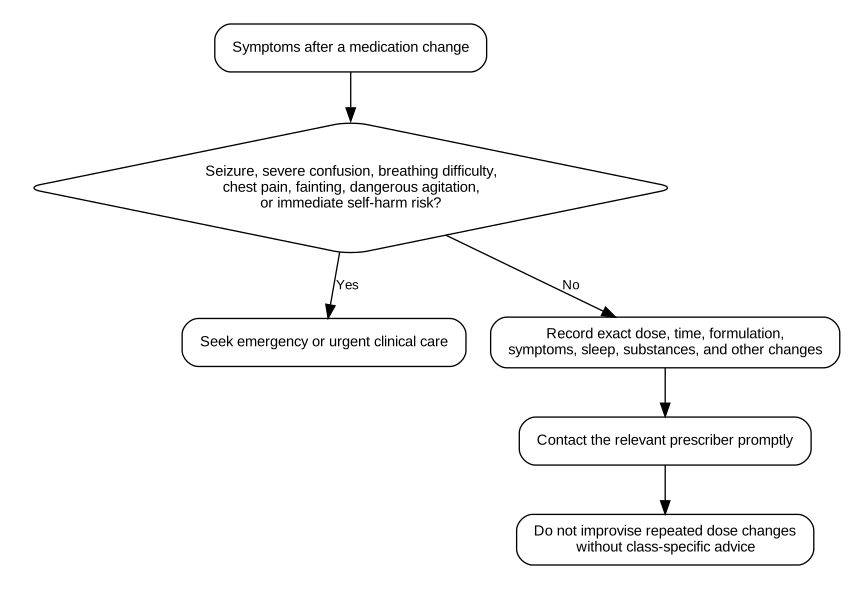
A clear rescue pathway matters. The person should know whom to contact, how to obtain naloxone where appropriate, and when breathing difficulty, overdose, severe dehydration, or immediate self-harm risk requires emergency care.
What the evidence does and does not say
Current guidance supports individualized, collaborative tapering and warns against abrupt or rapid reduction in people receiving long-term opioid therapy. It does not establish one percentage that is safe for every person. Evidence is limited by differences in pain conditions, baseline doses, taper support, outcome definitions, and the fact that many studies exclude people with the greatest complexity.
When urgent medical assessment may be needed
    Seek urgent local medical assessment when any of the following applies. This list is intentionally conservative and is not a diagnostic checklist:

- Slow or difficult breathing, blue lips, or unresponsiveness-
Suspected overdose or unexpected profound sedation
-
Immediate self-harm risk or severe mental-health deterioration
-
Severe vomiting or diarrhea with dehydration
-
Return to an unpredictable opioid supply after tolerance has fallen
Emergency pathways and telephone numbers vary by country. A tracking application or educational article cannot rule out an emergency.
Questions to take to the prescriber
- What is the current indication and treatment goal?
- Which alternative explanations for the symptoms need assessment?
- What is the exact medication, formulation, timing, and most recent change?
- Which outcome should be monitored before another change is considered?
- What are the urgent warning signs and the fastest route back to the clinical team?
Frequently asked questions
Is opioid withdrawal dangerous?
It is often intensely distressing and can cause dehydration and destabilization. The larger safety risks include overdose after loss of tolerance, uncontrolled coexisting illness, and unsafe return to opioid use.
Does a high dose prove addiction?
No. Dose alone does not diagnose opioid use disorder. A structured assessment of behavior, function, risk, and consequences is required.
Should benzodiazepines and opioids be reduced at the same time?
Not automatically. Combined use raises overdose risk, but sequencing must consider withdrawal risks, stability, and which change is most urgent. A coordinated prescriber plan is essential.
Can a clinic require a rapid taper?
Policies vary, but current clinical guidance warns that abrupt or rapid non-emergency reductions can cause harm. The clinical rationale, alternatives, monitoring, and patient concerns should be documented.
Regional and formulation note
Guidelines, labels, formulations, and care pathways vary by country. Verify the exact product label, manufacturer, strength, release system, and local clinical pathway before use. A tablet or capsule instruction that is correct for one product may be wrong for another.
References
-
CDC Clinical Practice Guideline for Prescribing Opioids for Pain — United States, 2022. Evidence type: Clinical practice guideline. Use in this article: Warns against abrupt discontinuation or rapid dose reduction except for life-threatening circumstances and emphasizes collaborative, patient-centered care.
-
NICE. Medicines associated with dependence or withdrawal symptoms: safe prescribing and withdrawal management for adults (NG215). Evidence type: Guideline. Use in this article: Individualized planning, slow stepwise reduction, monitoring, and differentiation of withdrawal from relapse.

Bring real data to your doctor
Generate a clinician-ready Doctor Report in SBAR format with trend charts, plus clean CSV and PDF exports. Walk into your next appointment with evidence, not guesswork.
RxDown is a data tracking and journaling tool for adults (18+). It does not provide medical advice, diagnosis, or treatment. Never stop taking medication or change your dose based solely on information from this app or website — medication reduction should always be supervised by a qualified healthcare professional.