 RxDown
Evidence reviewed through:
⚕️ This article is education, not medical advice. Every claim is sourced below. Never stop or change medication without your prescriber — some medications are dangerous to stop abruptly.
Anticholinergic Deprescribing: Burden, Benefits, and Withdrawal-Like Symptoms
Key answer
A specialist-review guide to reducing anticholinergic burden while separating potential cognitive and fall benefits from recurrence of the treated condition and medication-specific withdrawal effects. The central safety principle is: The combined effect of multiple medicines with anticholinergic activity, not a diagnosis or a precise biological measurement. [1–2]
A safe interpretation starts with the exact medication or intervention, the reason it is being used, the formulation, treatment duration, other medicines, current symptoms, and the risks of both continuing and changing treatment. The article therefore explains decision factors and safety boundaries rather than prescribing a fixed schedule.
At a glance
| Question or decision | Evidence-based answer |
|---|---|
| Anticholinergic burden | The combined effect of multiple medicines with anticholinergic activity, not a diagnosis or a precise biological measurement. |
| Potential reasons to review | Dry mouth, constipation, urinary retention, blurred vision, cognitive impairment, delirium, and falls—especially in older adults. |
| Why one score is insufficient | Burden scales differ, dose and indication matter, and a medicine may still provide meaningful benefit. |
| Main publication safeguard | Name the medication and indication; never recommend stopping an entire “anticholinergic list” at once. |
Evidence basis and uncertainty
This article prioritizes regulator-hosted product information, current clinical guidance, systematic reviews, randomized trials, and carefully labeled observational or mechanistic evidence. The references below are used according to their design and limitations [1–2]. Absence of a detected signal is not rewritten as absence of risk, and a population average is not presented as an individual prediction.
| Reference | Evidence type | How it is used in this article |
|---|---|---|
| 1 | Systematic review | Interventions can reduce anticholinergic burden, but evidence on patient-important outcomes remains limited. |
| 2 | Consensus criteria | Highlights risks from benzodiazepines, Z-drugs, anticholinergic burden, interactions, and polypharmacy in adults 65 and older. |
Working definitions
| Term | Meaning in this article |
|---|---|
| Withdrawal symptoms | New or intensified symptoms after a dose reduction, missed dose, formulation change, or stop when physiologic adaptation is a plausible contributor. |
| Rebound | Temporary return of a treated symptom above its pretreatment baseline. |
| Relapse or recurrence | Return of the underlying treated condition. |
| Physical dependence | Physiologic adaptation; it is not the same as addiction or a substance use disorder. |
What anticholinergic burden means
Many antidepressants, antipsychotics, bladder medicines, antihistamines, gastrointestinal medicines, and Parkinson medicines have anticholinergic effects. Burden scales estimate cumulative exposure but assign different weights and do not fully capture dose, blood–brain penetration, frailty, kidney function, or patient priorities. The score is a prompt for medication review, not an order to discontinue.
Possible benefits and tradeoffs
Reducing unnecessary exposure may improve dry mouth, constipation, alertness, or fall risk in some people. Evidence for consistent improvements in cognition and other patient-important outcomes remains limited. Removing an effective medicine can worsen urinary symptoms, movement symptoms, nausea, sleep, mood, allergy symptoms, or another treated condition.
Symptoms after a change
The pattern depends on the medication. Possible effects can include nausea, sweating, gastrointestinal symptoms, insomnia, anxiety, return of extrapyramidal symptoms, or rapid return of the original indication. These are not interchangeable across the class. A page should discuss the named medication rather than inventing one “anticholinergic withdrawal syndrome.”
How a medication review is sequenced
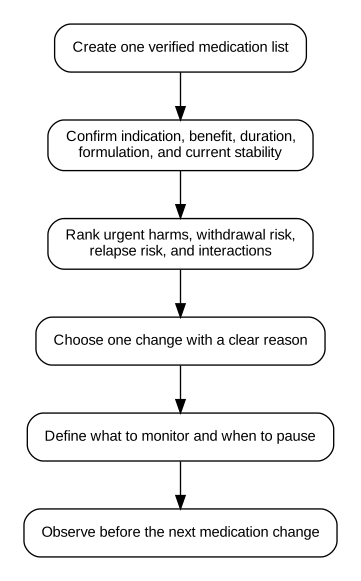
Confirm every prescription, over-the-counter product, sleep aid, and as-needed medicine. Identify duplicate indications and medicines with the weakest benefit or greatest harm. Change one medicine at a time when clinically feasible, define the outcome to observe, and include nonmedication or lower-burden alternatives when appropriate.
Evidence limits
Deprescribing interventions can reduce measured anticholinergic burden, but trials vary in setting, scale, duration, and clinical outcomes. The evidence does not justify claiming that reducing a score will reverse dementia or prevent every fall. Specialist input is important for Parkinson disease, severe mental illness, bladder disease, and complex polypharmacy.
When urgent medical assessment may be needed
    Seek urgent local medical assessment when any of the following applies. This list is intentionally conservative and is not a diagnostic checklist:

- Acute confusion, hallucinations, inability to urinate, severe constipation with abdominal pain, or a fall with injury-
Abrupt return of severe Parkinson symptoms or another disabling treated condition
-
A medication for severe mental illness is being changed without psychiatric review
-
Several sedating or anticholinergic medicines are being changed simultaneously without a monitoring plan
Emergency pathways and telephone numbers vary by country. A tracking application or educational article cannot rule out an emergency.
Questions to take to the prescriber
- What is the current indication and treatment goal?
- Which alternative explanations for the symptoms need assessment?
- What is the exact medication, formulation, timing, and most recent change?
- Which outcome should be monitored before another change is considered?
- What are the urgent warning signs and the fastest route back to the clinical team?
Frequently asked questions
Is diphenhydramine part of the medication review?
Yes. Over-the-counter antihistamines and sleep products can materially add to burden.
Will reducing anticholinergic burden improve memory?
It may help some people, but consistent reversal of cognitive impairment has not been proven.
Should all anticholinergic medicines be stopped?
No. Benefit, indication, alternatives, and medication-specific risks must be reviewed.
Why change one at a time?
It improves causal interpretation and reduces regimen complexity, unless urgent toxicity or another reason requires faster coordinated action.
Regional and formulation note
Guidelines, labels, formulations, and care pathways vary by country. Verify the exact product label, manufacturer, strength, release system, and local clinical pathway before use. A tablet or capsule instruction that is correct for one product may be wrong for another.
References
-
Griffiths R, et al. Deprescribing anticholinergic medications in hospitalized older adults: systematic review. 2025. Evidence type: Systematic review. Use in this article: Interventions can reduce anticholinergic burden, but evidence on patient-important outcomes remains limited.
-
American Geriatrics Society 2023 Updated AGS Beers Criteria for Potentially Inappropriate Medication Use in Older Adults. Evidence type: Consensus criteria. Use in this article: Highlights risks from benzodiazepines, Z-drugs, anticholinergic burden, interactions, and polypharmacy in adults 65 and older.

Bring real data to your doctor
Generate a clinician-ready Doctor Report in SBAR format with trend charts, plus clean CSV and PDF exports. Walk into your next appointment with evidence, not guesswork.
RxDown is a data tracking and journaling tool for adults (18+). It does not provide medical advice, diagnosis, or treatment. Never stop taking medication or change your dose based solely on information from this app or website — medication reduction should always be supervised by a qualified healthcare professional.