 RxDown
Evidence reviewed through:
⚕️ This article is education, not medical advice. Every claim is sourced below. Never stop or change medication without your prescriber — some medications are dangerous to stop abruptly.
Pediatric and Adolescent Antidepressant Discontinuation: What Is Known and What Is Not
Key answer
A specialist-review guide to antidepressant discontinuation in children and adolescents, including limited evidence, developmental context, relapse monitoring, family communication, and urgent safety concerns. The central safety principle is: Children and adolescents are not smaller adults; development, diagnosis, family supervision, school function, and suicide-risk monitoring change the decision. [1–3]
A safe interpretation starts with the exact medication or intervention, the reason it is being used, the formulation, treatment duration, other medicines, current symptoms, and the risks of both continuing and changing treatment. The article therefore explains decision factors and safety boundaries rather than prescribing a fixed schedule.
At a glance
| Question or decision | Evidence-based answer |
|---|---|
| Why this needs a separate page | Children and adolescents are not smaller adults; development, diagnosis, family supervision, school function, and suicide-risk monitoring change the decision. |
| Evidence status | The pediatric discontinuation evidence base is limited, heterogeneous, and weaker than the adult evidence base. |
| What must be monitored | Withdrawal symptoms, return of the treated condition, suicidality, activation or mania, eating and hydration, sleep, school participation, and family observations. |
| What the page does not provide | A dose schedule, a recommendation to stop treatment, or an adult schedule converted by body weight. |
Evidence basis and uncertainty
This article prioritizes regulator-hosted product information, current clinical guidance, systematic reviews, randomized trials, and carefully labeled observational or mechanistic evidence. The references below are used according to their design and limitations [1–3]. Absence of a detected signal is not rewritten as absence of risk, and a population average is not presented as an individual prediction.
| Reference | Evidence type | How it is used in this article |
|---|---|---|
| 1 | Systematic review | Pediatric evidence is limited and cannot simply be replaced by adult tapering assumptions. |
| 2 | Guideline | Individualized planning, slow stepwise reduction, monitoring, and differentiation of withdrawal from relapse. |
| 3 | Professional guidance | Patient-facing guidance on withdrawal, proportional reductions, and formulation considerations. |
Working definitions
| Term | Meaning in this article |
|---|---|
| Withdrawal symptoms | New or intensified symptoms after a dose reduction, missed dose, formulation change, or stop when physiologic adaptation is a plausible contributor. |
| Rebound | Temporary return of a treated symptom above its pretreatment baseline. |
| Relapse or recurrence | Return of the underlying treated condition. |
| Physical dependence | Physiologic adaptation; it is not the same as addiction or a substance use disorder. |
Why adult tapering advice cannot simply be copied
Medication metabolism, brain development, diagnostic stability, family involvement, and the consequences of relapse differ across childhood and adolescence. Trials of antidepressants in young people usually were not designed to determine the safest way to discontinue long-term treatment. Adult principles—such as avoiding abrupt stopping and using individualized monitoring—may still be relevant, but they do not supply pediatric dose steps or predict individual risk.
What symptoms may mean
Dizziness, nausea, headache, unusual sensory symptoms, sleep disruption, irritability, anxiety, agitation, tearfulness, or flu-like symptoms can occur after a missed dose or reduction. None is specific. Return of depression, anxiety, obsessive-compulsive symptoms, or another treated condition may overlap. Activation, mania, substance use, bullying, family conflict, medical illness, and developmental stressors also need consideration.
What a specialist assessment should include
Review the original diagnosis, episode severity, prior self-harm, comorbidity, duration of stability, previous missed-dose reactions, exact formulation, adherence, family capacity to supervise, school demands, and access to urgent care. Ask the young person privately about safety while also involving caregivers appropriately. The plan should state who observes what and how rapidly the prescriber can be contacted.
Communication and assent
Explain physical dependence without implying addiction. Use age-appropriate language, include the young person in decisions, and avoid framing symptoms as misbehavior. A written symptom and function plan can reduce conflict between the young person, family, school, and clinical team. Confidentiality limits and emergency pathways should be explicit.
Evidence limits
Systematic review evidence identifies major gaps in pediatric deprescribing research. It cannot define one optimal pace, prove that a particular formulation manipulation is accurate, or determine when an individual no longer benefits from treatment. Publication requires current specialist review and jurisdiction-specific safeguarding language.
When urgent medical assessment may be needed
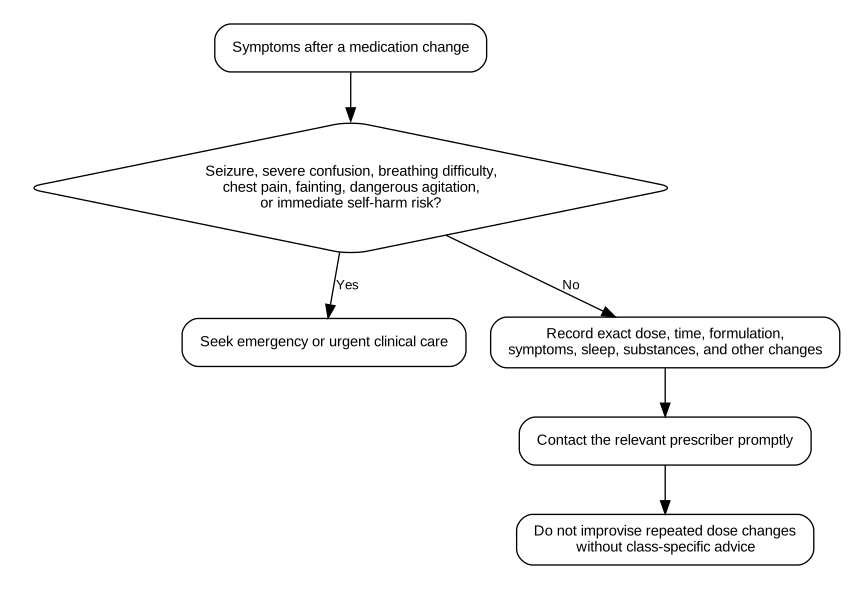
    Seek urgent local medical assessment when any of the following applies. This list is intentionally conservative and is not a diagnostic checklist:

- Immediate self-harm risk or a new suicide plan-
Mania, psychosis, severe aggression, or a sudden dangerous behavioral change
-
Seizure, fainting, severe confusion, or a serious medical symptom
-
A child cannot be safely supervised or the family cannot access the prescriber
Emergency pathways and telephone numbers vary by country. A tracking application or educational article cannot rule out an emergency.
Questions to take to the prescriber
- What is the current indication and treatment goal?
- Which alternative explanations for the symptoms need assessment?
- What is the exact medication, formulation, timing, and most recent change?
- Which outcome should be monitored before another change is considered?
- What are the urgent warning signs and the fastest route back to the clinical team?
Frequently asked questions
Can an adult taper schedule be adjusted by weight?
No. Body weight does not convert an adult schedule into a validated pediatric plan.
Is irritability always withdrawal?
No. It may reflect withdrawal, relapse, sleep loss, stress, activation, or another problem.
Who should be involved?
The young person, caregiver where appropriate, prescriber, and often a child and adolescent mental-health specialist and pharmacist.
When is urgent help needed?
Immediate self-harm risk, severe behavioral change, mania, psychosis, seizure, or inability to maintain safety requires urgent assessment.
Regional and formulation note
Guidelines, labels, formulations, and care pathways vary by country. Verify the exact product label, manufacturer, strength, release system, and local clinical pathway before use. A tablet or capsule instruction that is correct for one product may be wrong for another.
References
-
Stimpfl JN, et al. Deprescribing Antidepressants in Children and Adolescents: A Systematic Review. 2025. Evidence type: Systematic review. Use in this article: Pediatric evidence is limited and cannot simply be replaced by adult tapering assumptions.
-
NICE. Medicines associated with dependence or withdrawal symptoms: safe prescribing and withdrawal management for adults (NG215). Evidence type: Guideline. Use in this article: Individualized planning, slow stepwise reduction, monitoring, and differentiation of withdrawal from relapse.
-
Royal College of Psychiatrists. Stopping antidepressants. Evidence type: Professional guidance. Use in this article: Patient-facing guidance on withdrawal, proportional reductions, and formulation considerations.

Bring real data to your doctor
Generate a clinician-ready Doctor Report in SBAR format with trend charts, plus clean CSV and PDF exports. Walk into your next appointment with evidence, not guesswork.
RxDown is a data tracking and journaling tool for adults (18+). It does not provide medical advice, diagnosis, or treatment. Never stop taking medication or change your dose based solely on information from this app or website — medication reduction should always be supervised by a qualified healthcare professional.