 RxDown
Evidence reviewed through:
⚕️ This article is education, not medical advice. Every claim is sourced below. Never stop or change medication without your prescriber — some medications are dangerous to stop abruptly.
Clonidine Withdrawal: Rebound Hypertension and Sympathetic Symptoms
Key answer
A high-risk guide to clonidine withdrawal and rebound hypertension, including missed-dose risk, formulation differences, interacting medications, and emergency symptoms. The central safety principle is: Abrupt interruption can cause a rapid sympathetic surge and rebound hypertension. [1]
A safe interpretation starts with the exact medication or intervention, the reason it is being used, the formulation, treatment duration, other medicines, current symptoms, and the risks of both continuing and changing treatment. The article therefore explains decision factors and safety boundaries rather than prescribing a fixed schedule.
At a glance
| Question or decision | Evidence-based answer |
|---|---|
| Core risk | Abrupt interruption can cause a rapid sympathetic surge and rebound hypertension. |
| Possible symptoms | Headache, agitation, tremor, sweating, palpitations, nausea, and marked blood-pressure elevation. |
| Formulations differ | Immediate-release tablets, extended-release tablets, and transdermal systems have different instructions and indications. |
| Interaction that needs planning | Concurrent beta-blocker therapy can complicate sequencing and must be managed by the prescriber. |
Evidence basis and uncertainty
This article prioritizes regulator-hosted product information, current clinical guidance, systematic reviews, randomized trials, and carefully labeled observational or mechanistic evidence. The references below are used according to their design and limitations [1]. Absence of a detected signal is not rewritten as absence of risk, and a population average is not presented as an individual prediction.
| Reference | Evidence type | How it is used in this article |
|---|---|---|
| 1 | Regulator-hosted product labeling | Warns about rebound hypertension and sympathetic symptoms after abrupt discontinuation. |
Working definitions
| Term | Meaning in this article |
|---|---|
| Withdrawal symptoms | New or intensified symptoms after a dose reduction, missed dose, formulation change, or stop when physiologic adaptation is a plausible contributor. |
| Rebound | Temporary return of a treated symptom above its pretreatment baseline. |
| Relapse or recurrence | Return of the underlying treated condition. |
| Physical dependence | Physiologic adaptation; it is not the same as addiction or a substance use disorder. |
Why a missed dose can matter
Clonidine reduces central sympathetic outflow. With repeated exposure, abrupt interruption can produce an exaggerated sympathetic response. The timing and severity depend on dose, formulation, duration, adherence, and other cardiovascular medicines. Vomiting, a lost transdermal patch, or inability to swallow can therefore require prompt medication-specific advice.
Symptoms and differential diagnosis
Rebound may include headache, nervousness, agitation, tremor, sweating, palpitations, nausea, and elevated blood pressure. The same findings can occur with pain, panic, stimulant exposure, thyroid disease, infection, or another cardiovascular condition. Severe headache or neurologic symptoms must not be dismissed as “just withdrawal.”
Formulation and indication
Clonidine may be prescribed for hypertension, attention-deficit/hyperactivity disorder, sleep-related symptoms, withdrawal management, or other uses. Immediate-release and extended-release tablets are not interchangeable milligram for milligram without instructions, and transdermal systems have delayed onset and offset. Product-specific labeling must be followed.
Why medication sequencing matters
Clonidine and beta-blockers both affect cardiovascular control. Changing either can alter heart rate, blood pressure, and rebound risk. A generic rule about which to reduce first is unsafe because the indication, dose, and clinical context matter. The prescriber should specify sequencing and what to do after a missed dose.
Evidence limits
Product labels and clinical reports clearly support rebound risk, but they do not create one universal schedule. Home blood pressure can support monitoring but cannot replace urgent assessment when severe symptoms or neurologic signs are present.
When urgent medical assessment may be needed
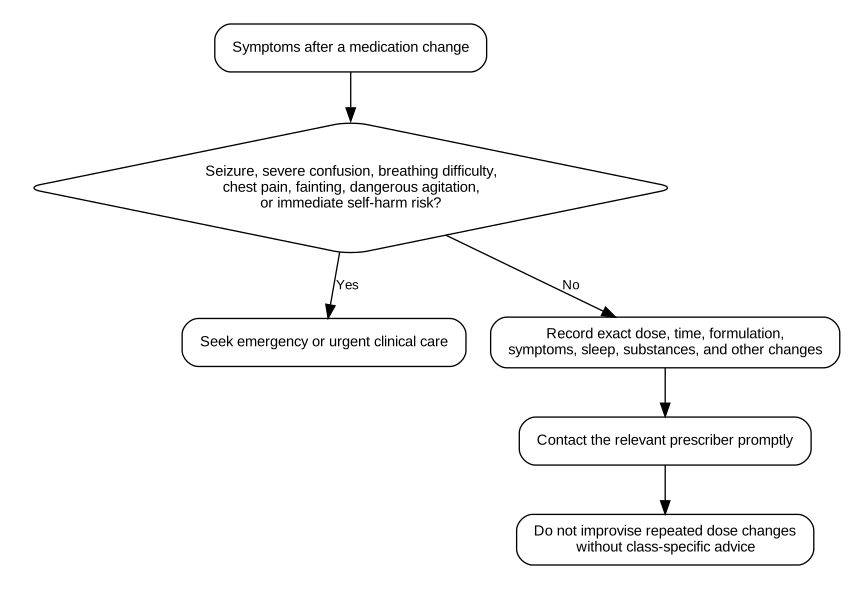
    Seek urgent local medical assessment when any of the following applies. This list is intentionally conservative and is not a diagnostic checklist:

- Very high blood pressure with severe headache, chest pain, breathlessness, confusion, weakness, or vision change-
New focal neurologic symptoms or possible stroke
-
Fainting, severe palpitations, or an unstable heart rhythm
-
A child or adult cannot take clonidine because of vomiting and has no missed-dose plan
Emergency pathways and telephone numbers vary by country. A tracking application or educational article cannot rule out an emergency.
Questions to take to the prescriber
- What is the current indication and treatment goal?
- Which alternative explanations for the symptoms need assessment?
- What is the exact medication, formulation, timing, and most recent change?
- Which outcome should be monitored before another change is considered?
- What are the urgent warning signs and the fastest route back to the clinical team?
Frequently asked questions
Can I double the next clonidine dose after a missed dose?
Do not improvise. Follow the exact product instructions or contact a prescriber or pharmacist.
Can a patch be cut?
Transdermal systems generally require product-specific handling and should not be cut unless the exact label explicitly permits it.
Does normal blood pressure exclude withdrawal?
No. Symptoms and blood pressure can fluctuate, and another cause may be present.
Why is a beta-blocker relevant?
The combination changes sympathetic and cardiovascular responses, so discontinuation sequencing needs clinician oversight.
Regional and formulation note
Guidelines, labels, formulations, and care pathways vary by country. Verify the exact product label, manufacturer, strength, release system, and local clinical pathway before use. A tablet or capsule instruction that is correct for one product may be wrong for another.
References
- US prescribing information for clonidine products. Evidence type: Regulator-hosted product labeling. Use in this article: Warns about rebound hypertension and sympathetic symptoms after abrupt discontinuation.

Bring real data to your doctor
Generate a clinician-ready Doctor Report in SBAR format with trend charts, plus clean CSV and PDF exports. Walk into your next appointment with evidence, not guesswork.
RxDown is a data tracking and journaling tool for adults (18+). It does not provide medical advice, diagnosis, or treatment. Never stop taking medication or change your dose based solely on information from this app or website — medication reduction should always be supervised by a qualified healthcare professional.