 RxDown
Evidence reviewed through:
⚕️ This article is education, not medical advice. Every claim is sourced below. Never stop or change medication without your prescriber — some medications are dangerous to stop abruptly.
CBT-I for Chronic Pain: Sleep Benefits and Limits for Pain Relief
Key answer
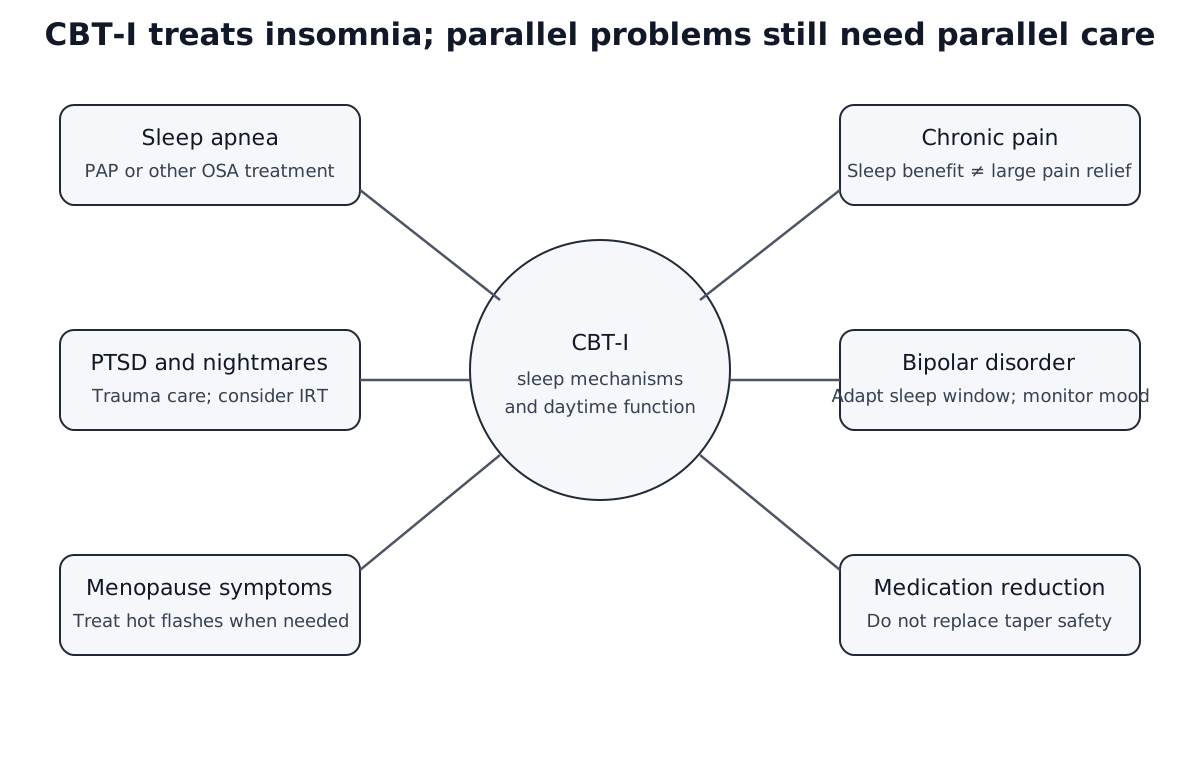
Cognitive behavioral therapy for insomnia (CBT-I) is the recommended first-line treatment for chronic insomnia. It combines assessment, stimulus control, sleep scheduling or sleep-restriction methods, cognitive strategies, and relapse prevention. The treatment can be delivered in person, by telehealth, in groups, or through validated digital programs, but the components and level of supervision may need adaptation when another condition changes the safety of sleep loss or the interpretation of symptoms. [1–3]
At a glance
| Question | Evidence-based answer |
|---|---|
| Is CBT-I the same as sleep hygiene? | No. Sleep hygiene is supportive education; multicomponent CBT-I is an active treatment. [1] |
| Does it work with comorbid illness? | Often yes, and guidelines recommend it across many comorbidities, but parallel illnesses still need parallel care. [2,3] |
| Can it be digital? | Validated digital CBT-I can be effective; therapist support, engagement, and complexity influence results. |
| Is sleep restriction always used unchanged? | No. Time-in-bed reduction may need adaptation for bipolar disorder, seizure risk, excessive sleepiness, falls, pregnancy, or unstable illness. [3] |
| Does CBT-I guarantee medication discontinuation or cure another condition? | No. It treats insomnia mechanisms and may support other goals, but it does not erase medication-specific risk or replace other treatment. |
What CBT-I includes
A full program usually begins with a sleep and medical history plus a sleep diary. Stimulus control strengthens the connection between bed and sleep. Sleep scheduling or sleep restriction therapy reduces excessive time awake in bed and later expands the sleep window as sleep consolidates. Cognitive strategies test catastrophic predictions and unhelpful monitoring. Relapse-prevention planning prepares for travel, illness, stress, medication changes, or symptom flares. Relaxation and sleep-hygiene education may support the program but do not replace the core treatment. [1–3]
The evidence pattern: larger sleep benefits, smaller pain benefits
A meta-analysis of randomized trials in chronic non-cancer pain found a large post-treatment effect on global sleep measures, a small effect on pain, and improvement in depressive symptoms; sleep benefit persisted at follow-up, while pain effects were modest. A 2024 review in chronic musculoskeletal pain likewise found a large insomnia effect but no statistically significant reduction in pain intensity. In fibromyalgia, a 2025 review found improved sleep quality with CBT-I, while evidence for other interventions and broader outcomes remained uncertain. [4–6]
The practical message is not that pain is “all in the mind.” It is that insomnia has its own maintaining mechanisms and can be treated even when pain continues. Better sleep may improve coping and function without producing a large change in the underlying pain generator.
Adaptations for pain and disability
Positioning, mobility, night-time medications, flare patterns, and the need for rest can affect stimulus control and sleep scheduling. “Leave the bed when awake” may need a safe seated alternative. A fixed wake time may be retained while the sleep window is adjusted more gently. Pain medication timing should be reviewed separately; CBT-I does not justify abrupt opioid, gabapentinoid, antidepressant, or sedative changes.
Separate the outcomes
| Outcome | Why it should be tracked separately |
|---|---|
| Insomnia severity | Primary target of CBT-I. |
| Pain intensity | May change little even when sleep improves. |
| Pain interference | Function may improve without large intensity change. |
| Fatigue and mood | Can improve, persist, or have another cause. |
| Medication use | A separate clinical decision, not an automatic CBT-I outcome. |
Safety and adaptation
Transient sleepiness can occur when time in bed is compressed. A trained clinician should review driving, safety-sensitive work, falls, untreated sleep apnea, uncontrolled seizure disorder, bipolar disorder, active substance-use problems, acute suicidality or psychosis, pregnancy or postpartum demands, and unstable medical illness. The response may be a gentler sleep-compression approach, a wider initial sleep window, closer monitoring, treatment of another disorder first, or referral to a behavioral sleep medicine specialist. [3]
What to track
Track bedtime, final wake time, estimated sleep onset, awakenings, naps, daytime sleepiness, functional safety, relevant symptoms, medication timing, alcohol or other sedatives, and adherence to the agreed components. Wearables can show trends but do not diagnose insomnia or sleep apnea and should not overrule a clinical assessment.
Questions to take to the clinical team
- Has insomnia disorder been assessed, or could another sleep disorder explain the pattern?
- Which CBT-I components are appropriate now, and which need adaptation?
- What outcome will be monitored: insomnia severity, function, medication use, mood, pain, PAP use, or another goal?
- What symptoms require stopping the self-guided plan and contacting the team?
- Is the digital or group program validated, and is clinician support available if progress stalls?
Frequently asked questions
Will CBT-I reduce my pain?
It may produce a small average pain benefit, but the more reliable effect is on insomnia. Do not use a sleep response to judge whether the pain condition is real.
What if pain wakes me repeatedly?
The pain condition and nighttime treatment need review while CBT-I addresses the insomnia loop around those awakenings.
Is sleep restriction safe during a pain flare?
It may need adaptation when mobility, falls, severe fatigue, driving, or medication sedation creates risk.
Can CBT-I replace pain treatment?
No. It is an insomnia treatment that can be integrated with pain care.
References
-
Edinger JD, et al. Behavioral and psychological treatments for chronic insomnia disorder in adults: an American Academy of Sleep Medicine clinical practice guideline. 2021. Evidence type: Clinical practice guideline. Use: Strong recommendation for multicomponent CBT-I; sleep hygiene alone is not an adequate stand-alone treatment.
-
Riemann D, et al. The European Insomnia Guideline: an update on diagnosis and treatment of insomnia 2023. Evidence type: European guideline. Use: CBT-I as first-line treatment in adults of any age, including comorbidities, in-person or digitally.
-
VA/DoD. Clinical Practice Guideline for the Management of Chronic Insomnia Disorder and Obstructive Sleep Apnea. 2025. Evidence type: National clinical practice guideline. Use: Delivery options, diagnostic screening, and situations requiring adaptation or delay.
-
Selvanathan J, et al. CBT-I in patients with chronic pain: systematic review and meta-analysis of randomized trials. 2021. Evidence type: Systematic review and meta-analysis. Use: Stronger sleep than pain effects.
-
Esteve R, et al. CBT-I in chronic musculoskeletal pain: systematic review and dose-response meta-analysis. 2024. Evidence type: Systematic review and meta-analysis. Use: Large insomnia effect and nonsignificant pain-intensity effect.
-
Treatments for enhancing sleep quality in fibromyalgia: systematic review and meta-analysis. 2025. Evidence type: Systematic review. Use: Sleep-quality benefit in fibromyalgia and uncertainty about broader outcomes.

Bring real data to your doctor
Generate a clinician-ready Doctor Report in SBAR format with trend charts, plus clean CSV and PDF exports. Walk into your next appointment with evidence, not guesswork.
RxDown is a data tracking and journaling tool for adults (18+). It does not provide medical advice, diagnosis, or treatment. Never stop taking medication or change your dose based solely on information from this app or website — medication reduction should always be supervised by a qualified healthcare professional.