 RxDown
Evidence reviewed through:
⚕️ This article is education, not medical advice. Every claim is sourced below. Never stop or change medication without your prescriber — some medications are dangerous to stop abruptly.
Beta-Blocker Discontinuation: Rebound Heart Rate, Blood Pressure, and Angina Risk
Key answer
A high-risk guide to beta-blocker discontinuation, explaining why the indication, drug, dose, half-life, cardiac history, and rebound symptoms must be assessed before change. The central safety principle is: Beta-blockers are used for coronary disease, heart failure, arrhythmia, hypertension, migraine, tremor, anxiety symptoms, glaucoma, and other indications. [1]
A safe interpretation starts with the exact medication or intervention, the reason it is being used, the formulation, treatment duration, other medicines, current symptoms, and the risks of both continuing and changing treatment. The article therefore explains decision factors and safety boundaries rather than prescribing a fixed schedule.
At a glance
| Question or decision | Evidence-based answer |
|---|---|
| Why risk varies | Beta-blockers are used for coronary disease, heart failure, arrhythmia, hypertension, migraine, tremor, anxiety symptoms, glaucoma, and other indications. |
| Possible rebound effects | Tachycardia, palpitations, blood-pressure increase, tremor, sweating, headache, anxiety, and worsening angina. |
| Highest concern | People with coronary artery disease or serious arrhythmia may face myocardial ischemia or another cardiac event after abrupt discontinuation. |
| Do not generalize | Propranolol, metoprolol, bisoprolol, carvedilol, atenolol, and topical ophthalmic beta-blockers are not interchangeable. |
Evidence basis and uncertainty
This article prioritizes regulator-hosted product information, current clinical guidance, systematic reviews, randomized trials, and carefully labeled observational or mechanistic evidence. The references below are used according to their design and limitations [1]. Absence of a detected signal is not rewritten as absence of risk, and a population average is not presented as an individual prediction.
| Reference | Evidence type | How it is used in this article |
|---|---|---|
| 1 | Clinical review | Describes beta-blocker rebound risks; exact reduction plans remain patient- and indication-specific. |
Working definitions
| Term | Meaning in this article |
|---|---|
| Withdrawal symptoms | New or intensified symptoms after a dose reduction, missed dose, formulation change, or stop when physiologic adaptation is a plausible contributor. |
| Rebound | Temporary return of a treated symptom above its pretreatment baseline. |
| Relapse or recurrence | Return of the underlying treated condition. |
| Physical dependence | Physiologic adaptation; it is not the same as addiction or a substance use disorder. |
The indication changes the meaning of every symptom
A higher heart rate after reducing a beta-blocker may be a pharmacologic rebound, return of atrial fibrillation, worsening heart failure, hyperthyroidism, infection, dehydration, anxiety, or another problem. For migraine or tremor, the main consequence may be return of the treated condition. For coronary disease, chest pain can signal myocardial ischemia and needs urgent assessment.
Why abrupt discontinuation can be risky
Repeated beta-receptor blockade can lead to physiologic adaptation. Abrupt removal may increase sympathetic responsiveness, heart rate, blood pressure, and myocardial oxygen demand. Risk depends on the medication, half-life, dose, treatment duration, cardiac disease, and concurrent drugs. A person should not use a generic online taper to manage a cardiovascular indication.
What clinicians review
Confirm the exact medication and formulation, indication, resting and exertional symptoms, pulse, blood pressure, electrocardiographic history, heart failure status, angina, prior myocardial infarction, asthma or COPD, diabetes, and interacting rate-control medicines. Ophthalmic products should be included because they can have systemic effects.
Monitoring during a planned change
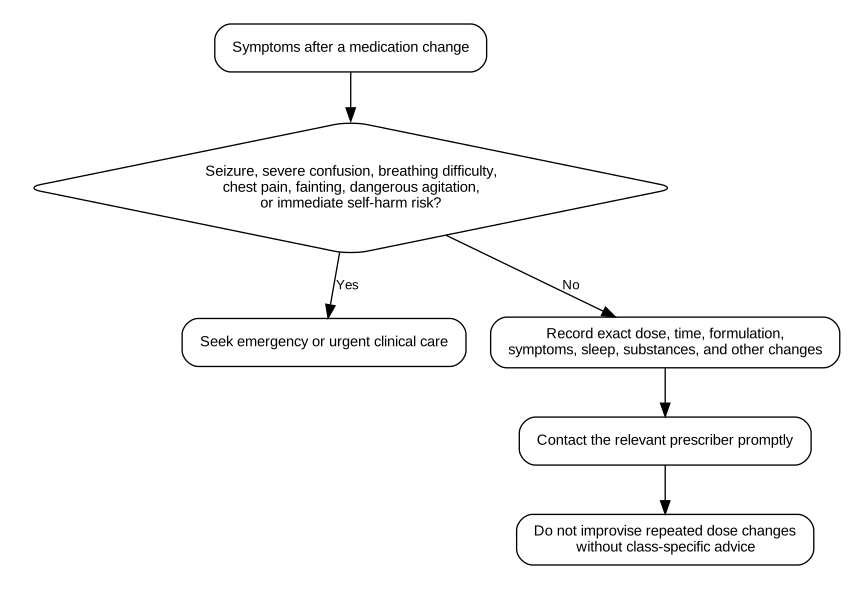
The plan may include home pulse and blood-pressure measurements using validated technique, symptom thresholds, activity advice, and scheduled follow-up. Numbers should be interpreted with symptoms and baseline; a single wearable alert is not a diagnosis. Any chest pain, syncope, severe breathlessness, or sustained rapid rhythm requires urgent assessment.
Evidence limits
Withdrawal risk is supported by pharmacology, clinical reports, and cardiac practice, but there is no single schedule for all beta-blockers and indications. Product labeling and current disease-specific guidelines should be checked before making treatment changes.
When urgent medical assessment may be needed
    Seek urgent local medical assessment when any of the following applies. This list is intentionally conservative and is not a diagnostic checklist:

- New or worsening chest pressure, pain, or an anginal equivalent-
Fainting, severe breathlessness, new neurologic symptoms, or a sustained rapid or irregular rhythm
-
Marked blood-pressure elevation with symptoms
-
Known coronary disease, heart failure, or serious arrhythmia without a prescriber-led plan
Emergency pathways and telephone numbers vary by country. A tracking application or educational article cannot rule out an emergency.
Questions to take to the prescriber
- What is the current indication and treatment goal?
- Which alternative explanations for the symptoms need assessment?
- What is the exact medication, formulation, timing, and most recent change?
- Which outcome should be monitored before another change is considered?
- What are the urgent warning signs and the fastest route back to the clinical team?
Frequently asked questions
Is propranolol withdrawal the same as metoprolol withdrawal?
No. They differ in selectivity, half-life, formulation, metabolism, and indications.
Can a smartwatch guide the taper?
It may show trends, but it cannot determine the cause of a rate change or prescribe a dose.
What if the beta-blocker is used only for performance anxiety?
Cardiac risk may differ, but the exact exposure, comorbidity, and reason for use still require review.
Should eye drops be listed?
Yes. Timolol and other ophthalmic beta-blockers can contribute to systemic beta-blockade.
Regional and formulation note
Guidelines, labels, formulations, and care pathways vary by country. Verify the exact product label, manufacturer, strength, release system, and local clinical pathway before use. A tablet or capsule instruction that is correct for one product may be wrong for another.
References
- Bangert MK, et al. Drug deprescription—withdrawal risk, prevention, and treatment. 2020. Evidence type: Clinical review. Use in this article: Describes beta-blocker rebound risks; exact reduction plans remain patient- and indication-specific.

Bring real data to your doctor
Generate a clinician-ready Doctor Report in SBAR format with trend charts, plus clean CSV and PDF exports. Walk into your next appointment with evidence, not guesswork.
RxDown is a data tracking and journaling tool for adults (18+). It does not provide medical advice, diagnosis, or treatment. Never stop taking medication or change your dose based solely on information from this app or website — medication reduction should always be supervised by a qualified healthcare professional.