 RxDown
Evidence reviewed through:
⚕️ This article is education, not medical advice. Every claim is sourced below. Never stop or change medication without your prescriber — some medications are dangerous to stop abruptly.
Benzodiazepine Taper Symptoms: Hold, Slow Down, or Return to the Previous Dose?
Key answer
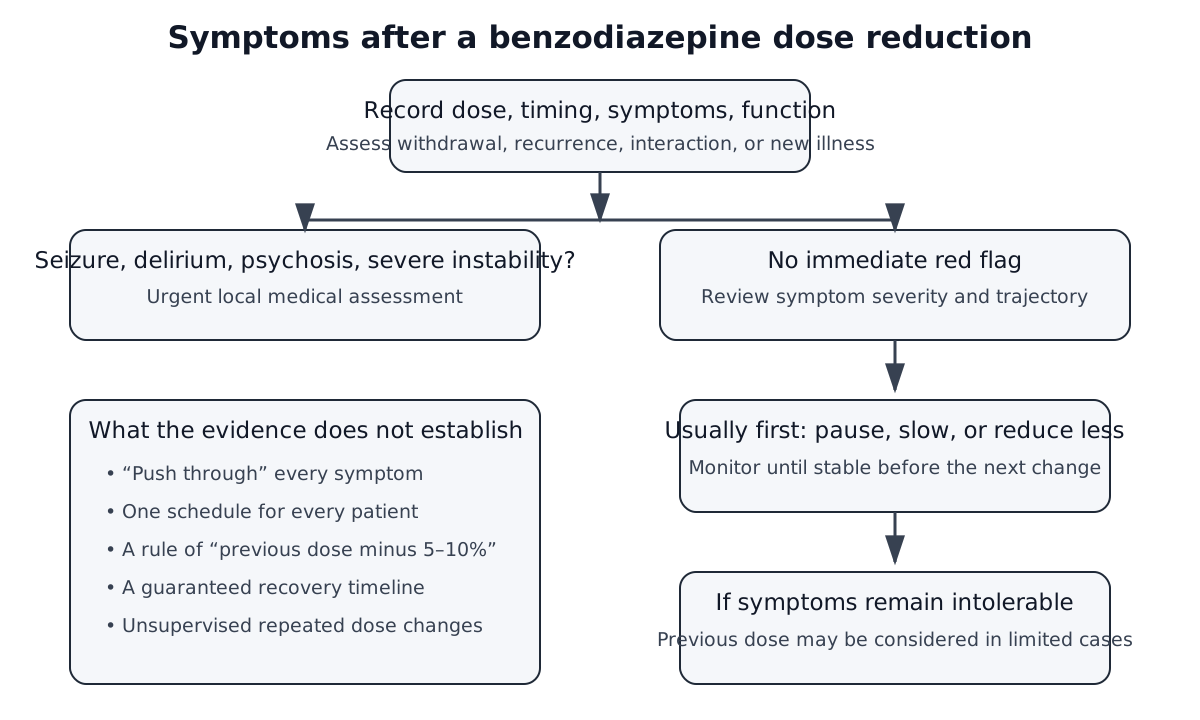
Current guidance does not support a universal instruction to “push through” every symptom after a benzodiazepine reduction. The 2025 multisociety guideline recommends monitoring after each reduction and, when significant taper-related symptoms emerge, first slowing or pausing the taper and/or making smaller reductions. NICE similarly advises delaying the next reduction, trying a smaller reduction, or reverting to the previous dose when distressing new symptoms occur. [1,2]
Returning to the previous dose is not the routine first step, but it may be reasonable in limited cases when symptoms are intolerable and have not improved with pausing or slowing. No guideline or randomized trial found in this review establishes a formula of taking “the previous dose minus 5% or 10%.” That number should not be presented as an evidence-based rule. [1,2]
At a glance
| Claim or question | What the evidence supports |
|---|---|
| Reduce 10–20% every 1–2 weeks for everyone | No. Some people with short, low-dose exposure may tolerate faster reductions, but the general ASAM starting framework is 5–10% every 2–4 weeks and slower for stronger physical dependence. [1] |
| Push through dizziness or other symptoms | Not as a blanket rule. Assess the symptom and its severity; significant taper-related symptoms are a reason to slow, pause, or reduce less. [1,2] |
| The brain needs time to readapt | Physiologic readaptation is a plausible clinical concept, but it does not predict one recovery time or justify ignoring dangerous deterioration. [1,4] |
| Never return to a previous dose | Too absolute. Guidelines allow a previous dose in selected intolerable cases, generally after considering pause, slower pace, and smaller reductions. [1,2] |
| Use the previous dose minus 5–10% | No direct guideline or trial support was found for this exact formula. |
| Symptoms and duration vary | Yes. Taper tolerance varies between people and can vary within the same person over time. [1,2] |
Evidence hierarchy for the specific advice
| Advice heard in clinic | What was found | Confidence and limit |
|---|---|---|
| 10–20% every 1–2 weeks | Historical schedules and selected studies used reductions in this range, but ASAM 2025 generally starts at 5–10% every 2–4 weeks and may be much slower for strong physical dependence. | Guidelines are largely consensus because direct comparative trials are missing. [1,4–8] |
| Endure all symptoms until the brain adapts | No guideline endorses enduring every symptom. ASAM and NICE use symptoms to modify the plan. | Strong agreement across guidelines; the exact best response has limited trial evidence. [1,2] |
| Every person has different symptoms and duration | Supported. | High clinical plausibility and consistent guideline recognition, but individual duration cannot be predicted. [1,2] |
| Do not automatically return to the previous dose | Generally supported as a preference, not an absolute prohibition. | Previous dose is allowed in selected intolerable or new distressing cases. [1,2] |
| Previous dose minus exactly 5–10% | No guideline or randomized trial identified. | Unsupported formula; do not implement as an app rule. |
Why a percentage is not a complete taper plan
A percentage is incomplete unless the plan states the denominator, interval, formulation, rounding method, indication, and response rule. Ten percent of the current dose creates progressively smaller milligram reductions; ten percent of the starting dose creates fixed reductions. Those are not equivalent. Tablet strengths may also make the calculated amount impossible to deliver accurately.
ASAM describes 5–10% every 2–4 weeks as a general initial pace and says the taper should typically not exceed 25% every 2 weeks. For people likely to have strong physical dependence, it suggests considering 5% first and then 5–10% every 6–8 weeks or slower. Faster 10–25% reductions may be considered for people with lower-dose, shorter exposure, but this is not a default for long-term clonazepam use. [1]
What “hold,” “pause,” and “maintain” mean
A pause means staying at the current dose with the intention to continue after symptoms stabilize. Maintaining can mean remaining at a lower dose for a longer or indefinite period when further reduction is not currently tolerable or the risk–benefit balance has improved. Neither requires pretending that symptoms are harmless.
A pause can also be diagnostically useful. Symptoms that change in parallel with dose changes or improve after a pause are more compatible with withdrawal, although this is not proof. Symptoms that persist, evolve, or do not fit the medication timeline require assessment for recurrence of the original condition, interactions, another medication, substance use, sleep loss, or a new medical problem. [1,2]
What “return to the previous dose” means in guidance
ASAM says clinicians should generally avoid going back up automatically because repeated reversals can undermine the taper goal. It also states that, in limited instances of intolerable symptoms, returning to the previous benzodiazepine dose and pausing until stabilization may be appropriate. NICE lists reverting to the previous dose as one option when new distressing symptoms occur. [1,2]
Neither source specifies “previous dose minus 5% or 10%.” A partial upward adjustment may be chosen clinically, but the exact amount is an individualized prescribing decision rather than a validated universal formula. Evidence is also insufficient to promise that reinstatement will work after every time interval or for every symptom pattern.
Is it true that the brain “repairs itself” if a person endures symptoms?
Benzodiazepines produce neuroadaptation, and receptor systems can readjust over time after exposure changes. The ASAM guideline describes the clinical goal of allowing receptor levels and symptoms to stabilize, but the phrase “the brain automatically repairs itself” is too certain and too broad. Recovery can be nonlinear, symptoms can have multiple causes, and severe sleep loss, suicidality, seizure, delirium, psychosis, dehydration, or falls should not be reframed as a healing test. [1]
A safer statement is: the nervous system may need time to adapt to a lower exposure, and the taper can be adjusted to reduce harm while that adaptation occurs.
Dizziness: expected, dangerous, or unrelated?
Dizziness can occur during benzodiazepine withdrawal, but it is nonspecific. It can also reflect oversedation, low blood pressure, dehydration, vestibular illness, anemia, infection, an interaction, alcohol or other sedatives, or another neurologic or cardiovascular problem. Record onset, relation to the dose change, standing versus lying symptoms, falls, hearing symptoms, headache, weakness, and other medications. New focal neurologic symptoms, fainting, chest pain, severe headache, or inability to walk safely requires prompt assessment.
What a prescriber-led response can look like
| Situation | Options supported by current guidance |
|---|---|
| Mild symptoms that are improving and function remains safe | Monitor closely; do not make the next reduction merely because the calendar says so. |
| Significant symptoms linked to the last reduction | Pause, slow the pace, and/or make the next reduction smaller. [1] |
| New distressing symptoms | Reassess withdrawal versus recurrence or new illness; delay, use a smaller reduction, or consider the previous dose. [2] |
| Intolerable symptoms despite pause/slowing | In limited cases, the previous dose may be resumed until stable, with shared decision-making. [1] |
| Seizure, delirium, hallucinations, psychosis, severe agitation, or immediate self-harm risk | Urgent local medical care; this is not a routine taper-adjustment problem. |
Questions to take to the prescriber
- Is the proposed percentage based on my current dose or original dose?
- What exposure history makes this pace reasonable for me?
- What symptoms mean “hold,” “call soon,” or “seek urgent care”?
- If symptoms appear, is the first response a pause, smaller reduction, longer interval, or something else?
- Under what circumstances would returning to the previous dose be considered?
- Can the chosen formulation deliver the planned small reductions accurately?
Frequently asked questions
Should every symptom disappear before another reduction?
Not necessarily. The decision depends on severity, trajectory, function, safety, and the risk of continuing the medication. A rigid “zero symptoms” rule and a rigid “push through everything” rule are both unsupported.
Does a long clonazepam half-life make a fast taper safe?
No. A longer half-life can delay symptom onset and smooth some concentration changes, but it does not remove physical dependence or seizure risk.
Is going back to the previous dose a failure?
No. In current guidance it is a limited clinical option, not a moral judgment. The important questions are why it is being considered, what happened after the last reduction, and how the next plan will be safer.
Can an app decide which option to use?
No. An app can organize dose, symptom, sleep, and function data for the clinical team. It should not diagnose withdrawal or prescribe a dose response.
References
-
Brunner E, et al. Joint Clinical Practice Guideline on Benzodiazepine Tapering: Considerations When Risks Outweigh Benefits. 2025. Evidence type: Multisociety clinical practice guideline. Use: Initial pace, symptom-responsive adjustment, pausing, smaller reductions, and limited circumstances for returning to a previous dose.
-
NICE. Medicines associated with dependence or withdrawal symptoms: safe prescribing and withdrawal management for adults (NG215). Evidence type: National guideline. Use: Slow stepwise proportional reduction; delay, smaller reduction, or previous dose when distressing symptoms occur.
-
U.S. Food and Drug Administration. Boxed Warning updated to improve safe use of benzodiazepines. 2020. Evidence type: Regulatory safety communication. Use: Physical dependence, withdrawal, overdose and co-use risks.
-
Horowitz MA, et al. Pharmacological principles for safe benzodiazepine and Z-drug dose reduction. 2026. Evidence type: Pharmacological analysis and clinical proposal. Use: Proportional/hyperbolic rationale and formulation constraints; not treated as a definitive comparative trial.
-
Brandt J, et al. Benzodiazepine receptor agonist deprescribing principles for long-term use and dependence: modified Delphi recommendations. 2026. Evidence type: Modified Delphi expert consensus. Use: Patient-controlled proportional tapering and pause/reversion principles; evidence level remains expert consensus.
-
Connor KM, et al. Discontinuation of clonazepam in the treatment of social phobia. 1998. Evidence type: Small selected discontinuation study. Use: Historical fixed 0.25 mg every two weeks schedule; not universalizable.
-
Otto MW, et al. Discontinuation of benzodiazepine treatment: efficacy of cognitive-behavioral therapy for panic disorder. 1993. Evidence type: Small randomized trial. Use: Added CBT improved discontinuation in a selected sample; does not validate one taper percentage.
-
ASAM guideline evidence statement. Evidence type: Systematic review plus consensus. Use: The guideline explicitly reports no trials comparing tapering strategies and therefore cautions against rigid algorithms.

Bring real data to your doctor
Generate a clinician-ready Doctor Report in SBAR format with trend charts, plus clean CSV and PDF exports. Walk into your next appointment with evidence, not guesswork.
RxDown is a data tracking and journaling tool for adults (18+). It does not provide medical advice, diagnosis, or treatment. Never stop taking medication or change your dose based solely on information from this app or website — medication reduction should always be supervised by a qualified healthcare professional.