 RxDown
Evidence reviewed through:
⚕️ This article is education, not medical advice. Every claim is sourced below. Never stop or change medication without your prescriber — some medications are dangerous to stop abruptly.
Antiseizure Medication Withdrawal: Why the Diagnosis and Seizure Risk Come First
Key answer
A specialist-review guide explaining why antiseizure medication withdrawal depends on the indication, epilepsy syndrome, seizure history, electroencephalography, medication, and consequences of recurrence. The central safety principle is: Is the medication treating epilepsy, another seizure risk, bipolar disorder, pain, migraine, or a different condition? [1–2]
A safe interpretation starts with the exact medication or intervention, the reason it is being used, the formulation, treatment duration, other medicines, current symptoms, and the risks of both continuing and changing treatment. The article therefore explains decision factors and safety boundaries rather than prescribing a fixed schedule.
At a glance
| Question or decision | Evidence-based answer |
|---|---|
| First question | Is the medication treating epilepsy, another seizure risk, bipolar disorder, pain, migraine, or a different condition? |
| Primary danger | Seizure recurrence can cause injury, driving restrictions, loss of employment, status epilepticus, or death. |
| Risk is individualized by | Age, epilepsy syndrome, seizure type, seizure-free duration, electroencephalography, imaging, prior withdrawal, medication combination, and consequences of recurrence. |
| Not a self-directed taper | Changes require the prescribing specialist or another clinician able to assess seizure risk and rescue planning. |
Evidence basis and uncertainty
This article prioritizes regulator-hosted product information, current clinical guidance, systematic reviews, randomized trials, and carefully labeled observational or mechanistic evidence. The references below are used according to their design and limitations [1–2]. Absence of a detected signal is not rewritten as absence of risk, and a population average is not presented as an individual prediction.
| Reference | Evidence type | How it is used in this article |
|---|---|---|
| 1 | Practice advisory | Risk depends on age, epilepsy syndrome, EEG findings, seizure-free duration, and other factors; the indication is decisive. |
| 2 | Regulator-hosted product labeling | The indication, interacting medications, seizure risk, and restart precautions are essential. |
Working definitions
| Term | Meaning in this article |
|---|---|
| Withdrawal symptoms | New or intensified symptoms after a dose reduction, missed dose, formulation change, or stop when physiologic adaptation is a plausible contributor. |
| Rebound | Temporary return of a treated symptom above its pretreatment baseline. |
| Relapse or recurrence | Return of the underlying treated condition. |
| Physical dependence | Physiologic adaptation; it is not the same as addiction or a substance use disorder. |
“Antiseizure medication” is not one tapering problem
The same medication can be used for epilepsy, mood stabilization, neuropathic pain, or migraine prevention. The main risk may therefore be seizure recurrence, mood relapse, pain return, withdrawal symptoms, or several of these. A page that ignores the indication can give dangerously incomplete advice.
How clinicians estimate recurrence risk
Assessment may include the epilepsy syndrome, cause, age at onset, number and type of seizures, duration of seizure freedom, neurologic examination, electroencephalography, imaging, medication history, and prior attempts to stop. Driving, swimming, heights, machinery, caregiving, pregnancy, and access to emergency care affect the consequences of recurrence even when the statistical probability is uncertain.
Medication-specific differences
Antiseizure medications differ in half-life, interactions, formulation, and nonseizure withdrawal effects. Some also treat mood disorders, so a reduction can destabilize mood. Abrupt changes to certain medications may increase seizure risk. Restart instructions can also matter: for example, lamotrigine may require re-titration after an interruption because rapid re-exposure can increase serious rash risk.
What a safety plan includes
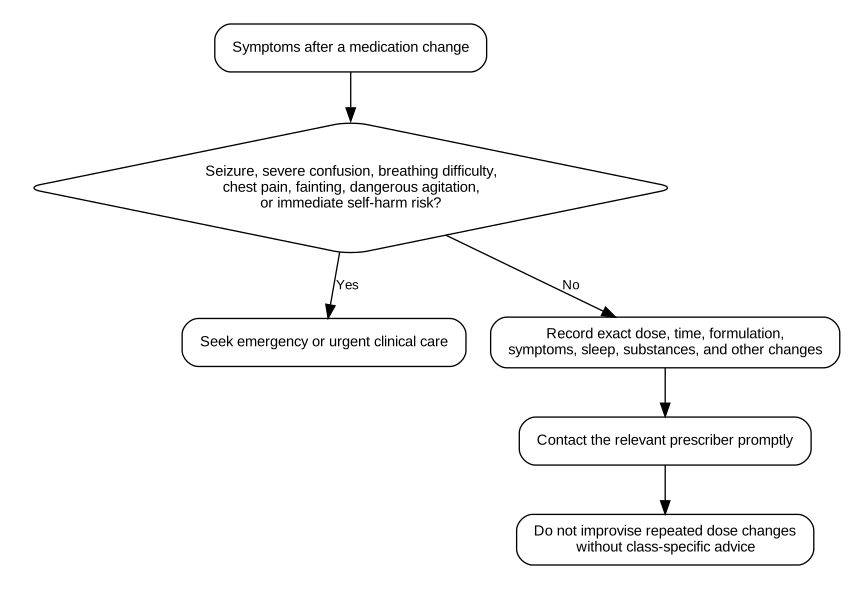
The specialist should define the purpose of change, driving and activity advice, rescue medication where indicated, what counts as a possible seizure, who to contact, and when emergency services are required. Medication adherence and exact formulation should be recorded. A suspected seizure after reduction needs clinical assessment rather than an automatic return to a prior dose without instructions.
Evidence limits
Practice advisories provide population-level estimates and risk factors, not a guarantee for an individual. Evidence varies by age and syndrome, and many combinations are under-studied. A website must not provide one schedule across all antiseizure medications or imply that seizure-free status means no recurrence risk.
When urgent medical assessment may be needed
    Seek urgent local medical assessment when any of the following applies. This list is intentionally conservative and is not a diagnostic checklist:

- A seizure lasting about five minutes or longer, repeated seizures without recovery, or breathing difficulty-
A first seizure, serious injury, pregnancy with a seizure, or seizure in water
-
Severe rash, mucosal sores, fever, or systemic illness while taking lamotrigine
-
Loss of consciousness, severe confusion, or a new focal neurologic deficit
Emergency pathways and telephone numbers vary by country. A tracking application or educational article cannot rule out an emergency.
Questions to take to the prescriber
- What is the current indication and treatment goal?
- Which alternative explanations for the symptoms need assessment?
- What is the exact medication, formulation, timing, and most recent change?
- Which outcome should be monitored before another change is considered?
- What are the urgent warning signs and the fastest route back to the clinical team?
Frequently asked questions
Can seizure medication be stopped after two seizure-free years?
That duration may inform assessment, but it is not a universal rule and does not replace syndrome-specific evaluation.
Does a normal electroencephalogram exclude recurrence risk?
No. It is one piece of evidence and cannot exclude recurrence.
What if the medicine is being used for bipolar disorder?
Mood-relapse risk and psychiatric monitoring become central, even when there is no epilepsy diagnosis.
Why can restarting lamotrigine be complicated?
After a sufficient interruption, the product label may require re-titration to reduce serious rash risk; a prescriber or pharmacist must check the exact situation.
Regional and formulation note
Guidelines, labels, formulations, and care pathways vary by country. Verify the exact product label, manufacturer, strength, release system, and local clinical pathway before use. A tablet or capsule instruction that is correct for one product may be wrong for another.
References
-
American Academy of Neurology. Antiseizure Medication Withdrawal in Seizure-Free Patients: Practice Advisory Update Summary. 2021. Evidence type: Practice advisory. Use in this article: Risk depends on age, epilepsy syndrome, EEG findings, seizure-free duration, and other factors; the indication is decisive.
-
US prescribing information for lamotrigine. Evidence type: Regulator-hosted product labeling. Use in this article: The indication, interacting medications, seizure risk, and restart precautions are essential.

Bring real data to your doctor
Generate a clinician-ready Doctor Report in SBAR format with trend charts, plus clean CSV and PDF exports. Walk into your next appointment with evidence, not guesswork.
RxDown is a data tracking and journaling tool for adults (18+). It does not provide medical advice, diagnosis, or treatment. Never stop taking medication or change your dose based solely on information from this app or website — medication reduction should always be supervised by a qualified healthcare professional.